See Films Differently Momo Notices
Did I Want That—or Was It Just What Came Next?
Why an action does not reveal how strongly you wanted it: small preferences, specific habit studies and a marked ending discussion of Marty.

An unremarkable snack, a familiar evening and Marty’s trouble with the usual plan.
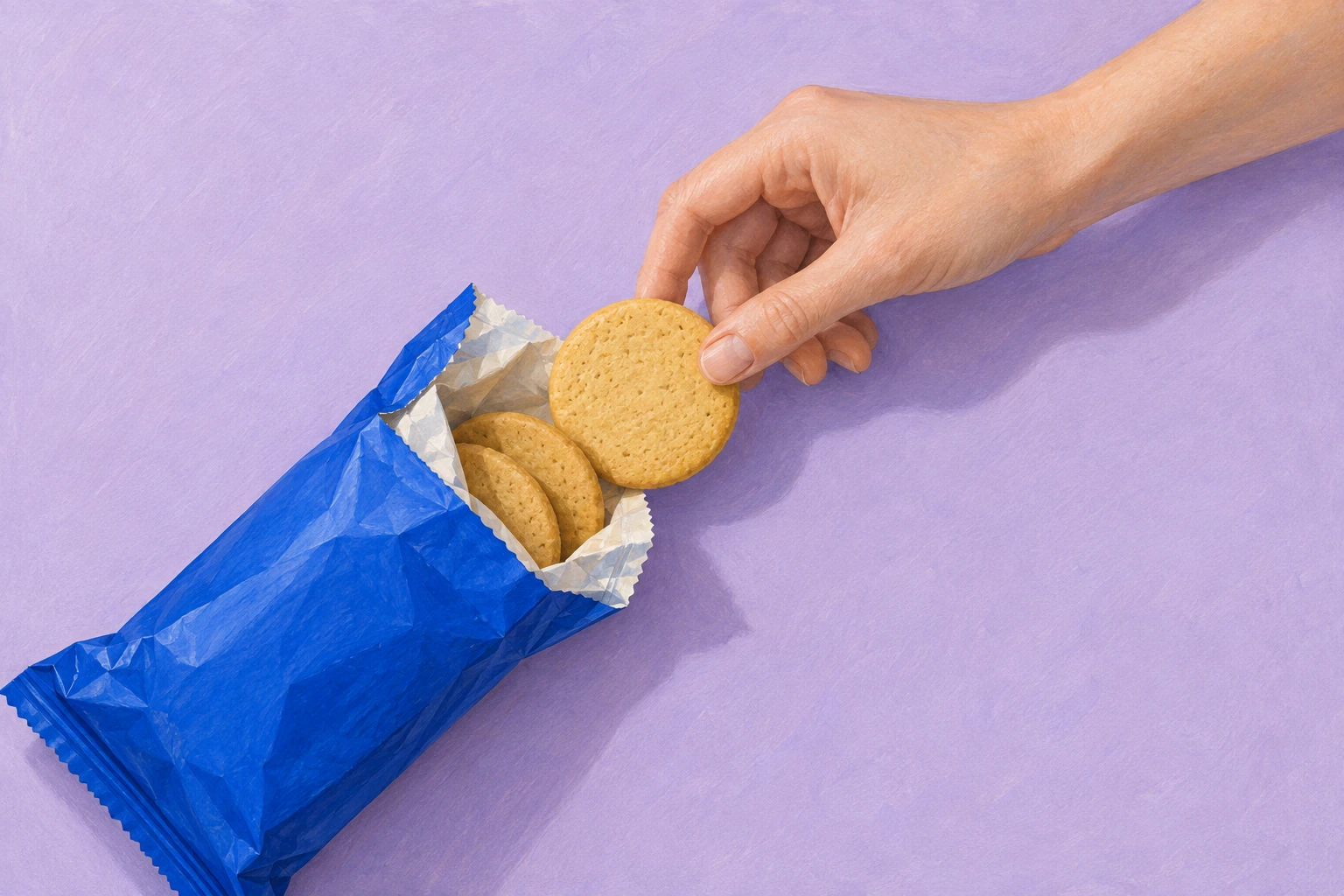
Suppose you take another biscuit. It’s perfectly all right. You weren’t particularly hungry, and you weren’t sitting there longing for a biscuit. There was a packet beside you; now there’s one less in it.
Did you want it?
Perhaps a little. Perhaps reaching into that packet was already part of what you were doing. An action tells us what happened. It doesn’t, by itself, tell us how strongly somebody wanted it. I’d be wary of promoting every biscuit to a statement of personal conviction.
A small preference can be enough
Imagine someone asks whether you fancy staying for another drink. You could go home. You could stay. Staying sounds marginally nicer, so you stay.
There’s no mystery that requires a hidden, powerful desire. A slight preference can settle a choice when the alternatives are close. You might also speak because a silence feels awkward, although you have no particular news to deliver. Wanting to keep a conversation going is different from having something you’re eager to say.
These are imagined examples, with several possible explanations. Tiredness, convenience and other people’s company could matter too. I wouldn’t diagnose a habit from one biscuit or one rather thin anecdote.
But “I did it, so I must have wanted it very much” has already become an unreliable account.
The situation can supply the next move
Habit offers another explanation. Repeating a response in a familiar setting can make that setting a cue for doing it again. [1]
In Wendy Wood, Jeffrey Quinn and Deborah Kashy’s 2002 diary studies, university students recorded their activities and thoughts at hourly intervals. During actions classified as habitual—performed almost daily, usually in the same location—their thoughts were more often elsewhere than during less habitual actions. [2]
That’s evidence about attention in those students’ reports. It doesn’t establish that they lacked desires, or that a fixed proportion of everyone’s day runs without thought. You can want clean teeth without becoming passionately interested in brushing them each evening.
A habit can continue to serve something you value. The interesting question is whether today’s action still responds to today’s circumstances.
Popcorn without much enthusiasm
A 2011 study by David Neal and colleagues made that question unusually tangible. At a campus cinema, participants received fresh popcorn or popcorn made seven days earlier. They watched fifteen minutes of trailers, and the researchers weighed how much they ate. [1]
Freshness made no statistically significant difference to consumption at the stronger end of reported cinema-popcorn habits, although stale popcorn received worse ratings. In a separate meeting-room setting, where participants watched music videos, those with strong cinema-popcorn habits ate less stale than fresh popcorn. [1]
The study supports a gap between liking this particular food and eating it in a familiar setting. It doesn’t prove that the two amounts were identical, or that cinema-goers never notice their snacks. Nor can its design isolate one magic cue: the room, screening material and recruitment differed between settings.

Still, “you ate it, therefore you liked it” looks rather less convincing with a week-old box of popcorn in the evidence.
Marty and another evening with the boys
Here’s where I’d take a detour to Delbert Mann’s black-and-white Marty (1955).
Marty Piletti, played by Ernest Borgnine, is a Bronx butcher. After work, he spends time with his friend Angie. They have no plan for the evening; Angie urges him to telephone a woman they met earlier, but Marty says he’s tired of looking for someone. Later, encouraged by his mother, he goes to a ballroom and meets Clara. [3]
There are several wants in that outline already: companionship, relief from rejection, perhaps simply something to do. Calling all of it habit would flatten a fairly complicated evening.
Spoilers: Marty’s decision near the ending
After enjoying Clara’s company, Marty initially gives in to his friends’ disparaging judgement of her and doesn’t telephone. Faced with another evening at their usual restaurant, he challenges his friends and goes to call her. [3]
My reading is that the familiar arrangement briefly carries him away from someone he wants to see. The company is available, the evening has a usual shape, and accepting his friends’ verdict lets that shape continue. Their pressure matters; this isn’t a laboratory demonstration of a habit.
What I like is the specificity of his eventual decision. He has somebody to telephone. His dissatisfaction with the usual evening acquires an alternative he actually wants.

What made this the next thing?
I’d ask that before demanding to know what an action reveals about your deepest self.
Was there a small preference? Did the setting suggest a familiar response? Were you avoiding an awkward moment? More than one answer may fit, and observing what happened next won’t settle them all.
These questions concern why an action occurred. Whether you owed someone that action, or whether an enjoyable evening needed to be useful, are further questions.
You don’t need a tremendous desire to stay for a drink. But if you keep staying and keep wishing you’d gone home, the repetition deserves a closer look. “It’s what I usually do” describes a pattern. I’d still like to know what you make of the evening.
References & Further Reading
The research supports specific findings about habit, attention and consumption. The everyday examples and the reading of Marty’s decision are Monocurator’s own framing.
- David T. Neal, Wendy Wood, Mengju Wu and David Kurlander (2011), ‘The Pull of the Past: When Do Habits Persist Despite Conflict With Motives?’, Personality and Social Psychology Bulletin 37(11), 1428–1437. DOI: 10.1177/0146167211419863. Author-hosted full paper; particularly Study 1.
- Wendy Wood, Jeffrey M. Quinn and Deborah A. Kashy (2002), ‘Habits in Everyday Life: Thought, Emotion, and Action’, Journal of Personality and Social Psychology 83(6), 1281–1297. DOI: 10.1037/0022-3514.83.6.1281. Author-hosted full paper.
- American Film Institute, Marty (1955), AFI Catalog. Film credits, physical properties and synopsis. The linked synopsis includes the ending.
For the next unexpected question, follow the Journal in your RSS reader.
On screen
Films discussed
- Marty (1955) · Delbert Mann
Further reading
Read next in the Journal

Want a recommendation shaped around your evening? Ask Momo what to watch next →