See Films Differently Art & Preservation
Ecce Homo Restoration: What Was Lost—and What Gained Value
Borja’s 2012 Ecce Homo intervention obscured García Martínez’s painted surface. Viral fame then created visitor and social value—but did not repair the loss.
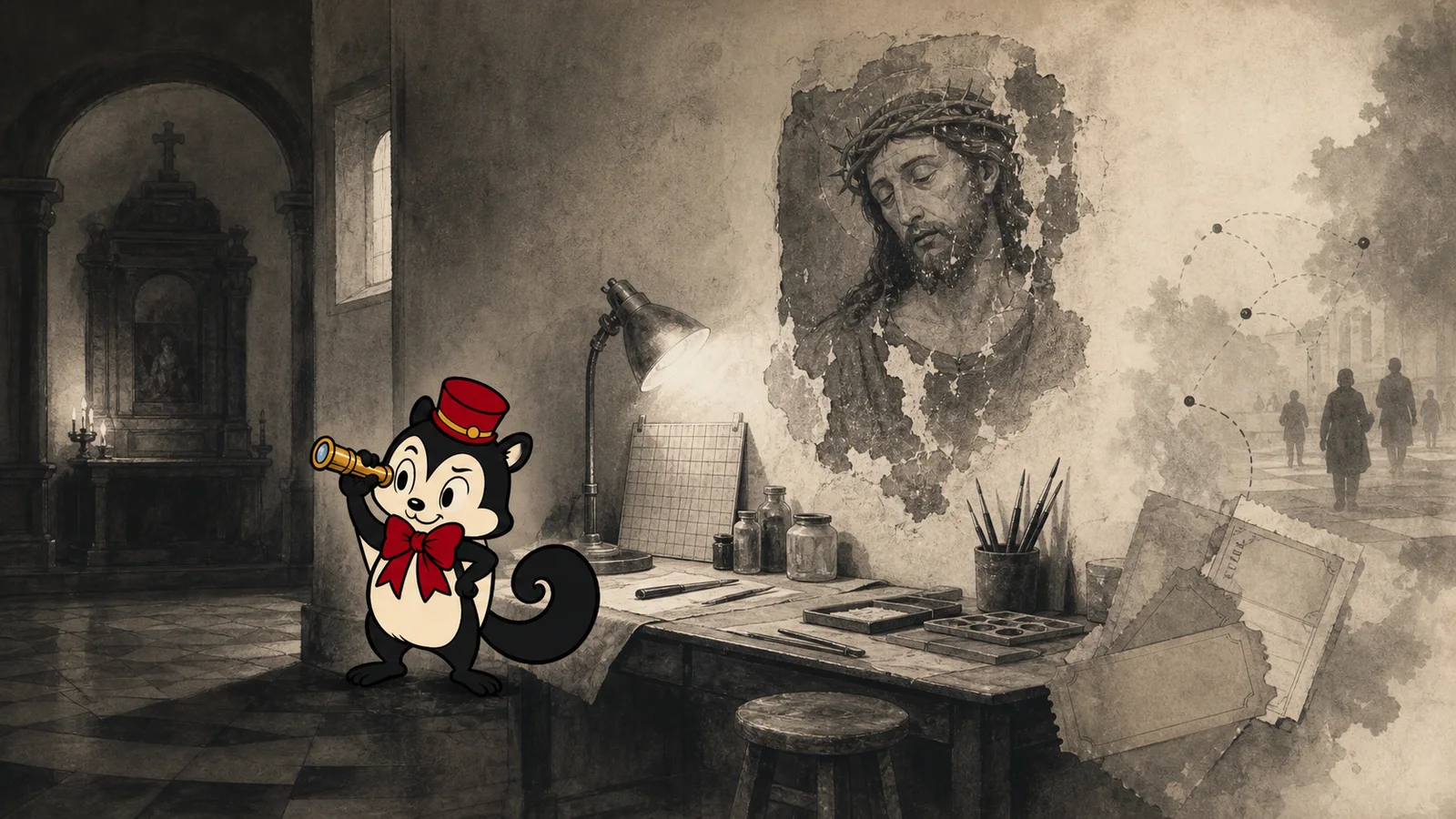
In 2012, an unqualified intervention on Borja’s Ecce Homo obscured original material. The altered image then became a visitor destination and a shared memory. The second fact does not undo the first.
Cecilia Giménez, a regular helper at the sanctuary, tried to repair the deteriorating wall painting by Elías García Martínez. The intervention broke its material continuity with García Martínez’s hand: the altered surface could no longer offer the same evidence of his decisions. What followed was real but different. The image travelled around the world, visitors came to Borja, and the sanctuary became a ticketed destination carrying a new social memory.
The tempting conclusion is that the mistake simply made the artwork more valuable. That step is too quick.
It treats value as if it were a single quantity, like water added to a glass. Yet the Ecce Homo of Borja did not merely acquire more of the value it already possessed. Some kinds of value were damaged; other kinds appeared. Meaning moved from one place to another: from the hand of Elías García Martínez to the event of 2012, from visual continuity to social memory, from the painted surface to the town that now cares for its aftermath.
The result is neither a triumph of restoration nor only a joke. Its failure has become historically irreversible—and therefore, in a new sense, irreplaceable.
For a film publication, the case offers a useful preview: cinema also gathers value through survival, repetition and the stories that accumulate around an image.
What Restoration Is Supposed to Preserve
Conservation begins from a deceptively modest obligation: do not treat an old object as a blank surface awaiting improvement.
ICOM’s conservation committee defines restoration as direct action intended to make a stable object easier to appreciate, understand or use after alteration or deterioration. Such work must respect original material; conservation more broadly must respect both the physical properties and significance of the object. [1] The American Institute for Conservation makes the ethical demand more concrete: examine carefully, document permanently, work within one’s competence and avoid methods that obstruct future study or treatment. [2]
These principles matter because cultural objects carry evidence. Pigment is evidence of a maker’s decision. A crack records material stress. An old retouching may tell us how another generation understood what it inherited. Even damage belongs to history once it has occurred.
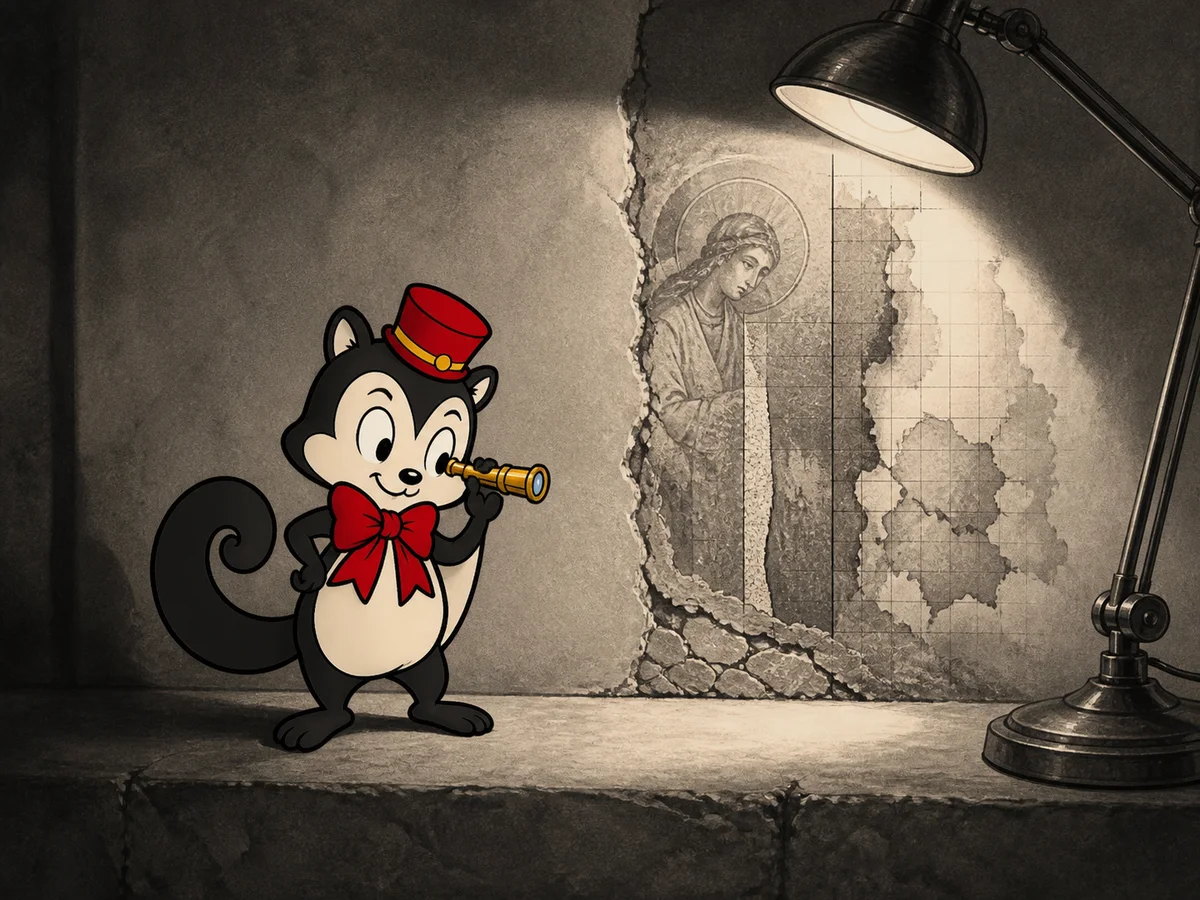
The 2012 intervention at Borja did not meet that professional standard. Later attention produced benefits, but ticket sales cannot retroactively turn the treatment into successful conservation. A damaged film negative would remain damaged even if a documentary about the accident became popular.
There is also a person behind the shorthand ‘botched restoration’. Alberto Sánchez Sánchez’s account places Cecilia Giménez within a rural culture of unpaid care: a regular helper at the sanctuary, motivated by religious attachment, working in a setting where local residents—often women—sustain heritage with limited resources and little professional support. [3] That context does not convert an unqualified intervention into conservation. It does make ridicule an inadequate response. The lesson is institutional as much as individual: affection for an object is essential, but affection needs access to knowledge, advice and care.
Before and After Are Different Kinds of Object
Before 2012, the painting’s value lay partly in continuity. It was a devotional wall painting made by García Martínez, physically connected to his labour and to the sanctuary’s history. Its authorship was not a theory imposed from outside; it remained in the material arrangement of the surface.
After the intervention, that continuity was interrupted. The altered image could no longer offer the same encounter with García Martínez’s decisions. Whatever artistic judgement one makes about the original, this loss is not cancelled by popularity. Quality and replaceability are separate questions. A modest object can still contain evidence that no substitute can reproduce.
Yet the altered painting now carries another singular connection. It is the surface on which the event happened. A perfect facsimile could copy its appearance; it could never become the wall altered in Borja in 2012, circulated through millions of screens and kept in place while the town learned to live with its fame.
This is where saying ‘it became more valuable’ obscures more than it explains. Antonio J. Sánchez Fernández describes the case as a process of heritage formation driven by emotion, identity and media circulation. [4] The object’s later value is relational. It exists between image and story, sanctuary and visitor, local embarrassment and local care. The official visitor information still presents the work as a destination with opening hours and admission. [5] The painting has not simply risen on an imaginary scale. It has entered a different system of attention.
Cinema Knows That Value Can Move
Films acquire second lives in comparable ways, although the material ethics are different.
It’s a Wonderful Life arrived in 1946 without the status of an inevitable Christmas ritual. Its unrenewed film copyright made repeated broadcasting much cheaper, but television had carried it before the lapse; the full television history follows how abundance became a household ritual and later narrowed into an annual appointment. [6] The images stayed fixed while their social setting changed.
The Night of the Hunter found its afterlife by another route. Its unfavourable first reception was followed by television screenings, repertory circulation and sustained critical advocacy. [7] Those later audiences did more than correct an old review score. They built habits of attention around Laughton’s only film as director: the storybook silhouettes, the river journey, the collision of hymn and threat. Reception became part of how the film survived.
Neither history travels backwards. Television repetition cannot make It’s a Wonderful Life an initial hit; canonisation cannot give The Night of the Hunter a successful 1955 release. The value gathers around the same images as new audiences, rituals and arguments.
The Ecce Homo differs because its afterlife began with an intervention that obscured original material. Cinema still helps us name the change. Circulation and repetition can create forms of value around an object while leaving the loss inside it intact.
Irreplaceable Does Not Mean Improved
Imagine two impossible operations.
In the first, the Borja wall is returned perfectly to its pre-2012 appearance. In the second, the altered image is removed and replaced with an indistinguishable copy.
The first would recover an appearance but erase the material fact of the intervention and its extraordinary social history. The second would preserve an appearance but lose the surface that actually passed through that history. There is no neutral reset. Once the event became part of the object, every choice preserved one kind of evidence by sacrificing another.
That is the uncomfortable source of its present irreplaceability. This exact object now holds two incompatible histories: the diminishing trace of García Martínez’s work and the globally recognised consequence of Giménez’s action.
Scientific examination, professional conservation and careful documentation remain essential precisely because time does not reverse. But the humanities add another warning: significance does not stay obediently inside materials. People attach stories to objects, and those stories can become historically real even when they begin in error.
The Ecce Homo did not simply gain value. Value changed its address. Some remained in the damaged material, some moved into memory, and some settled in Borja itself. To see all three is to refuse both easy mockery and easy celebration—and to understand why a failed restoration can produce an object that should never have existed, yet can no longer simply be replaced.
References
- ICOM Committee for Conservation, ‘Terminology to Characterize the Conservation of Tangible Cultural Heritage’, resolution adopted at the 15th Triennial Conference, New Delhi, 2008.
- American Institute for Conservation, ‘Code of Ethics and Guidelines for Practice’ (accessed 16 August 2026).
- Alberto Sánchez Sánchez, ‘Detrás del Ecce Homo: retos y oportunidades para la conservación del patrimonio rural español en un contexto de despoblación’, revista PH, 98 (2019), 2–4.
- Antonio J. Sánchez Fernández, ‘Medios de comunicación, viralización y restauración del patrimonio cultural: el efecto Ecce Homo’, Liño, 24 (2018), 105–16.
- Ecce Homo de Borja, ‘Visita el Ecce Homo de Borja’, official visitor information (accessed 16 August 2026).
- Stephen Carlisle, ‘It’s a Wonderful Life’, Copyright Lore, Library of Congress, 20 December 2017.
- Peter Rainer, ‘The Night of the Hunter’, National Film Registry essay, Library of Congress.
On screen
Films discussed
- It's a Wonderful Life (1946) · Frank Capra
- The Night of the Hunter (1955) · Charles Laughton
Continue exploring on Monocurator
Want a recommendation shaped around your evening? Ask Momo what to watch next →