See Films Differently Momo Notices
Is a Family Tree Really a Tree?
An invented family shows why eight ancestor positions can contain six people, before Kind Hearts and Coronets asks what a chart is for.
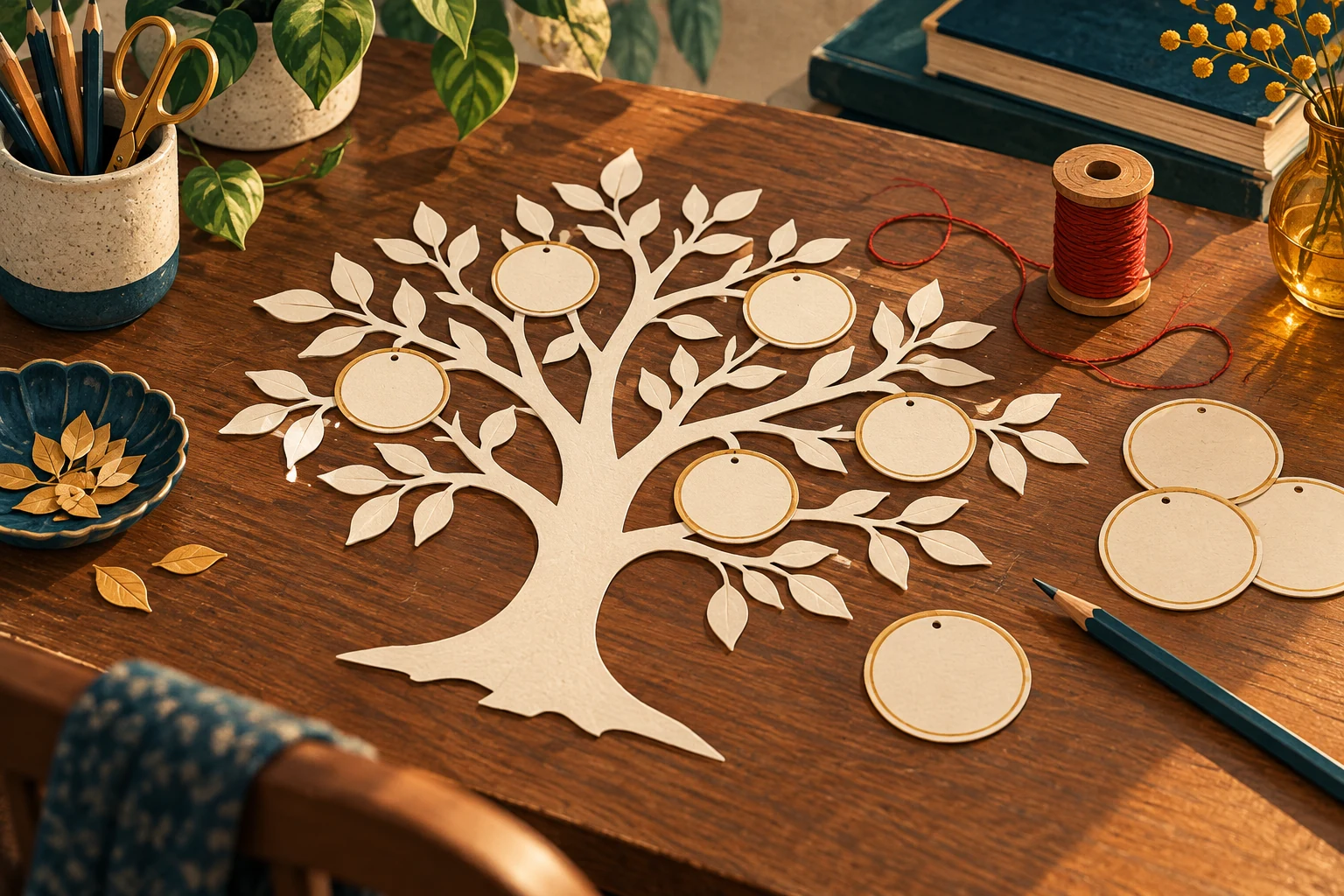
A family tree can show the same person in more than one place. Trace each ancestral line separately and a shared ancestor appears on several branches; draw that person once and the lines meet. This repeated ancestry is known as pedigree collapse. [1] The family hasn’t lost anybody. We have changed how we count and draw its connections.
I find that rather reassuring. “Collapse” sounds as though someone has leaned on the chart and broken the grandparents.
The useful question is what you want the diagram to show: a route through ancestors, distinct people, a household, or the relatives involved in a particular story.
Two, four, eight — positions or people?
We’ll use a simple biological-ancestry model with two parents for each person. Start with one child. There are two parental positions, four grandparental positions and eight great-grandparental positions. Each step back doubles the positions, provided we keep unfolding every line separately. Ten generations back, that gives 1,024 positions.
Those positions do not guarantee 1,024 different people. Graham Coop’s original explanatory simulation makes that distinction by tracking both ancestral lines and unique ancestors: the same individual can be reached by more than one route. [1] Its numerical results belong to its model; we can see the basic counting issue with a much smaller invented family.
An entirely fictional family
Nora and Otto have two children, Ada and Ben. Ada and Leo have a daughter, Mira. Ben and Ruth have a son, Jon. Mira and Jon, who are first cousins, have a child, Kit.
For this example, Leo’s parents are Rosa and Sam, and Ruth’s are Tessa and Will. Assume those four people, Nora and Otto are all distinct. These names and relationships are invented for the explanation.
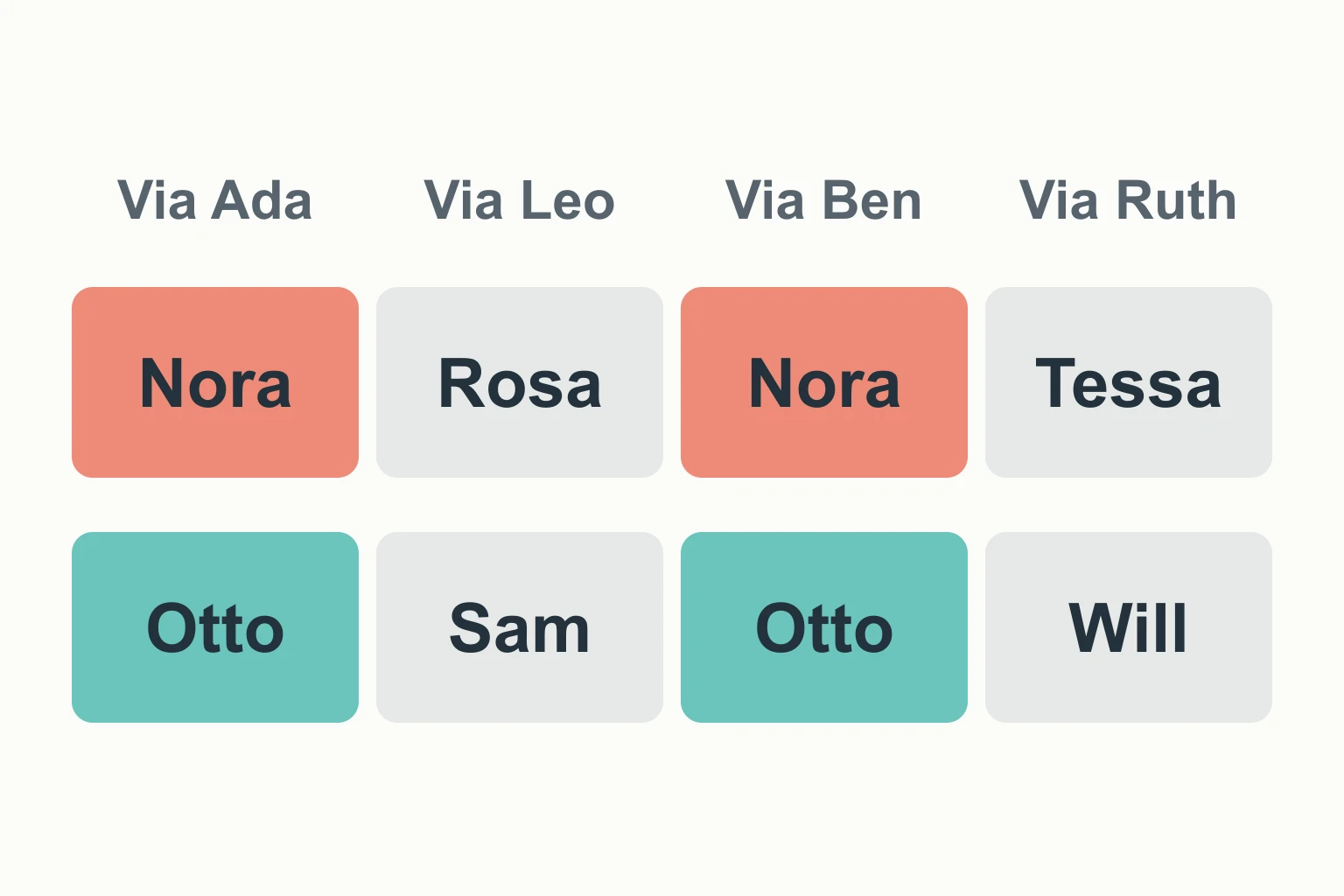
Kit has four different grandparents: Ada, Leo, Ben and Ruth. Follow each grandparent’s parents and the next row looks like this:
| Through Kit’s grandparent | Great-grandparent positions contain |
|---|---|
| Ada | Nora and Otto |
| Leo | Rosa and Sam |
| Ben | Nora and Otto again |
| Ruth | Tessa and Will |
Eight positions contain six people. Nora and Otto each appear twice because Kit descends from both of their children.
Nothing mysterious happened to the other two great-grandparents. There never were two extra people: two routes took us back to the same pair. Counting boxes and counting individuals answer different questions.
What happens when we draw each person once?
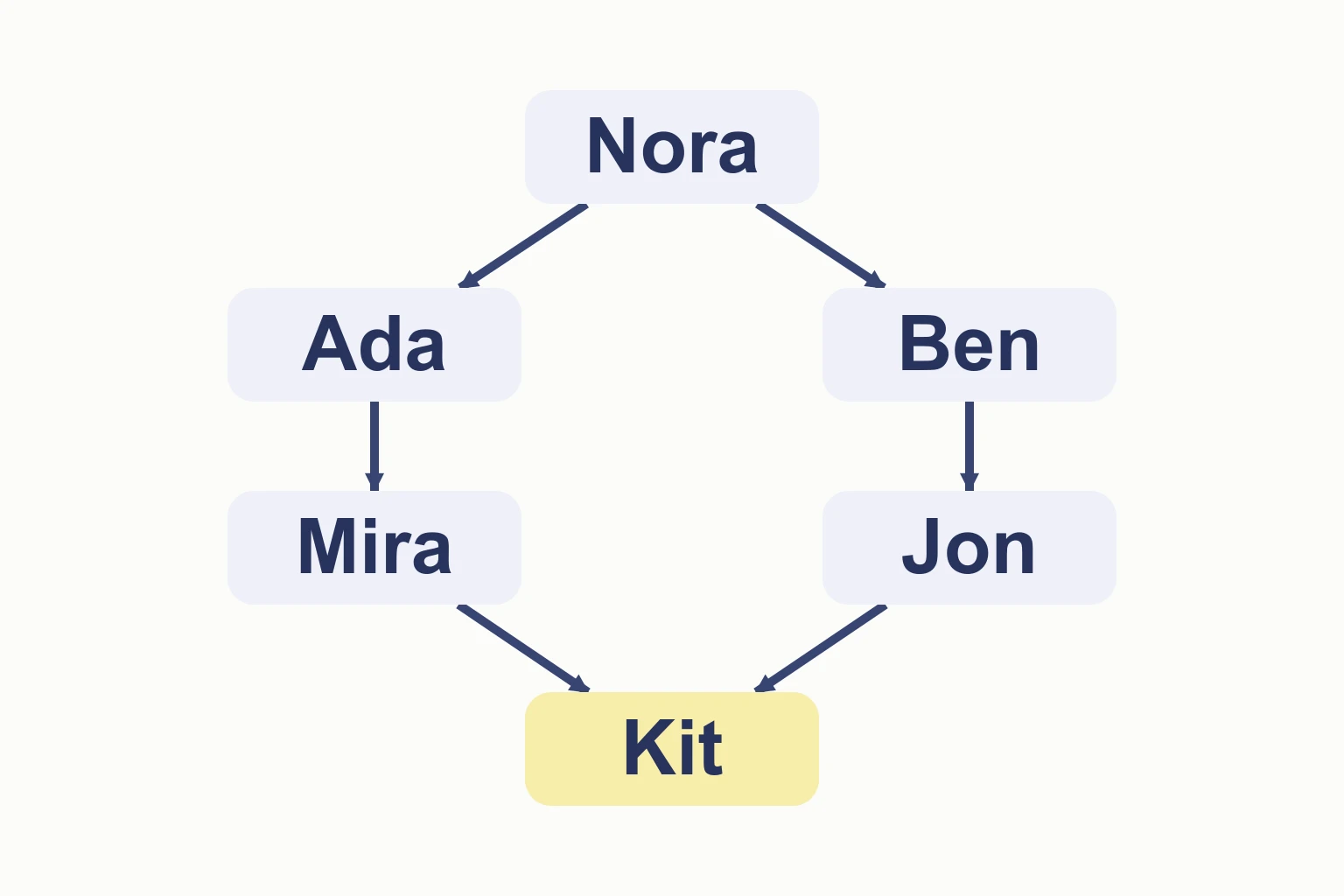
A branching chart can preserve both routes by repeating Nora and Otto, with labels showing that the entries refer to the same people. Alternatively, give each person one entry and connect it to all the relevant children. Nora then connects to both Ada and Ben, and both lines eventually reach Kit.
The word “tree” has a stricter mathematical meaning. NIST’s dictionary defines a tree, in the graph sense, as connected and without cycles when the lines have no direction. [2] In our one-entry-per-person drawing, you can follow a closed route: Nora, Ada, Mira, Kit, Jon, Ben, then Nora again. Under that definition, this graph is not a tree.
If arrows point from parent to child, though, you cannot follow that whole route in the direction of the arrows. Getting from Kit to Jon would mean going backwards. The closed route in the drawing without arrows does not make Nora her own descendant.
I’d keep that distinction clear before the chart becomes a time-travel screenplay.
Different diagrams have different jobs
American Ancestors offers both an ancestor chart centred on one subject and a family group sheet recording a couple and their children. Its guidance gives these forms different jobs: following generations and recording a family unit. [3] Neither is expected to put every family connection on one page.
In our fictional example, the group sheet for Nora and Otto would make Ada and Ben’s shared parents easy to see. A chart centred on Kit would make the two routes back to that couple easy to follow. A drawing with one entry per person would make their shared identity explicit, at the cost of lines converging across the page.
I’d choose the form after choosing the question. A crowded page can be useful if the connection you need is visible; a tidy one can be useful if its labels tell you what has been repeated or left outside its scope.
A family with a rather alarming succession problem
That brings me to Robert Hamer’s black-and-white Kind Hearts and Coronets (1949). Criterion describes Dennis Price’s Louis seeking his mother’s family dukedom, with eight relatives between him and his goal. [4] The BFI explains that his mother was cast out after marrying an Italian opera singer, and that Louis plans to remove the remaining family members in the succession. [5]
I’m borrowing that premise to ask a different diagram question: which relatives stand between Louis and the title? A succession diagram would foreground those relationships. It would have no need to include every ancestor of every character.
This is my comparison about the purpose of a chart. The film’s premise does not establish pedigree collapse in the D’Ascoyne family, and I’m not adding it. I do think Louis would find a diagram terribly convenient. I would be less keen to receive one of his invitations.
Before following the next branch of a family chart, look for its starting person, its relationship labels and any repeated entries. That gives you a much better chance of finding the connection you came for.

References & Further Reading
The small family and its counts are original fictional examples. The simulation supplies a distinction between lineages and individuals, not a prediction about any reader’s ancestry. Film premises support the chart-purpose comparison; no claim is made about an on-screen diagram.
- Graham Coop. “Our Vast, Shared Family Tree.” gcbias, 20 November 2017. Original explanatory simulation of repeated ancestors and multiple routes; model assumptions and particular results are kept separate from the fictional example.
- Paul E. Black et al. “Tree.” Dictionary of Algorithms and Data Structures, National Institute of Standards and Technology, modified 15 December 2017. Graph definition, distinguished from the data-structure definition.
- American Ancestors / New England Historic Genealogical Society. “Research Templates.” n.d. Five Generation Family Chart and Family Group Sheet descriptions.
- The Criterion Collection. Kind Hearts and Coronets. Film information, synopsis and credits, n.d. Confirms Robert Hamer, 1949, black-and-white format and the inheritance premise.
- Adam Scovell. “75 Years of Kind Hearts and Coronets: How Locations from the Murderous Ealing Classic Look Today.” British Film Institute, 10 June 2024. Opening synopsis establishes the mother’s exclusion and Louis’s succession scheme; locations and later plot events are not used here.
For the next unexpected question, follow the Journal in your RSS reader.
On screen
Films discussed
- Kind Hearts and Coronets (1949) · Robert Hamer
Further reading
Read next in the Journal

Want a recommendation shaped around your evening? Ask Momo what to watch next →