See Films Differently Narrative
When a Confession Still Has a Punchline
Neff confesses, Gillis mocks himself, and Harry Lime jokes about his victims. Read how wit admits failure, manages sympathy and evades responsibility.
Plot details follow for Double Indemnity, Sunset Blvd. and The Third Man, including Double Indemnity’s final exchange.
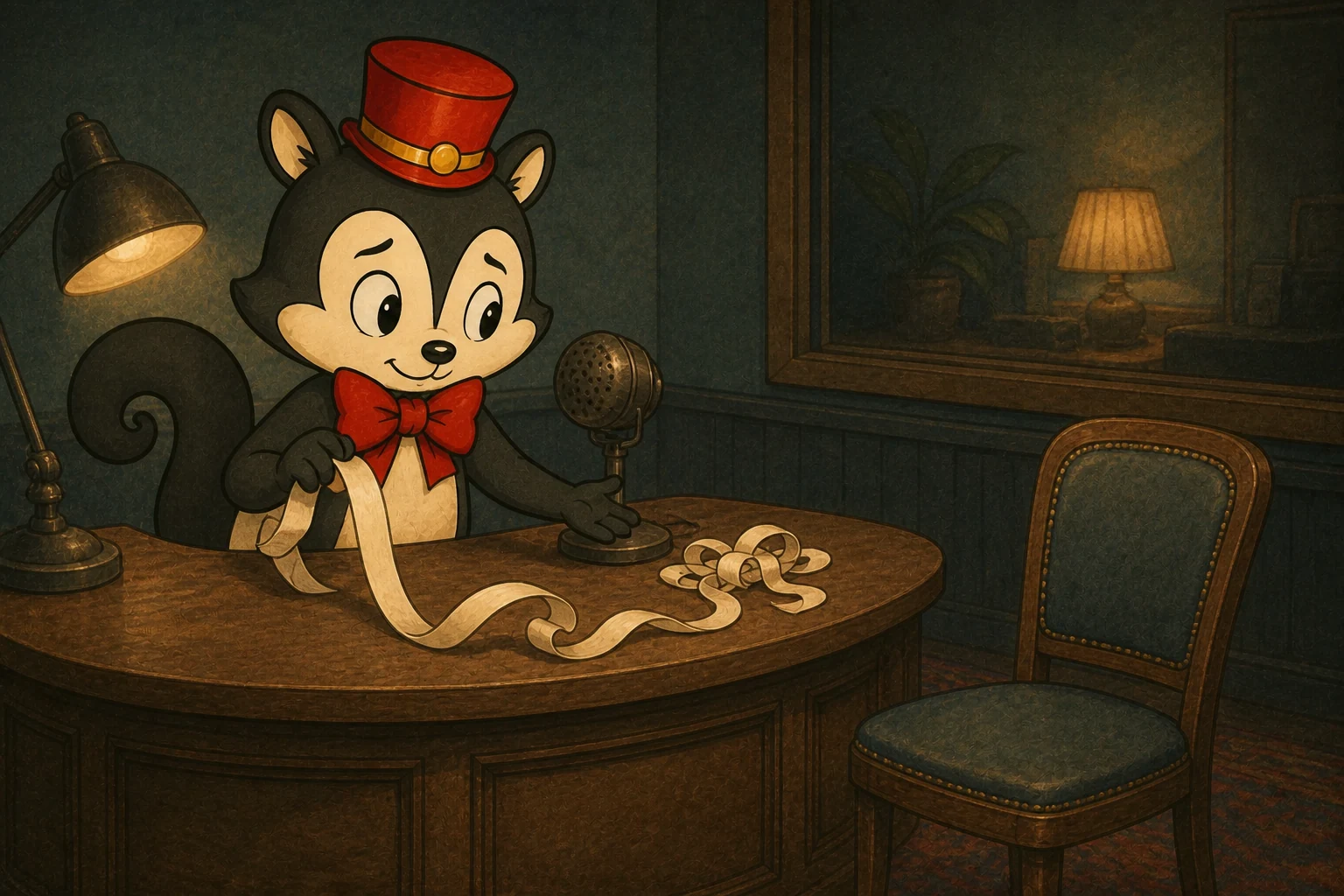
Wounded at his office desk in Double Indemnity (1944), Walter Neff records a message for his colleague Barton Keyes. He admits to murder, names the rewards he wanted—money and a woman—and acknowledges that he has ended up with neither. Then he supplies the finishing touch: ‘Pretty, isn’t it?’ [1] [2]
The joke belongs inside the confession. Neff can recognise the ruin of his own cleverness and still want to tell it cleverly. That combination makes these lines uncomfortable: a person can expose himself while continuing to manage the impression he leaves. To hear what the admission amounts to, we need to listen for whose failure the joke acknowledges, and whose suffering it leaves outside the sentence.
Billy Wilder gives Neff and Sunset Blvd.’s Joe Gillis wit that survives their prospects. Carol Reed’s The Third Man offers a revealing comparison: Harry Lime can sound just as knowing while making his victims harder to see. The difference lies in what each man asks his listener to accept.
The confession comes first
Neff’s recording frames the earlier events we are about to see. The film moves from the wounded man to his first visit to Phyllis Dietrichson, then follows the affair and the murder plan before returning to the office. We hear the failure before we hear the confident courtship. [1]
That order matters when Phyllis likens his advances to speeding. Neff takes up the traffic-police game, finding another flirtatious answer to each imagined penalty. Phyllis keeps pace and brings her husband back into the exchange when Neff imagines resting his head on her shoulder. The verbal fluency belongs to both of them. [3]
They have made a shared game out of approaching a boundary. Each reply proves that its speaker can recognise the invitation and return it. Heard after the opening confession, however, this ease already carries a question: how far will they trust their ability to talk a difficult situation into the shape they want?
The same issue enters Neff’s account of planning the crime. In his later voice to Keyes, he admits that the temptation to beat the insurance system existed before he met Phyllis. He compares his position to that of someone running a roulette wheel who begins to imagine cheating the establishment himself. His expertise gives him the opportunity as well as the fantasy. [4]
He supplies a motive that belongs to him, rather than assigning all initiative to the woman who approached him. Yet his account immediately starts negotiating the weight of that admission. He recognises that a man’s life is at stake and that the man has done him no personal wrong, then qualifies this with a claim about the husband’s lack of love for Phyllis. [4]
That qualification turns the prospective victim back into an obstacle to a relationship Neff would like us to value. His willingness to name his guilt and his wish to make it understandable remain entangled. The film lets us hear that entanglement without requiring us to adopt his view of the marriage.
Even the opening joke keeps the emphasis on what Neff failed to obtain. His accounting of the disaster is painfully frank about his losses; the man he killed scarcely fits into its neat balance. An admission can be true and still be an incomplete measure of the harm.
The man in the pool gets to describe himself
Sunset Blvd. (1950) begins with a narrator who is already dead. Joe Gillis’s body is in a swimming pool. His voice addresses the viewer, initially describing the dead writer in the third person before moving into a first-person account of events six months earlier. [5]
Gillis explains that the man always wanted a pool and finally acquired one, ‘only the price turned out to be a little high’. [6] The understatement makes death sound like an unfortunate purchase. The man floating there is also someone who wanted what the property represented.
There is self-knowledge in the joke. Gillis includes his own appetite in an account of Hollywood’s attractions. He also gives us a particular way to regard him: a failed writer who can still produce a good line about failure. The dead body is helpless; the voice retains the ability to arrange our introduction to it.
His self-mockery lets him belong to the world he ridicules while still presenting himself as its sharpest commentator. We can hear the embarrassment in that position without treating his murder as a punishment he deserved. Gillis’s compromises and the violence done to him are separate responsibilities.
A later conversation makes his use of self-exposure more complicated. When Betty Schaefer comes to Norma Desmond’s house, Gillis describes his financially dependent arrangement with Norma as ‘A long-term contract with no options.’ He presents the comforts as a reason to stay. Yet after Betty leaves, he prepares to leave Norma himself. [7] [5]
The contract joke gives an ugly truth a polished form. It acknowledges that his apparently enviable life has terms attached, but it also helps him play a part for Betty. Susan Bye’s ACMI study guide reads the scene as his deliberate attempt to make himself look worse so that Betty can leave him. [7] On that reading, apparent candour becomes another act of persuasion. Telling somebody an unflattering truth about yourself can still steer them towards the conclusion you have chosen for them.
Making the victims smaller
Harry Lime’s conversation with Holly Martins on the Ferris wheel in The Third Man (1949) turns the question outwards. Holly asks about the victims of Harry’s black-market racket. Harry directs his attention to the distant people below, reduces them to dots and asks him to imagine being paid for each person who stops moving. He adds a sales incentive: ‘Free of income tax, old man’. [8]
The comic detail is grotesquely practical. A question about responsibility has become a calculation of net profit. Harry also tries to recruit the person questioning him: would Holly really refuse the money? If he can make refusal sound naïve, he can treat his own conduct as ordinary worldly sense.
The height of the wheel assists the argument. From up there, individual people are difficult to distinguish. Harry uses that distance to make their disappearance seem calculable. Holly is asking him to look at the people he has hurt; Harry offers a view in which people barely register as people at all.
After the men leave the carriage, Harry ends with his celebrated comparison between the artistic achievements of violent Italy and the supposedly meagre product of peaceful Switzerland: the cuckoo clock. The speech was absent from Reed’s annotated shooting script; the BFI’s comparison identifies Welles’s addition to the finished scene. [8] [9]
Its historical shorthand is Harry’s argument, and a remarkably convenient one for Harry. The listener is invited to enjoy a surprising conclusion while the harm under discussion disappears into a sweeping account of civilisation. His wit exposes his evasions to us even as he tries to make them acceptable to Holly. That exposure is the film’s achievement; Harry has offered no corresponding acceptance of responsibility.
This does not make the three men interchangeable. Gillis is describing his compromises and his own death; Neff admits to a murder; Lime is defending a profitable racket. Their jokes have different things to answer for. Self-ridicule can open a speaker to scrutiny, but the crucial question remains what happens to the people affected by his actions.
A listener who can answer
Keyes provides a test that a witty monologue cannot control. Back at the end of Double Indemnity, the recording is finished, but Neff still wants to escape. He asks Keyes to delay acting on what he has found, announces that he is heading across the border, and collapses before reaching the lift. The admission has not brought a willing surrender to its consequences. [1] [4]
Now Neff jokes that somebody has moved the lift miles away. The exaggeration gives him a way to acknowledge what his body can no longer do. A few moments earlier, he was asking Keyes to watch him get away; now even crossing the office is beyond him. [4] His wit persists at the point where his performance of competence has become impossible.
He still tries to explain Keyes’s failure to identify him: the culprit was sitting just across the desk. Keyes answers, ‘Closer than that, Walter.’ Neff replies, ‘I love you, too.’ Those words of affection have appeared in their earlier workplace banter; the ending gives them the weight of a relationship Neff has betrayed and still needs. [4] [10]
Keyes has answered the explanation with the hurt it leaves out. His closeness was more than a distance between desks. He can care for Walter while recognising what Walter has done, and the film gives that care a small physical action: Keyes lights Neff’s cigarette, reversing the familiar favour Neff has performed for him. [1] [10]
The cigarette settles nothing about the murder. It leaves two men together after one has exhausted his plans and run out of room to move. The man who could always produce another line finally needs something another person must do for him.
References
- ‘Double Indemnity (1944)’, AFI Catalog of Feature Films, ‘Synopsis’ and ‘History’. The released film’s framing confession, attempted escape and final cigarette; the history separately records the deleted execution ending.
- Ashley Clark, ‘10 great films about money’, BFI, 9 January 2014, Double Indemnity section. Quotes Neff’s opening admission and punchline.
- Angelica Jade Bastién, ‘The Black Heart of Double Indemnity’, The Criterion Collection, 31 May 2022. The traffic-metaphor exchange between Phyllis and Neff.
- ‘Double Indemnity (1944)’, Forever Dreaming, dialogue transcript; compared with Billy Wilder and Raymond Chandler’s screenplay text hosted by IMSDb. Used for the retrospective roulette passage and the final office dialogue. The undated screenplay transcription includes an alternative ending and is not treated as a verbatim record of the released film.
- ‘Sunset Blvd. (1950)’, AFI Catalog of Feature Films, ‘History’ and ‘Synopsis’. The released opening’s address to the viewer and transition into flashback; Gillis’s departure after Betty leaves.
- Frank Miller, ‘Trivia – Sunset Blvd. – Trivia & Fun Facts About SUNSET BLVD’, Turner Classic Movies, 20 January 2011, ‘Famous Quotes’. Gillis’s pool joke.
- Susan Bye, ‘Sunset Boulevard study guide’, ACMI, ‘Genre’, romance discussion. The contract line and Bye’s reading of the conversation with Betty.
- Tim Dirks, ‘The Third Man (1949)’, Filmsite, plot synopsis, page 3. The Ferris-wheel dialogue and the cuckoo-clock speech after leaving the carriage. Dialogue and sequence also checked against the undated, shot-by-shot continuity-format text hosted by Script Slug, pp. 173–178.
- Nathalie Morris, ‘The annotated shooting script for The Third Man, minus the “cuckoo clock” speech’, BFI, 26 August 2025. Compares Reed’s annotated script with the released scene.
- Norman N. Holland, ‘Double Indemnity’, A Sharper Focus. The repeated expression of affection and the reversal of the cigarette-lighting gesture.
On screen
Films discussed
- Double Indemnity (1944) · Billy Wilder
- Sunset Blvd. (1950) · Billy Wilder
- The Third Man (1949) · Carol Reed
Continue exploring on Monocurator
Want a recommendation shaped around your evening? Ask Momo what to watch next →