See Films Differently Momo Notices
When a Pocket Was Something You Tied On
How tie-on pockets worked, what theft accounts can and cannot tell us about their contents, and a hand-and-wallet detour to Bresson’s Pickpocket.
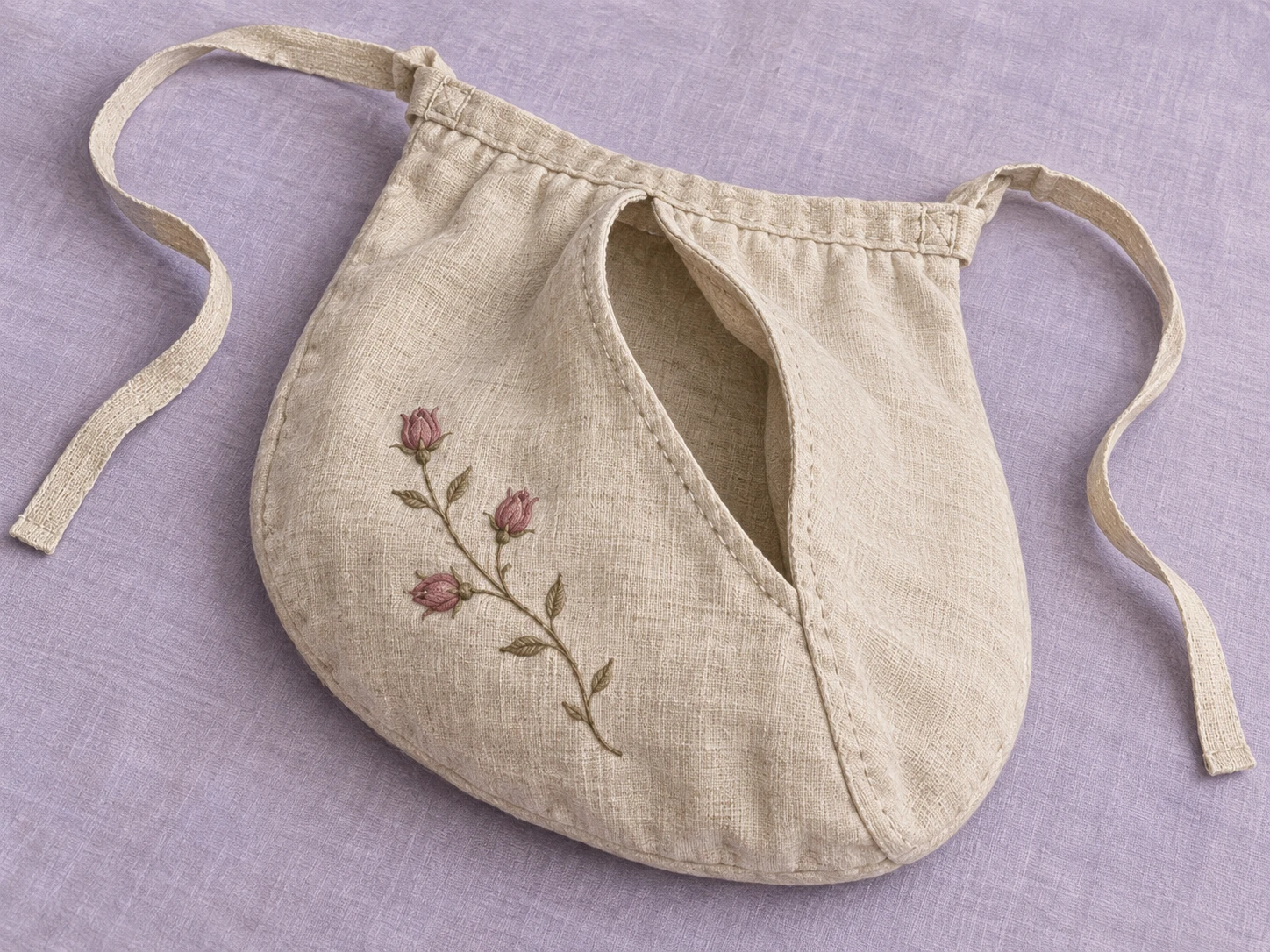
The Metropolitan Museum of Art has an American pocket dated around 1784. Made from cotton and wool, it is decorated with flowers. It belongs in a clothing collection, yet it was a separate accessory: its owner could tie it around her waist rather than wear it as part of one particular skirt. [1]
That changes the question “Does this dress have pockets?” You might have brought your own.
A detachable pocket gives us a small piece of clothing history with a surprisingly large complication. The object survives. What someone put in it usually doesn’t. To recover the contents, historians sometimes have to wait for something to go wrong.
A pocket with its own arrangement
Tie-on pockets could be reached through openings in dresses and petticoats. The V&A describes them as common from about 1650 to the end of the nineteenth century, with some later use. Precise beginnings are harder to establish because so little clothing survives. [2]
The important detail is the separation between container and garment. Changing the dress needn’t mean changing the place that held your possessions. You could keep the pocket, or put it away separately.
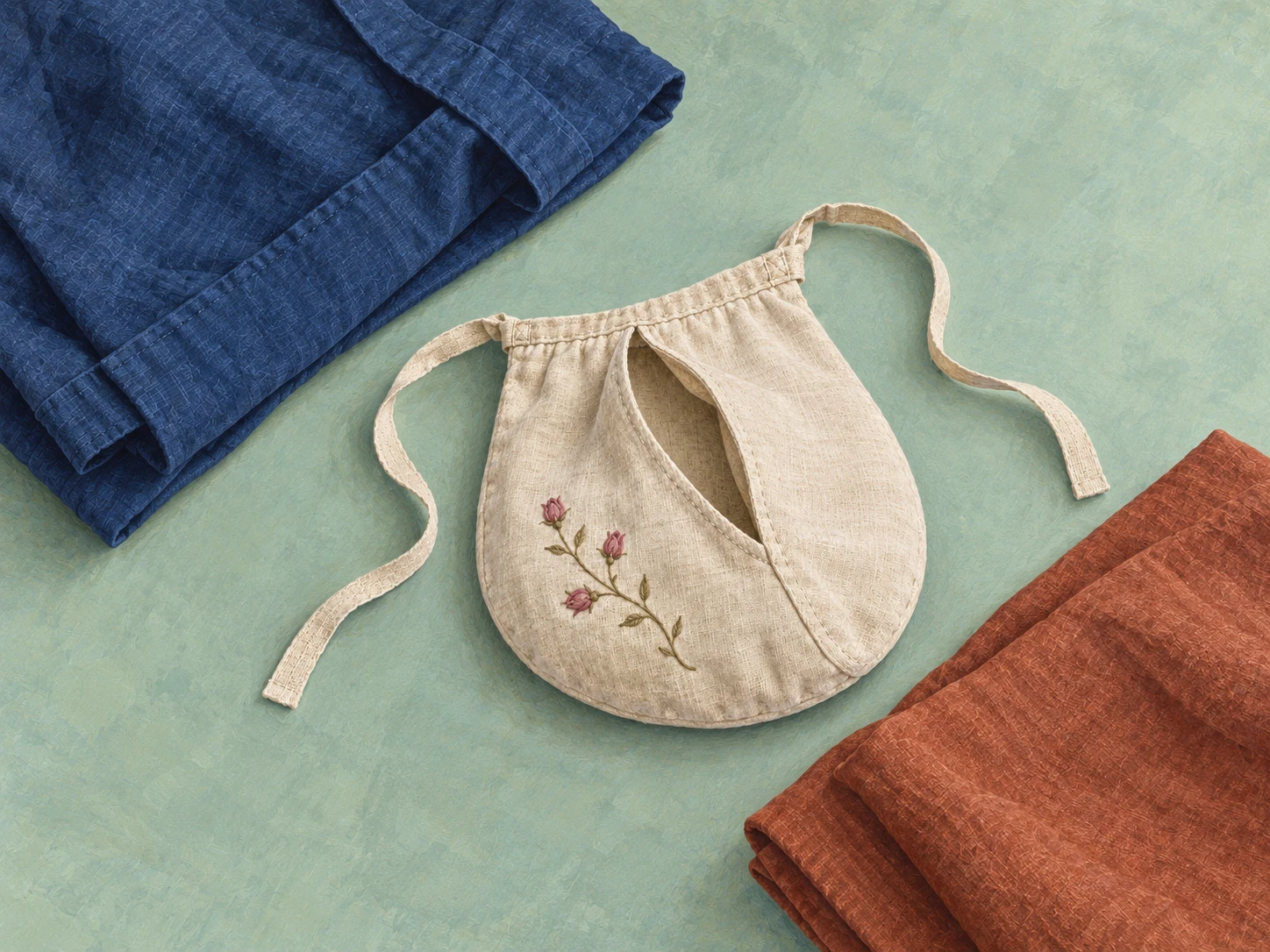
That is an appealing bit of practical design. A modern coat pocket makes you remember which coat had your keys. A detachable one offers another arrangement for the same problem. Whether a particular wearer found it more convenient is another question; a surviving object cannot give us everybody’s verdict.
Nor should we turn its disappearance into a tidy contest with the handbag. The V&A’s Lady Clapham doll, dated 1690–1700, has a tie-on pocket, a petticoat with integrated pockets and a gaming bag. These forms could coexist. [2]
One wardrobe is enough to spoil a beautifully neat timeline. I’m rather pleased about that. Clothing has a habit of being used by people, who keep requiring more than one thing from it.
The contents become evidence
In a theft report, the owner has a reason to say what was missing. The resulting list can preserve objects that would otherwise attract very little attention.
According to the V&A’s summary of an eighteenth-century case involving Elizabeth Adams, papers, including pawnbroker valuations and receipts, were concealed in a nutmeg grater among the items reportedly stolen from her pocket. Ambrose Cook, accused of picking it, was found not guilty. [2]
That verdict matters. A list of reported missing objects does not entitle us to retell an allegation as a proven theft by the named defendant. Nor does an inventive little container tell us why Adams chose it. It does make a simple picture of an undifferentiated pocketful rather less persuasive: here was a container inside a container, holding paperwork.
In historians Barbara Burman and Ariane Fennetaux’s account of a different case, published by Yale University Press, Ann Clough examined servant Frances Burk’s conspicuously full pocket in a London household in 1765 and found clothing and cloth belonging to Clough, including an apron and a silk handkerchief. [3]
The historians present this as concealment of Clough’s goods. Adams’s reported contents and Burk’s concealed articles reach us through different circumstances. Combining them into one “typical woman’s pocket” would erase the difference that makes either account useful.
A list has a reason for existing
These cases are presented here through the museum’s account and the historians’ published discussion. I would keep that mediation visible: their summaries are not a substitute for reading every word of the underlying proceedings.
They also pose a useful question for any history built from losses: why did this particular list get written down?
A person who put the same key in the same pocket every morning had little need to announce it. A disputed theft created a need for names, objects and testimony. Such a record may be rich in detail while leaving ordinary, uneventful use out of view.
That is a limitation of what we can learn from the record, rather than a reason to discard it. We can ask which things were reported, who described them and what the proceedings established. Counting the colourful examples would not, by itself, tell us how frequently every woman carried those things.
The embroidered pocket and the reported contents answer different questions. One gives us material and construction; the other gives us a description made for a particular purpose. Put them together carefully, and we get a more interesting object than either “pretty accessory” or “secret hiding place” can manage alone.
Momo has a pickpocket for you
Robert Bresson’s Pickpocket (1959) is black-and-white, follows a thief through Paris and makes an excellent detour from a pocket to the act of taking something from it. [4]
Criterion’s account of Pierre Étaix’s contribution is wonderfully specific: what remains of his performance is one hand stealing a wallet. [5]
One hand gets the job. The rest of the actor can apparently wait outside.
Here the connection is a short invitation to follow a hand and a wallet. Criterion’s text identifies those two things; it does not identify the costume or the construction of a pocket. I would keep the observation at that scale.
This twentieth-century film about Paris supplies a detour into the act of taking. It supplies no evidence here for eighteenth-century dress. Even a verified film costume would require comparison with historical clothing records.
The detour leaves me with a question to carry back to the museum object: how could its owner reach what she needed while keeping it out of everybody else’s sight? Look for the opening, then the opening in the garment over it. The contents had a route to travel.

References & Further Reading
Object details come from museum records. Historical cases are attributed to the museum and historians who discuss them; their underlying court texts have not been independently examined for this article. The practical comparisons and viewing questions are Monocurator’s interpretation.
- The Metropolitan Museum of Art, Pocket, American, ca. 1784, cotton and wool, object no. 2009.300.2241, Costume Institute collection record.
- Victoria and Albert Museum, ‘Women’s Tie-on Pockets’, updated 17 April 2024. Museum-object discussion and accounts of historical court cases, including Old Bailey case t17840114-54.
- Barbara Burman and Ariane Fennetaux, ‘A “Pocket” History of Women’s Lives (1660–1900)’, Yale University Press London Blog, 16 February 2026; discussion drawn from their pocket-history research.
- The Criterion Collection, Pickpocket (1959), film record, synopsis and credits.
- The Criterion Collection, ‘Pierre the Pickpocket’, 26 April 2013. The accompanying text describes Étaix’s contribution.
For the next unexpected question, follow the Journal in your RSS reader.
On screen
Films discussed
- Pickpocket (1959) · Robert Bresson
Further reading
Read next in the Journal
Want a recommendation shaped around your evening? Ask Momo what to watch next →