See Films Differently Momo Notices
Why Does Rain Smell So Good? Start with the Soil
Petrichor, soil-derived material and a drop’s aerosol mechanism explain different things from liking the smell, with a deliberate Pather Panchali comparison.
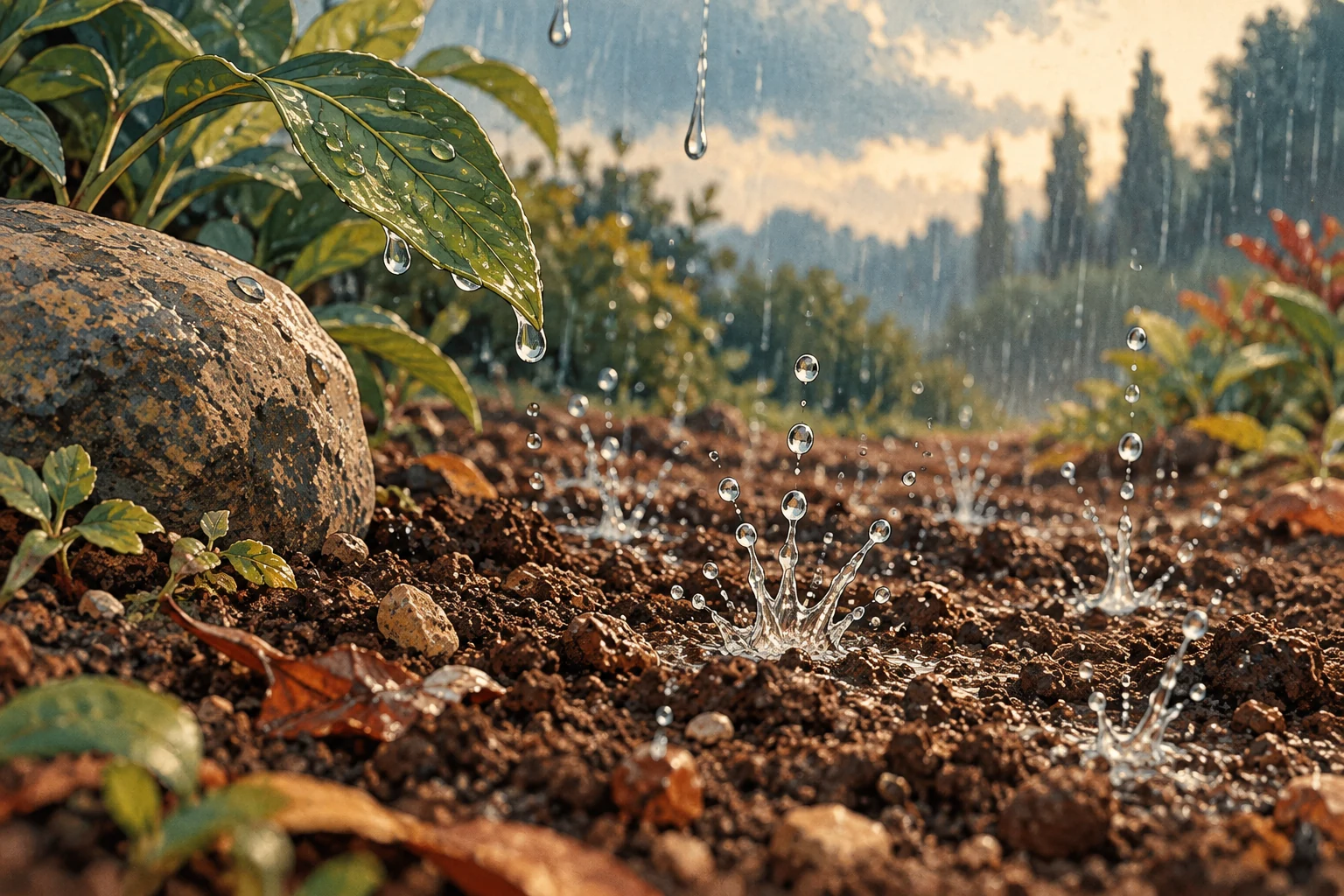
That earthy smell when rain reaches dry ground has a pleasingly precise name: petrichor. Say it aloud and you sound as though you’ve brought the correct equipment.
The word does useful work. It doesn’t, however, explain why you might enjoy the smell. There are three questions here: what produces it, how material reaches the air, and what makes the result welcome. I like the small machinery involved in the second. The third deserves a little more care than “our ancestors needed water”.
A name isn’t an ingredient list
CSIRO’s account of Isabel Joy Bear and Richard Thomas’s work describes the naming of petrichor in 1964. They obtained an odorous oil by steam-distilling rocks exposed to warm, dry conditions. Their subject was material held in rocks and soil and released by moisture. The name belongs to that investigation; it isn’t a chemical formula for every smell accompanying rain. 1
Geosmin is a particular earthy-smelling compound, produced by organisms including soil bacteria of the genus Streptomyces. It belongs in this discussion, though petrichor and geosmin aren’t interchangeable names. In a 2024 laboratory study, geosmin activated the human smell receptor OR11A1 expressed in cultured cells. That finding identifies a response to a substance; it supplies no pleasure rating. 2
This distinction saves us from a very tidy, very premature answer. Finding an ingredient doesn’t tell us the composition of the air beside a particular pavement. Finding a receptor doesn’t tell us whether you’d like to stay there.
The ground has a delivery system
Young Soo Joung and Cullen Buie’s 2015 experiments showed water drops striking dry, porous soil trapping air bubbles. As the bubbles burst, tiny jets broke into droplets suspended in air: aerosols. A fluorescent-dye experiment on a porous plate also demonstrated that material from the surface could travel with those droplets. 3
The effect depended on the surface and impact conditions. The researchers observed it under conditions consistent with light or moderate rain on clay-like soils; they didn’t observe it on sand or under their heavy-rain conditions. Their laboratory work demonstrated a possible transport mechanism, rather than measuring the smell of an entire storm. 3
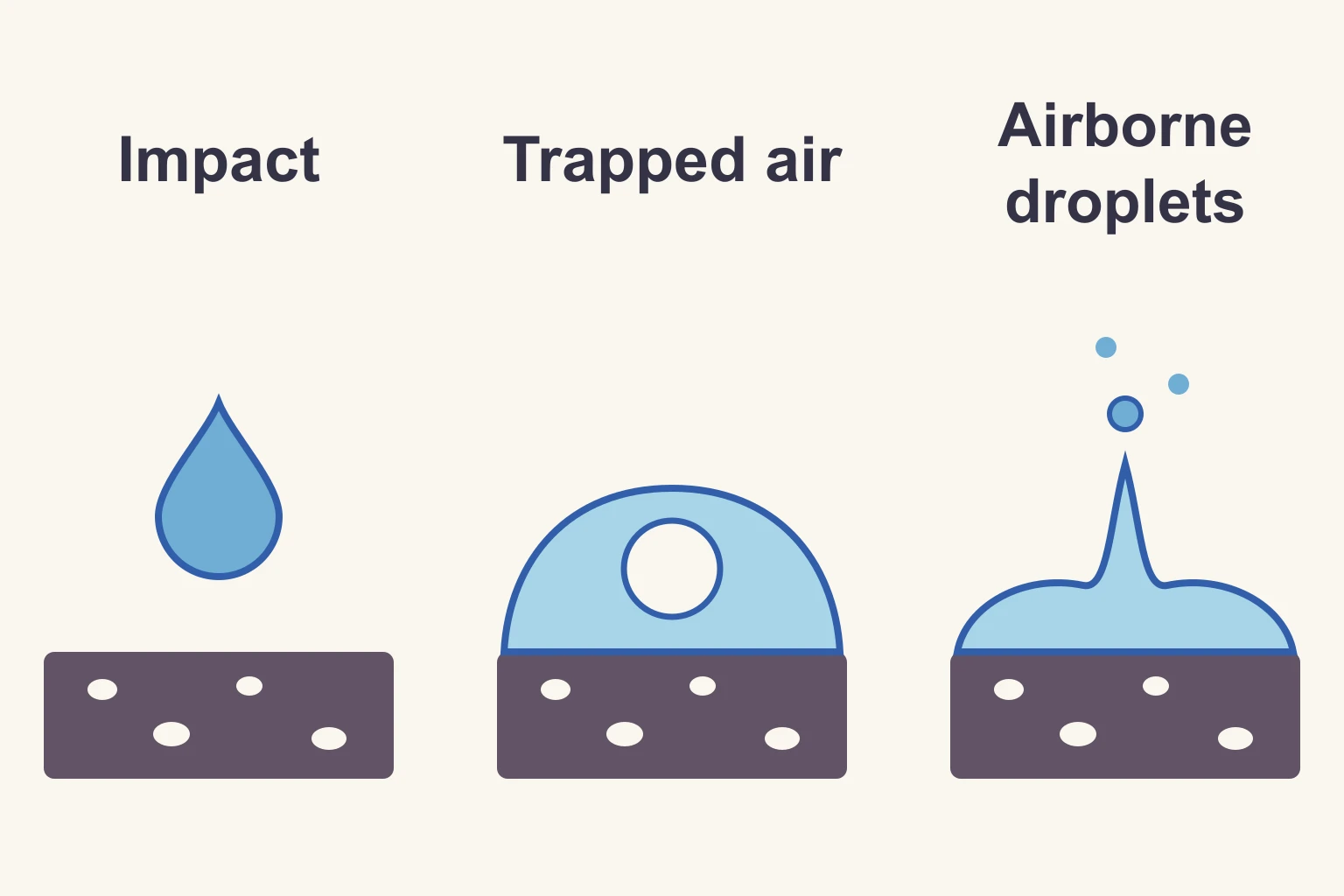
I find that more interesting than the notion that a shower simply washes a ready-made perfume out of the sky. The ground is participating. A drop can briefly become a means of lifting material from a surface into the air.
But an aerosol is a carrier, not a verdict on its contents. This experiment doesn’t establish which compounds reach your nose outdoors, in what proportions, or whether you’ll enjoy them. “Rain releases material” and “rain smells lovely” need separate evidence.
What does “good” add?
An experiment by Ivan de Araujo and colleagues offers a useful caution about descriptions. Twelve men aged 23–35 encountered the same test odour, a mixture of isovaleric acid and cheddar-cheese flavour, under two labels: cheese and body odour. It received a higher pleasantness rating with the cheese label. That group’s mean rating was approximately neutral, so “higher” shouldn’t quietly become “delightful”. 4
The study concerned an ambiguous laboratory odour, not rain or geosmin. It shows that a description can affect a judgement under those conditions. It doesn’t explain everyone’s affection for wet earth, or prove that all smell preferences come from words and memories.
Still, it gives me reason to resist treating pleasure as another ingredient in the bottle. If you enjoy a shower’s earthy smell, ask what you’ve recognised as well as what you’ve detected. Does “rain” mean a garden watered, a walk interrupted, or something else entirely? Those are questions for you, not memories I can assign you. The experiments above leave that part open.
A detour into Pather Panchali
Here I’ll take us to Satyajit Ray’s Pather Panchali (1955), a black-and-white film about a family in rural Bengal. Criterion’s synopsis introduces Apu and his elder sister Durga; Durga Chew-Bose’s essay singles out Durga dancing in the monsoon. 5 6
I bring it in as a comparison about atmosphere. A screen can’t send geosmin across the room. A rain scene gives us something else to work with: a depicted place, a character’s activity, and whatever associations we bring. That’s my invitation to think alongside the film, not a claim that Ray illustrated the aerosol experiment or that viewers have a measured olfactory response.
Nor would I turn this story, with its family hardship and loss, into a cheerful advertisement for petrichor. 5 6 The comparison earns its place by keeping the setting attached to the sensation. “Pleasant rain” is a judgement made somewhere, by someone.
We can describe earthy-smelling material and a mechanism that can lift surface material into air. The sources here don’t establish a universal reason for liking the result. I’d keep that question open, rather than issue everyone the same happy ending.

References
- CSIRO. “The smell of rain: how our scientists invented a new word.” 31 March 2015. Institutional account.
- Ball, L., et al. “Geosmin, a Food- and Water-Deteriorating Sesquiterpenoid and Ambivalent Semiochemical, Activates Evolutionary Conserved Receptor OR11A1.” Journal of Agricultural and Food Chemistry 72, no. 28 (2024): 15865–15874. DOI: 10.1021/acs.jafc.4c01515. Full text.
- Joung, Y. S., and C. R. Buie. “Aerosol generation by raindrop impact on soil.” Nature Communications 6 (2015), article 6083. DOI: 10.1038/ncomms7083. Publisher record; author-uploaded full text.
- de Araujo, I. E., E. T. Rolls, M. I. Velazco, C. Margot, and I. Cayeux. “Cognitive Modulation of Olfactory Processing.” Neuron 46, no. 4 (2005): 671–679. DOI: 10.1016/j.neuron.2005.04.021. Author-hosted full text.
- The Criterion Collection. “Pather Panchali.” Film information and synopsis.
- Chew-Bose, D. “Constant Compass: Uma Das Gupta in Pather Panchali.” The Criterion Collection, 8 May 2017. Essay.
For the next unexpected question, follow the Journal in your RSS reader.
On screen
Films discussed
- Pather Panchali (1955) · Satyajit Ray
Further reading
Read next in the Journal


Want a recommendation shaped around your evening? Ask Momo what to watch next →