Film Guides
Four Black-and-White Films for a Rainy Afternoon
Four black-and-white films for a rainy afternoon, compared by running time, mood, weather and content: two comedies, a windswept romance and a mystery.
Rain has cancelled the ambitious part of the day. You have a sofa, perhaps some tea, and a couple of hours that no longer need to prove anything. This sounds like an easy moment to choose a film. It rarely is.
“A film for a rainy afternoon” can mean at least four things. You might want something short. You might want light stakes. You might want the weather inside the story. Or you might want a mystery vigorous enough to compete with the window.
Those are different requests. A film can contain magnificent rain and leave you emotionally flattened. A film with no memorable shower can be exactly right while the real rain handles the atmosphere outside.
So this list begins with the desired weight, then uses running time, mood and content to narrow the choice. None of the four is promised as universally comforting. Momo has checked the forecast and found human taste remaining stubbornly local.
Choose by the afternoon you actually have
| If you want… | Try… | Approximate running time | What may rule it out |
|---|---|---|---|
| A short, affectionate comedy about keeping a cinema alive | The Smallest Show on Earth (1957) | 80–81 min | Debt, rats, failing equipment and elderly characters treated as comic eccentrics |
| Fast romantic sparring with very little solemnity | The Awful Truth (1937) | 91 min | Divorce, infidelity, jealousy and sustained romantic manipulation |
| Weather woven into a romantic story | I Know Where I’m Going! (1945) | 91–92 min | Dangerous sea travel, a life-threatening whirlpool and a curse |
| A mystery with wit and genuine peril | The Lady Vanishes (1938) | 96 min | Threat, fighting, shootings and period national stereotypes |
The small differences in listed running times come from specific institutional or distributor records, rather than a claim that every available edition runs identically. Check the version you can access before planning a very precise gap between lunch and dinner.
The Smallest Show on Earth: when you want the gentlest stakes
Basil Dearden’s The Smallest Show on Earth begins with a young couple inheriting a decrepit provincial cinema. The BFI describes the Bijou as debt-ridden and rat-ridden, with three elderly employees and a building that appears to regard maintenance as an insult. The resulting comedy follows the attempt to revive it. [1]
That makes it the best first choice when rain has already reduced your appetite for plot machinery. The machinery here is quite literally breaking. Screens rip, seats collapse and prints go through the projector incorrectly. The mishaps supply momentum, while the purpose of the enterprise remains easy to grasp: keep this tiny place going.
It is also a film about cinemagoing, which gives a home screening a pleasing extra layer. The audience inside the Bijou responds to each disaster as part of the entertainment. A rainy afternoon at home briefly becomes a visit to a flea-pit whose technical standards would make the buffering symbol look reassuringly professional.
The BFI lists the film at 81 minutes; current distributor Rialto Pictures lists an 80-minute black-and-white presentation. [2] It is the shortest option here and the warmest in tone. “Warm” still needs boundaries: the story starts with a death-related inheritance and financial strain, and it treats ageing and unsafe working conditions as comic material. Choose it for affectionate disorder, not for a world in which nothing unpleasant is mentioned.
The Awful Truth: when you want the room to move faster
In The Awful Truth, Lucy and Jerry Warriner decide to divorce, then devote impressive energy to spoiling each other’s next romantic move. Criterion lists Leo McCarey’s 1937 black-and-white comedy at 91 minutes and describes the couple’s infidelities, meddling and ill-matched engagements. [3]
This is the conversational choice. Its pleasures come from timing, embarrassment, performance and two people recognising an equal opponent while pretending to be finished with each other. A grey afternoon can make ninety minutes feel shapeless; this film keeps cutting it into social disasters.

It is lighter than the two films below, but “screwball” does not mean free of discomfort. Jealousy drives much of the comedy. Characters deceive one another, interfere with new partners and use public humiliation as a competitive sport. If a story about divorce or manipulative romance is the wrong company today, the wit will not magically cancel the premise.
Momo’s practical test is simple: do you want the rain to remain the loudest conflict in the house? If yes, the Warriners may be overqualified.
I Know Where I’m Going!: when the weather should enter the story
This is the one to choose if watching rain outside has made you want weather on screen as well.
Joan Webster is travelling to a remote Hebridean island to marry a wealthy industrialist. A storm strands her on Mull and disrupts a plan she has treated as settled. Criterion identifies Michael Powell and Emeric Pressburger’s film as a 1945 black-and-white production running 92 minutes. [4] The BFI lists 91 minutes and describes the weather delay, the ancient curse and the life-threatening whirlpool that later enters the story. [5]
The appeal is not simply “rain looks beautiful in monochrome”. Weather changes what Joan can do. Wind and sea turn an itinerary into a wait, and the wait gives people and places time to interfere with her certainty. The landscape has dramatic force without becoming a decorative screensaver.
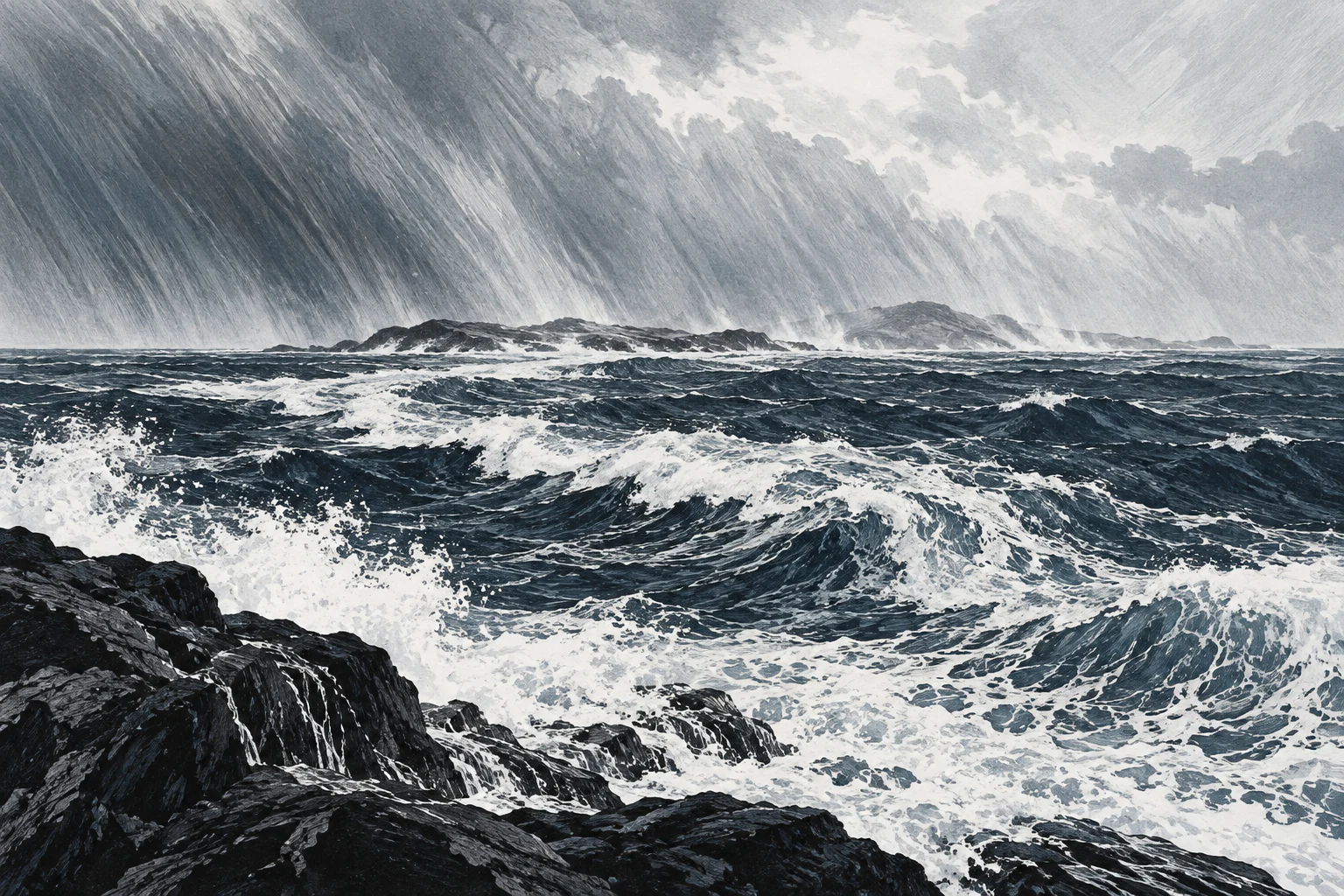
That distinction matters because this is the most tempting film here to mislabel as soothing. Its romance, community and black-and-white landscapes can feel enveloping. Its climax also involves serious maritime danger. Somebody wanting a gentle background film may find that sequence distinctly unwilling to stay in the background.
Choose it when you want atmosphere and emotional movement, and when sea peril is acceptable. Save it for another afternoon if storms, dangerous crossings or supernatural folklore make present weather harder to enjoy.
The Lady Vanishes: when comfort would be too quiet
Sometimes a rainy afternoon needs a plot with elbows.
Alfred Hitchcock’s The Lady Vanishes starts with travellers delayed at a crowded hotel and then moves onto a train. Iris searches for an elderly passenger whose existence the others deny. The BFI calls it a comic thriller and lists the film at 96 minutes, noting how suspense, comedy and romance operate together. [6]
This is the liveliest choice, and the least appropriate if “rainy-day film” means low tension. Banter and eccentric fellow passengers keep the film buoyant, while the disappearance steadily raises the danger. Later violence includes fighting and gunfire. Period national caricatures are also part of its comic and political texture. [7]
Monocurator already discusses The Lady Vanishes in its classic mystery guide and guide to starting with Hitchcock. It appears here for one narrow reason: it marks the high-tension end of this rainy-afternoon scale. Readers wanting a fuller account can follow those guides instead of receiving another reheating of the same plot.
Choose it when the weather has made the day feel stalled and you want forward motion. The train does plenty of that, even when its passengers are being remarkably unhelpful.
Three checks before pressing play
The useful part of a recommendation is often the part that lets you reject it. Before choosing, ask:
- How much attention is available? The Smallest Show on Earth tolerates a soft afternoon. The Lady Vanishes rewards attention to claims, faces and evasions.
- How much danger is welcome? Romantic sabotage is different from a whirlpool, and a whirlpool is different from gunfire. “Classic” does not turn any of them into neutral content.
- Do you want to match the weather or counter it? I Know Where I’m Going! puts weather into the drama. The two comedies let the rain stay outside. The mystery supplies its own pressure system.
Availability changes by country and service, so this guide does not promise that a particular edition is streaming. It also does not infer demand for black-and-white rainy-day films from broader interest in rainy-day viewing. The selection is editorial: four distinct answers to a recognisable choice.
If none fits, the table has still done its job. You now know whether the missing film needs to be shorter, gentler, stormier or more suspenseful. That is far more useful than accepting the first poster with an umbrella on it.
References & Further Reading
- British Film Institute, ‘10 great films about cinemagoing’, 3 December 2020. The entry describes the inheritance, the Bijou’s condition, its staff and the cinema mishaps.
- British Film Institute, The Smallest Show on Earth, film record; Rialto Pictures, The Smallest Show on Earth, current catalogue record. The records list 81 and 80 minutes respectively; Rialto also specifies black-and-white.
- The Criterion Collection, The Awful Truth, film record. United States, 1937, 91 minutes, black-and-white; synopsis and production credits.
- The Criterion Collection, I Know Where I’m Going!, film record. United Kingdom, 1945, 92 minutes, black-and-white; synopsis and production credits.
- British Film Institute, I Know Where I’m Going!, film record. The record lists 91 minutes and identifies the weather delay, life-threatening whirlpool and ancient curse.
- British Film Institute, The Lady Vanishes, film record; The Criterion Collection, The Lady Vanishes, presentation record. Both list 96 minutes; BFI supports the synopsis and suspense/comedy/romance discussion, while Criterion specifies black-and-white.
- Common Sense Media, The Lady Vanishes review, content advice, checked 24 September 2026. Used for the positive warnings about shootings, fighting, blows to the head and moving-train danger; it does not establish that no other difficult content appears. Period national stereotypes are also recorded in Monocurator’s verified film guide.
For the next unexpected question, follow the Journal in your RSS reader.
On screen
Films discussed
- The Smallest Show on Earth (1957) · Basil Dearden
- The Awful Truth (1937) · Leo McCarey
- I Know Where I’m Going! (1945) · Michael Powell and Emeric Pressburger
- The Lady Vanishes (1938) · Alfred Hitchcock
Further reading
Read next in the Journal

Want a recommendation shaped around your evening? Ask Momo what to watch next →