See Films Differently Momo Notices
Does Owning a Cat Make You Happier? Daily Life—and a Black-and-White Cat Film
Companionship, care, costs and grief: what happiness research can tell us about living with a cat, with a detour to the black-and-white comedy Rhubarb.
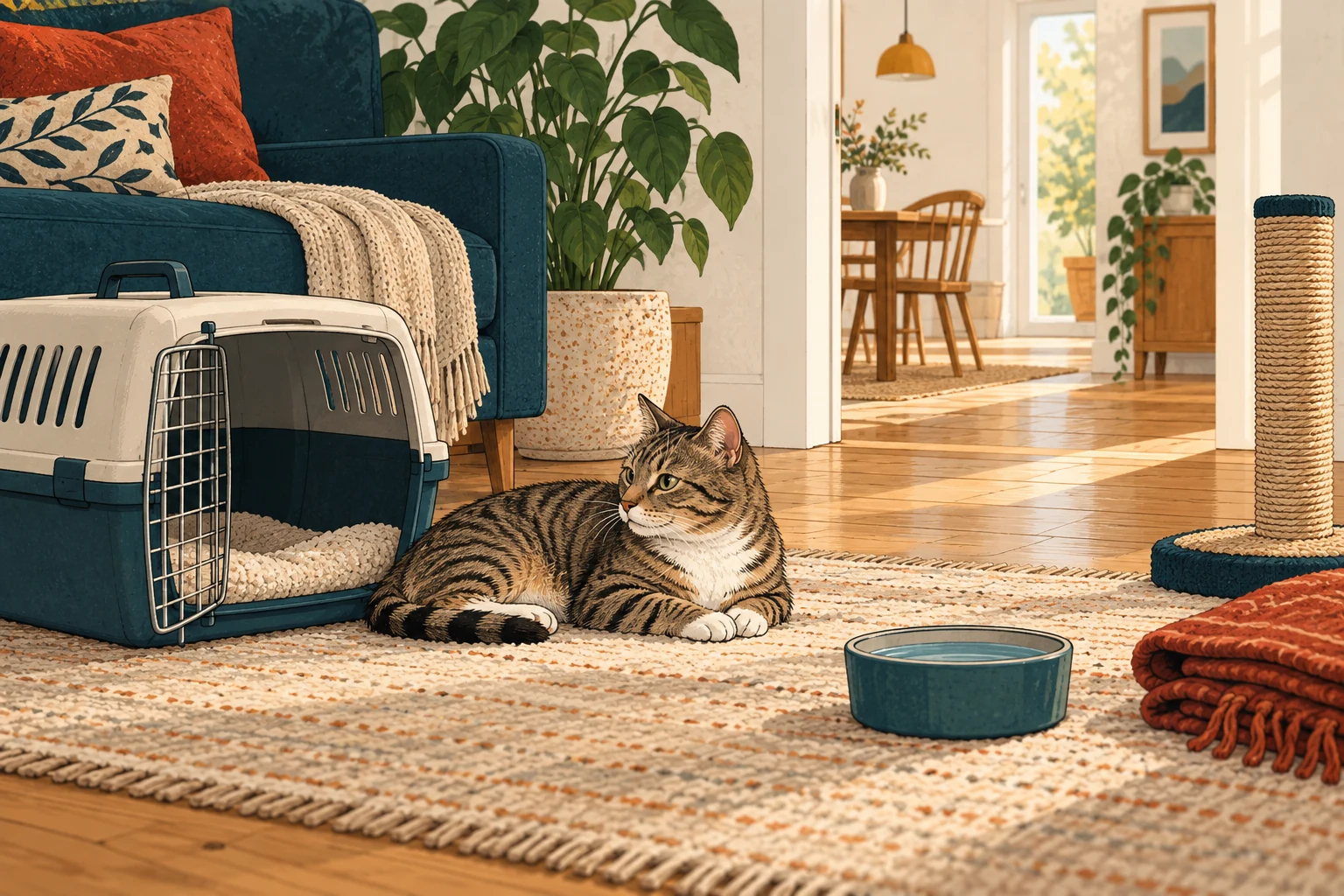
Living with a cat can bring pleasure, companionship and a relationship you value. Research does not establish that getting one reliably makes life more satisfying, however. Enjoying a cat’s company is a good starting point; deciding whether to live together also means asking whether you want, and can support, the care that continues when the cuddles stop.
A cat settling beside you may be the moment you picture. The less photogenic parts deserve a place in that picture too: cleaning a litter tray before work, arranging care when you travel, and noticing when an older cat needs help. Some of that work may become a welcome part of your day. Some may be tiring, expensive or upsetting. Both can belong to a relationship you are glad to have.

What does the happiness research actually measure?
Feeling better during a pleasant encounter, showing a change in a stress-related hormone, and judging your life as satisfying are different outcomes. There is also a question that no single score settles: how much does this particular relationship matter to you?
In a 2019 randomised trial, 249 university students were assigned to ten minutes of hands-on contact with cats and dogs, watching others interact, viewing animal photographs, or waiting. The hands-on group had lower subsequent salivary cortisol than the comparison groups, after relevant adjustments. This supports a short-term physiological effect in that setting. It neither isolates cats’ contribution nor tests whether years of ownership make people happier. Cortisol is not a happiness score. [1]
Ownership studies have a harder problem. People who get pets can already differ from those who do not—in their circumstances, preferences and wellbeing. Following people over time helps, but the reasons they acquire a pet can also change. Looking only at people still keeping pets may miss those who found the arrangement unmanageable.
A 2025 UK study estimated substantial gains in life satisfaction from pets. It used watching neighbours’ properties as an indirect predictor of ownership, assuming that this activity did not affect satisfaction through other unaccounted-for routes. Ownership was measured once and carried forward across survey waves. The cat-specific estimate was uncertain, and the authors caution that the large effects may concern a particular subgroup. The study also expressed the estimated satisfaction gain in income terms. That modelled equivalent is neither cash received nor an amount to deduct from veterinary bills. [2]
A 2026 Australian study used a change in rental rules to examine people who had no household pet in 2018 and were renting in Victoria when the rules changed in 2020. It followed outcomes through 2022. Under its assumptions about how participants’ lives would otherwise have changed, it found no statistically significant effects on life satisfaction, loneliness or health. This concerned household pets collectively, rather than cats alone. It could not precisely track acquisition or relinquishment dates, and its findings leave room for small effects and individual differences. A non-significant result does not mean that nobody benefits. [3]
These studies give no dependable personal forecast. They do give a reason to be wary of turning an enjoyable encounter, an owner survey or an impressive money figure into a promise about your future home.
The cat gets a choice, too
Wanting to stroke a cat tells you something about your wishes. Whether the cat approaches, stays or moves away offers clues about their willingness to interact.
In a 2021 study involving 100 cats at a UK rehoming centre and 120 people, researchers tested handling guidance centred on choice, attention to body language and where to touch. During interactions after the people received guidance, cats showed more friendly behaviour and fewer signs of conflict and aggression. These were brief encounters with unfamiliar people, not a test of lifelong relationships. [4]
For ordinary social contact, let the cat approach and leave freely. If they seek touch, keep it gentle, pause, and notice whether they invite more. Turning away or retreating is a reason to stop; holding on for the cuddle you wanted takes away that choice. [4]
Before adopting, ask the carer what this cat tends to enjoy, then allow for preferences to change as you get to know each other. Would quiet company across a room still please you? A cat who seldom sits on your lap may still be good company.
Budget for the ordinary week and the exceptional one
Food is only one part of the bill. A useful budget separates bringing a cat home, maintaining their everyday care, and coping with expenses that arrive unevenly.

For a UK example in pounds sterling, PDSA’s page, checked on 2 October 2026, gives estimates calculated using 2024 prices: about £366 to get set up and a £79 monthly minimum. The first covers equipment, initial vaccinations, neutering and microchipping; the second includes food, litter, toys, insurance and routine preventive care. Acquisition fees, illness or injury treatment, boarding or sitting, and special diets are excluded. These are minimum estimates from that calculation, not a current quote or a ceiling for your household. [5]
Use local prices to make three separate entries:
| Part of the budget | What to find out before committing |
|---|---|
| Getting started | What does the adoption or purchase fee include? What equipment and initial veterinary care remain to be paid for? |
| Regular spending | What will food, litter, replacement supplies and preventive care cost? If you choose insurance, what are its premiums, limits, exclusions and excess? |
| Irregular spending | How would you pay for an unexpected consultation or treatment, care while away, or changes needed as the cat ages? |
Housing belongs in this calculation too. Check the conditions of your own tenancy or home, the agreement of the people you live with, and whether the space can meet the cat’s needs. Affordable food does not solve a housing restriction or a household disagreement.
Time needs the same practical attention. Feeding, fresh water, litter cleaning, play and observation have to fit around your actual working week. There may also be grooming, veterinary journeys and prescribed care. Write down who will do what on a busy day and who can take over if you are ill or away. A possible helper becomes a plan only after they have agreed.
Care need not be counted solely as time lost. You may enjoy the familiar rhythm of preparing a meal or learning which game interests your cat. It is equally reasonable to find some jobs tedious. The useful distinction is between work you can sustain and work that repeatedly exceeds the money, time or energy available to you.
When the arrangement changes
A workable first year does not settle every later one. Consider a move, reduced income, longer working hours or a change in your own health. What help could you call on? Which expenses could you still meet? If circumstances tighten after adoption, speak to your vet or a reputable welfare organisation early about the options available; do not build a plan around unconfirmed assistance.
The cat’s needs can change too. Cats Protection’s older-cat guidance describes adjustments such as easier access to resources, help with grooming and closer attention to health changes. Budgeting for age therefore means allowing for practical work as well as appointments. A change in behaviour deserves attention rather than being dismissed as the cat simply getting old. [6]
There may eventually be decisions about treatment, comfort and euthanasia, made with veterinary guidance. Thinking about who could support you through those decisions is part of preparing to care. [6]
Grief deserves space without becoming a charge to subtract from earlier happiness. Dreading a cat’s death does not by itself tell you whether you should share a life with one. Nor must you convince yourself that every future difficulty will be outweighed by pleasure. You can value a relationship and still find its ending painful. Cats Protection provides resources for people facing or experiencing a cat’s death, including support around difficult decisions. [7]
Would you want the life between the cuddles?
Before deciding, try making these questions concrete:
- What company are you hoping for? Could you enjoy this cat’s presence if affection comes less often, or differently, than you imagined?
- Does the care fit your present life? Use a real week and a local budget, including housing and other household members, rather than an unusually quiet weekend.
- What happens when the plan is strained? Name a willing helper and a way to seek advice or fund additional care. Include your own illness, travel and the cat’s changing needs.
These are prompts for a decision, not a test with a passing score. If the attraction includes knowing a particular animal, making room for their preferences and keeping up their care, ownership may fit what you want. If what you chiefly want is occasional pleasant contact, there is no need to turn that into a responsibility you cannot presently sustain.
You can enjoy a friend’s cat with their permission and the cat’s willingness, or ask a reputable shelter about suitable volunteering. Such opportunities have their own commitments and rules. Choosing them, or waiting until your circumstances change, does not make your affection for cats less real.
A black-and-white cat comedy: Rhubarb (1951)
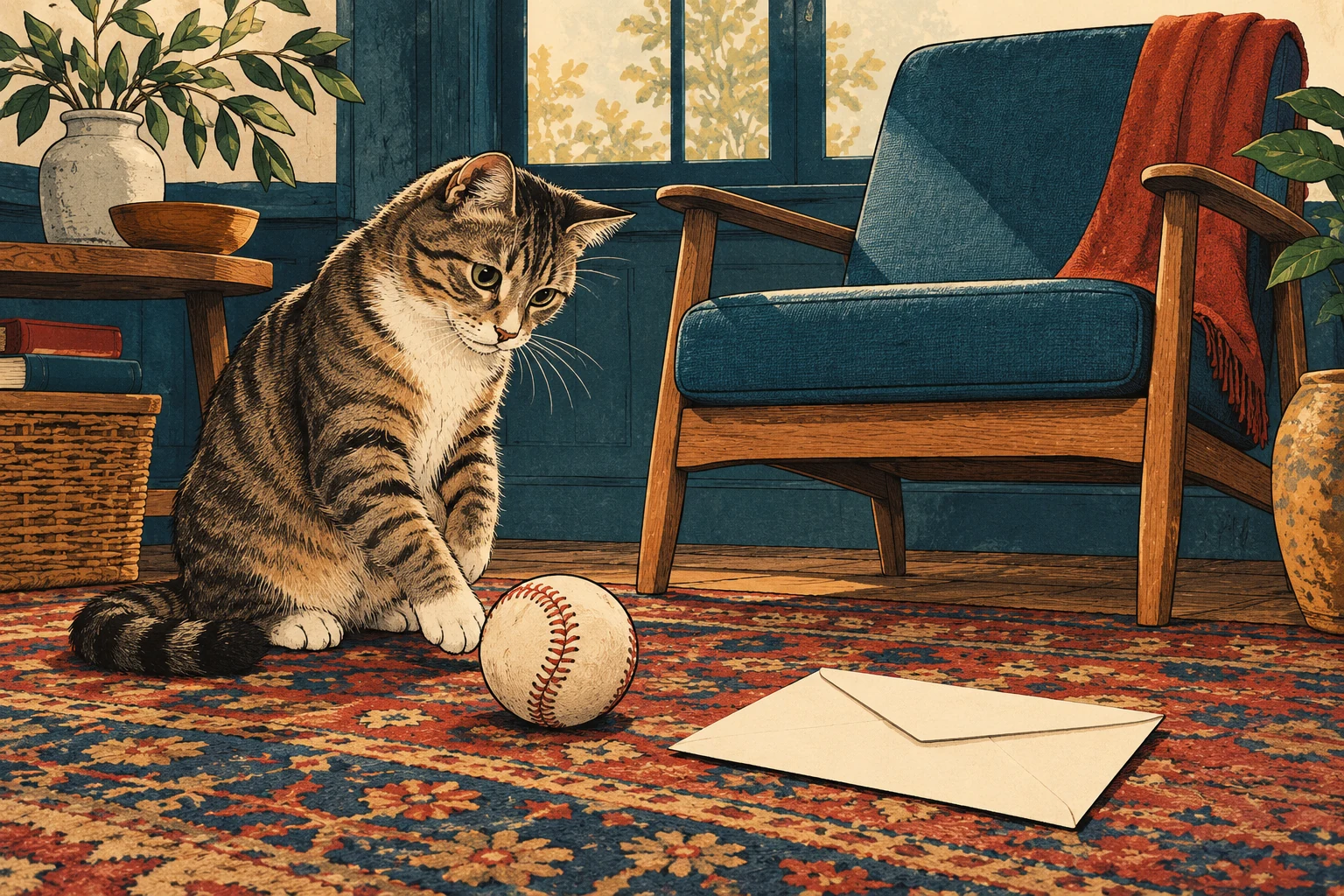
For a comic version of a cat reorganising human lives, Arthur Lubin’s Rhubarb offers a wonderfully extravagant premise. A millionaire leaves most of his fortune—including a baseball club—to his cat, and a human guardian has to manage the consequences. The film is in black and white. [8]
The players initially resent having a feline owner, then come to regard him as a source of luck. That reversal supplies a useful question alongside the ownership decision: how much of the role assigned to a cat comes from what the humans want? [8]
Its animal-peril scenes will not suit every viewer: the story includes trapping, kidnapping and attempts or threats to kill the cat. It is a comic fantasy, with no claim to be a guide to care or evidence of happiness benefits. [8] The pleasure to look for is the spectacle of human plans having to make room for an animal who has acquired an absurd amount of importance.
References
- Patricia Pendry and Jaymie L. Vandagriff, ‘Animal Visitation Program (AVP) Reduces Cortisol Levels of University Students: A Randomized Controlled Trial’, AERA Open 5(2), 2019.
- Michael W. Gmeiner and Adelina Gschwandtner, ‘The Value of Pets: The Quantifiable Impact of Pets on Life Satisfaction’, Social Indicators Research 178, 185–223, 2025.
- Maxim Ananyev, Ferdi Botha, Natalia Lamberova and Kyle Peyton, ‘The Causal Effect of Pet Ownership on Health and Well-being’, Applied Research in Quality of Life 21, 781–795, 2026.
- Camilla Haywood, Lucia Ripari, Jo Puzzo, Rachel Foreman-Worsley and Lauren R. Finka, ‘Providing Humans With Practical, Best Practice Handling Guidelines During Human-Cat Interactions Increases Cats’ Affiliative Behaviour and Reduces Aggression and Signs of Conflict’, Frontiers in Veterinary Science 8, 714143, 2021.
- PDSA, ‘The cost of owning a cat’. UK minimum estimates calculated in 2024; page checked 2 October 2026.
- Cats Protection, ‘Elderly cats’, care and end-of-life guidance.
- Cats Protection, ‘Grief and loss’.
- American Film Institute, Rhubarb (1951), AFI Catalog, credits, physical properties and synopsis.
For the next unexpected question, follow the Journal in your RSS reader.
On screen
Films discussed
- Rhubarb (1951) · Arthur Lubin
Further reading
Read next in the Journal


Want a recommendation shaped around your evening? Ask Momo what to watch next →