See Films Differently Momo Notices
How Do Holes in Jacquard Cards Become a Woven Pattern?
How punched cards select raised warp threads and turn successive crossings into a woven pattern, with a detour to The Man in the White Suit.
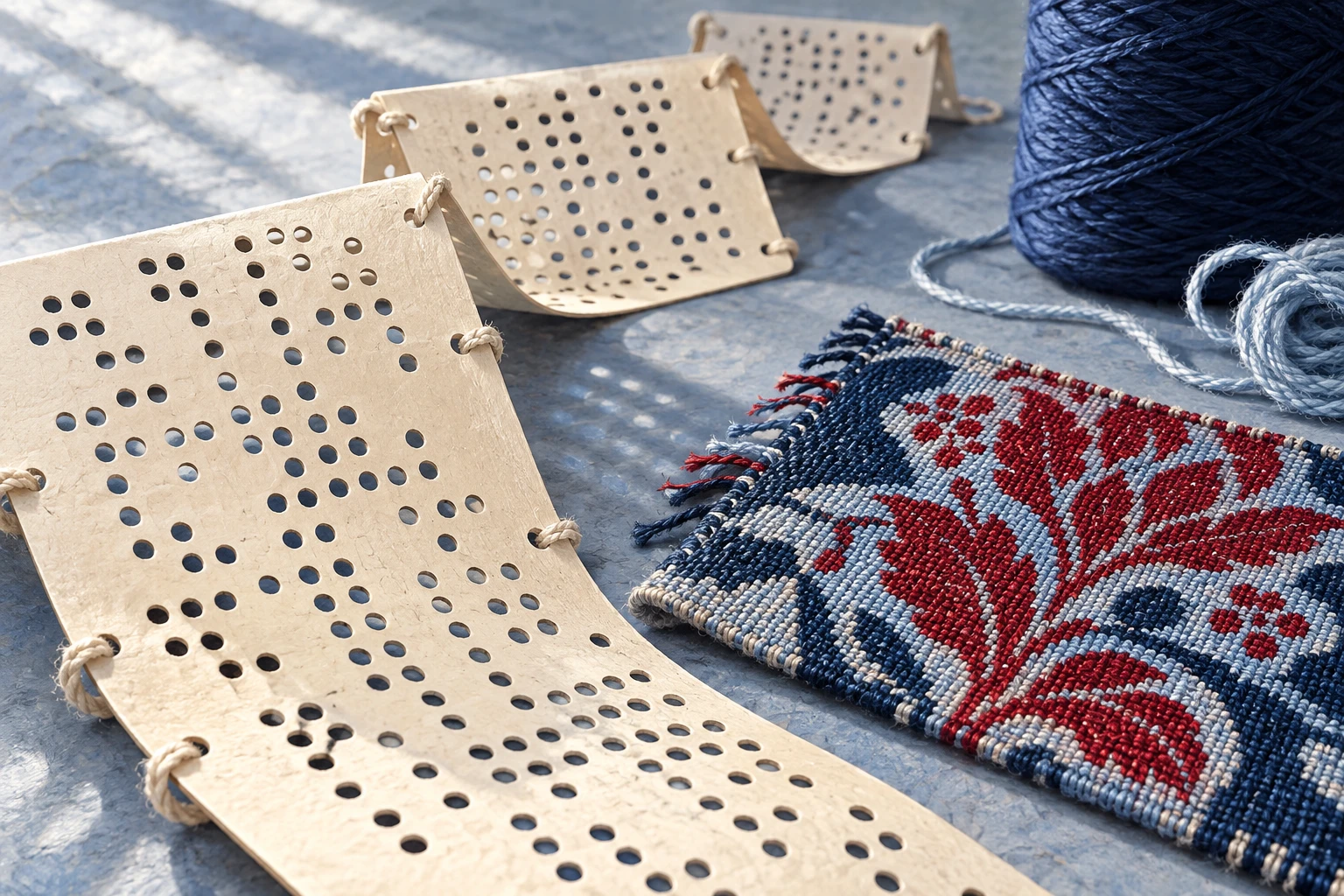
The holes help select which threads rise. The pattern appears as another thread passes between the raised and unraised ones, crossing them in the instructed order. [1]
That’s the short answer. I’d like us to follow one crossing before we admire the whole flower.
A woven fabric has two crossing sets of threads: warp and weft. The weft passes over some warp threads and under others. Change that order across successive passes and you change the interlacing that makes the pattern. [1] The hole in the card is a choice about that crossing, rather than a little window through which a picture is printed.
What the card allows to move
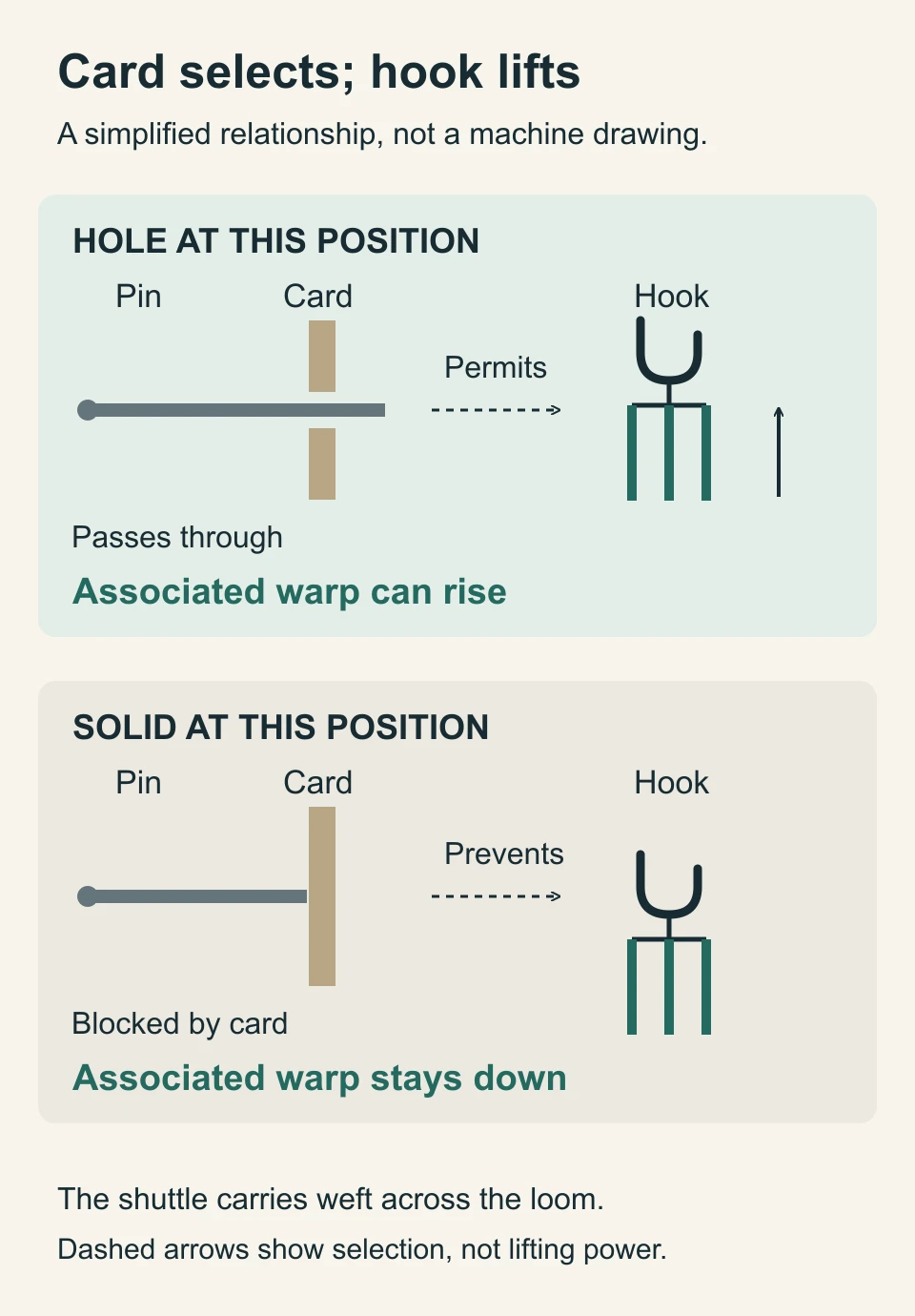
The Science and Industry Museum describes a Jacquard mechanism fitted above the loom. A card is presented to a set of pins. Where there’s a hole, a pin can pass through; the corresponding hook is allowed to raise its associated warp threads. Where the card is solid, it pushes against the pin and prevents the corresponding hook from raising its threads. [2]
The shuttle carries the weft across: underneath the raised warp threads and above those left down. [2] You can see why selecting the raised threads matters. It changes which thread lies over the other at each crossing.
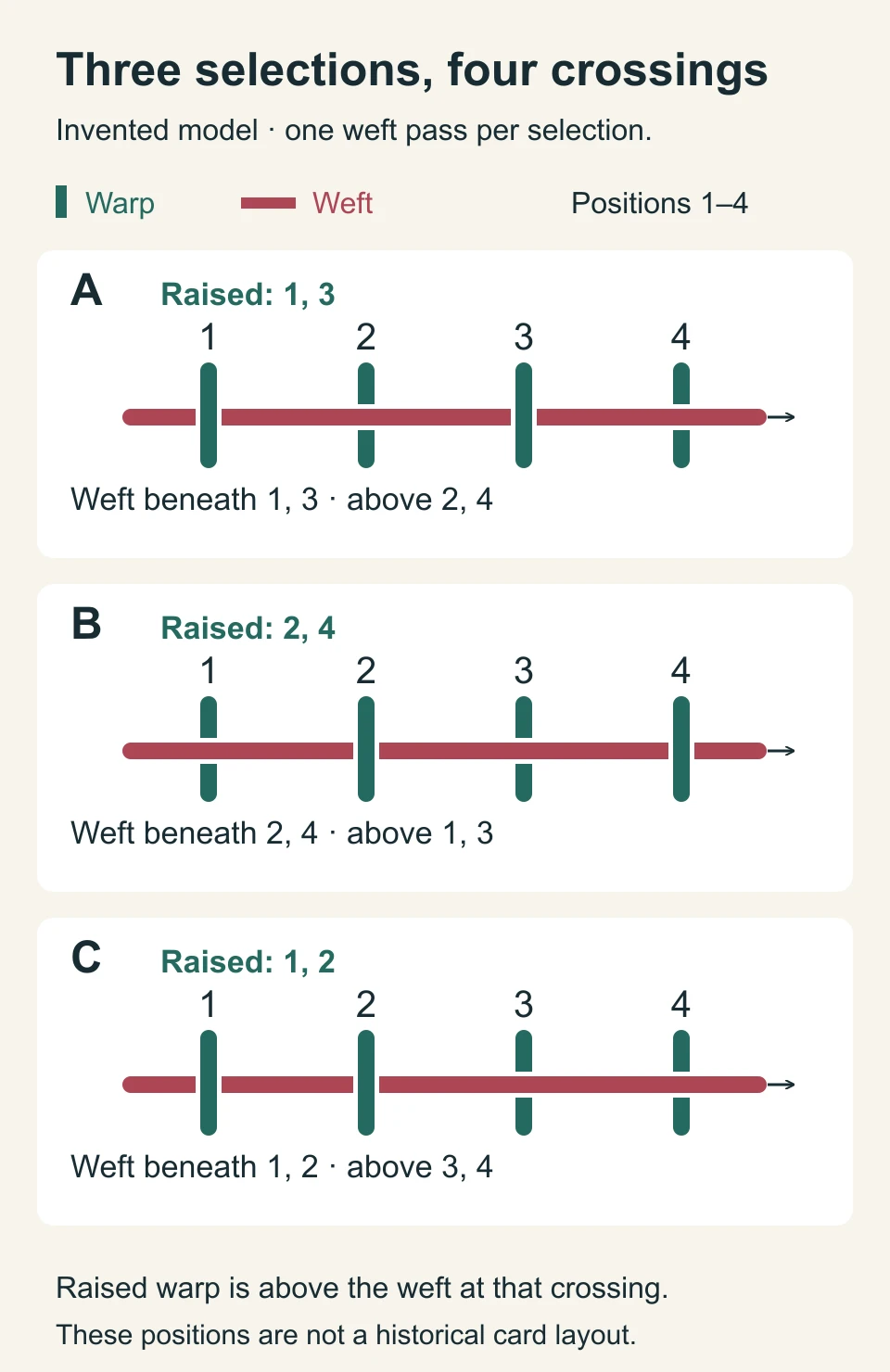
Let’s shrink that to four warp positions. These are invented selections to make the relationship visible, not a reproduction of a historical card’s layout.
| Selection | Warp positions raised | Weft passes beneath | Weft passes above |
|---|---|---|---|
| A | 1 and 3 | 1 and 3 | 2 and 4 |
| B | 2 and 4 | 2 and 4 | 1 and 3 |
| C | 1 and 2 | 1 and 2 | 3 and 4 |
Moving from A to B reverses the over-and-under order at all four positions. C gives a different arrangement. A single selection tells us what happens on one pass; the order of the selections tells us how those crossings develop through the cloth.
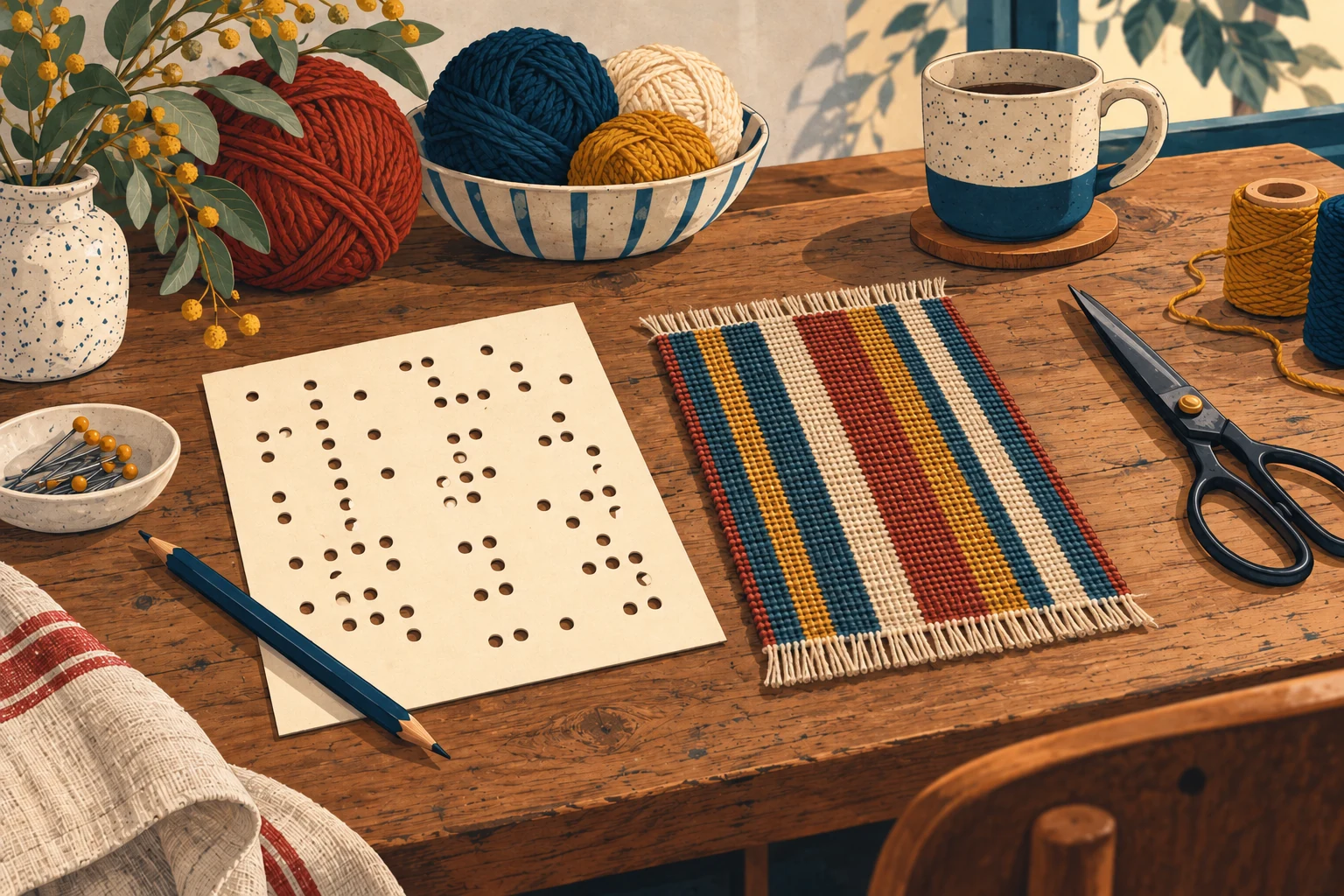
The working mechanism described by the museum receives a sequence of cards laced together. A designer’s drawing on squared paper is translated row by row into the punched sequence. [2] The finished flower requires choices made across many passes. One particularly artistic hole won’t do it.
The loom and the head have different jobs
‘Jacquard loom’ names an arrangement whose parts are worth separating. The Science Museum Group holds a ribbon loom made around 1900 by T. F. Wilkinson & Co. in Coventry, fitted with a Jacquard head made by J. McMurdo Ltd in Manchester. It was used at Cash’s ribbon manufacturers. [1]
The loom does the weaving; the head supplies the pattern selections. If you look only at the card chain, you’ve found an important part of the apparatus. You haven’t yet accounted for the shuttle carrying yarn through it.
That division also explains the attraction of interchangeable instructions. The cards can specify a sequence of choices without being the material woven into the cloth. Cardboard gives directions; yarn takes the crossings.
A short computing connection
There is a documented connection to computing. The Science Museum describes Charles Babbage’s proposed Analytical Engine as programmable through punched cards, drawing on the technique used in Jacquard weaving. Its design also included a store for numbers and a separate ‘mill’ for arithmetic. The complete engine was never built in his lifetime. [3]
The useful connection here is control through prepared instructions. The calculating machine required its own design and operations. We can follow that particular borrowing without turning every loom into a computer waiting to happen.
Now I’d like to change the cloth
Alexander Mackendrick’s black-and-white comedy The Man in the White Suit (1951) offers a rather different textile invention. Sidney Stratton develops a fabric that never gets dirty or wears out. Manufacturers and unions try to suppress it. [4][5]
I’m taking us from the pattern to the material. Jacquard selection governs the crossings we have just followed. Sidney’s promised breakthrough concerns what the cloth will endure. A new card sequence and an everlasting suit solve different problems.
I rather like the inconvenience of that premise. A fabric can sound marvellous to its wearer and alarming to the people whose business depends on replacing it. The film gives that disagreement to both sides of the factory hierarchy. [5] No Jacquard machine needs to appear on screen for the comparison to work.
For our card-operated loom, the question remains pleasingly concrete: which warp threads rise on the next pass? The flower grows out of those successive decisions. I shall leave the everlasting trousers to Sidney; we’ve enough to follow in a small piece of patterned cloth.
References
- Science Museum Group. ‘Ribbon Loom with Jacquard Head.’ Collection object Y1969.42, circa 1900. Collection record.
- Science and Industry Museum. ‘Programming Patterns: The Story of the Jacquard Loom.’ ‘Punch cards weaving patterns’ and ‘Step by step: how a Jacquard loom works.’ Museum explanation.
- Science Museum. ‘Charles Babbage’s Difference Engines and the Science Museum.’ Section ‘The Analytical Engine.’ Museum account.
- Harvard Film Archive. ‘The Man in the White Suit.’ Programme for 5–6 July 2004. Credits and black-and-white format.
- British Film Institute. ‘The Man in the White Suit (Blu-ray).’ Film premise and credits. Used for film information, not current price or availability.
For the next unexpected question, follow the Journal in your RSS reader.
On screen
Films discussed
- The Man in the White Suit (1951) · Alexander Mackendrick
Further reading
Read next in the Journal


Want a recommendation shaped around your evening? Ask Momo what to watch next →