See Films Differently Momo Notices
What Do the 17 Wallpaper Groups Actually Classify?
The 17 wallpaper groups classify repeating pattern symmetries. Separate that question from manufacture and placement, then visit The Haunting.
The V&A’s history of wallpaper includes Chinese papers painted as large, non-repeating scenes. Each set was composed individually. [1] They belong quite comfortably in a wallpaper collection, despite declining to repeat themselves.
That is a useful place to begin with the famous number 17. The International Union of Crystallography calls the symmetries of a two-dimensional crystal pattern its plane group, also known as a wallpaper group. [2] There are 17 symmetry types for these repeating plane patterns. [3] This does not count every kind of paper you could put on a wall.
To use the number properly, we need to separate three questions: how a paper was made, where it was used, and what its pattern does when we move it.
What stays the same when the pattern moves?
For the mathematical question, imagine a flat pattern extending indefinitely. It repeats in two independent directions: you can reach another copy by moving across the pattern, and another by moving in a direction that is not parallel to the first. The directions need not meet at right angles. [3]
A symmetry is a movement that leaves the whole pattern looking exactly as it did before. Four operations are relevant here:
- Translation: slide the pattern without turning it.
- Rotation: turn it around a point.
- Reflection: reverse it across a line, as in a mirror.
- Glide reflection: reflect it across a line and slide it along that line. [3]
The word whole matters. A single flower may look balanced while the spacing or orientation of neighbouring flowers prevents the whole arrangement from sharing that symmetry.
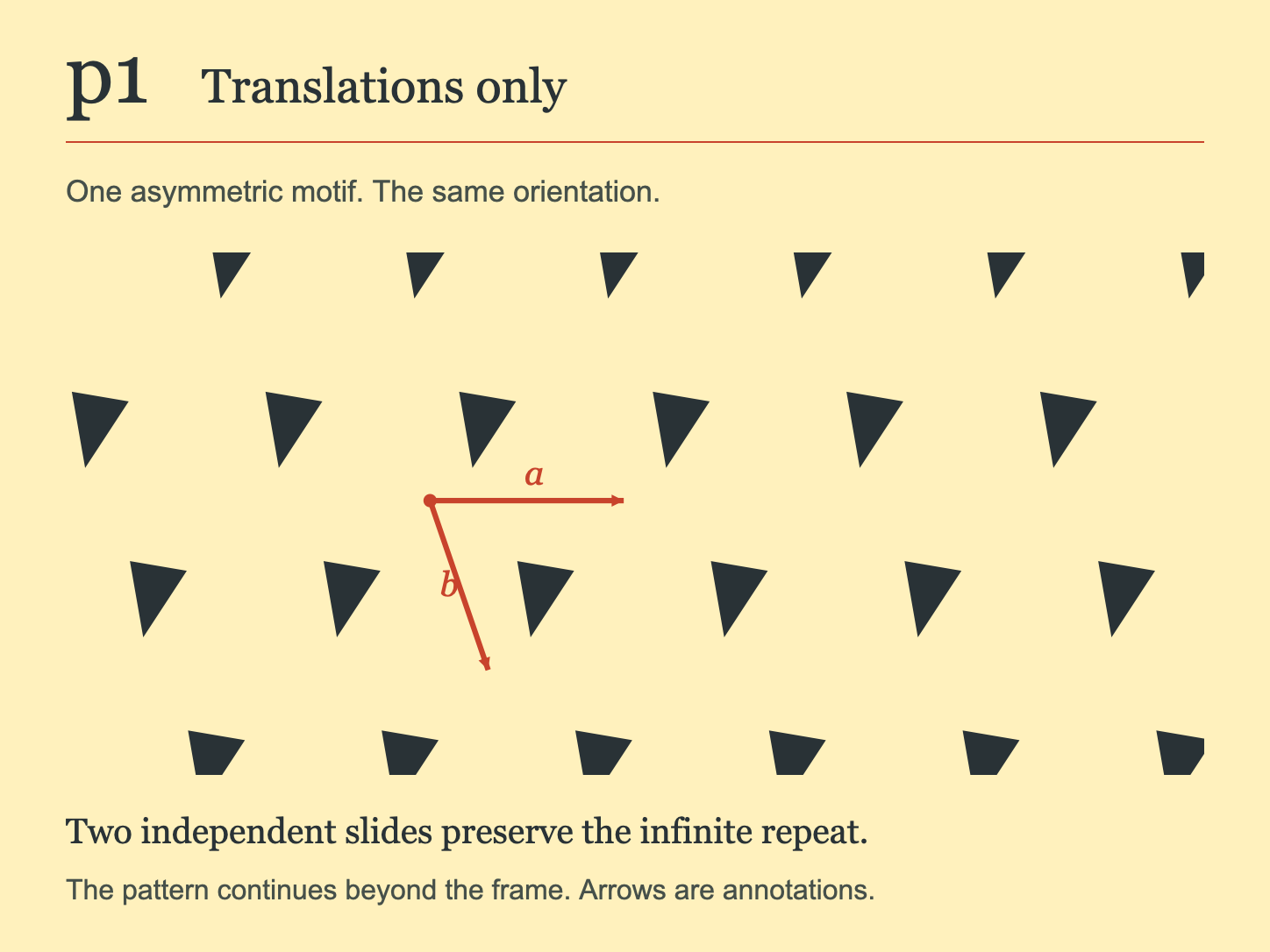
The simplest wallpaper group, p1, has translations alone. [4] You can imagine copies of a deliberately asymmetrical motif, all facing the same way in regular rows. Repetition has arrived; mirror symmetry has not been invited.
John Baez’s mathematical introduction contrasts a repeated asymmetric letter with a repeated letter that has mirror symmetry. The change affects the symmetry group even though both arrangements remain rows of letters. [4] The classification pays attention to what transformations work, rather than simply naming the subject of the decoration.
Why 17 is a complete count within that question
The 17 groups describe the possible symmetry types under those periodic plane-pattern conditions. Istvan Hargittai’s IUCr account discusses Pólya’s 1924 enumeration and its connection to repeated ornament, including wallpaper, fabrics and parquetry. [5]
This is a mathematical classification, not a survey that stopped after its seventeenth attractive sample. Its completeness belongs to its defined conditions. An individually composed landscape does not become an eighteenth wallpaper group just because a decorator hangs it beside a repeating design.
Nor does belonging to one group make two designs interchangeable. The symmetry type leaves plenty of room for differences in motifs, scale and appearance. Baez’s introduction makes the broader point that symmetry groups capture only part of what is interesting about a tiling. [4]
If you want to explore the groups visually, the UCL-hosted Wallpaper Groups Explorer offers a group selector and controls for displaying unit cells and symmetries. [6] A moving example is a kinder introduction than seventeen unexplained codes.
A wallpaper can answer several classification questions
The V&A describes wooden blocks used to print designs, rollers used in machine printing, flock made with powdered wool, and individually painted Chinese scenes. It also explains the Victorian arrangement of papers into a lower dado, central filling and upper frieze. [1]
Those descriptions concern different features:
| Question | The kind of answer it asks for |
|---|---|
| How was the design applied? | A printing or painting process |
| What gives the surface its character? | Materials and finish |
| What does the design depict? | Motifs or a pictorial scene |
| Where was the paper placed? | Its position within a room’s decorative scheme |
| Which movements preserve the repeating pattern? | Its mathematical symmetry |
These are useful questions about the same object, rather than competing lists from which we must choose a winner. Knowing the symmetry does not tell us which printing equipment made it. Knowing its position above a chair rail does not establish its symmetry.
For an actual wall, there is a further practical distinction. A room has edges, doors, corners and interruptions; the mathematical pattern is idealised as continuing indefinitely. When examining a repeating design, we are considering that underlying repeat, rather than requiring the entire furnished room to survive a translation unchanged. The sofa would make a very determined objection.
Momo visits a house with less reassuring geometry
From wallpaper to unsettling interiors is a short walk. I suggest taking it with Robert Wise’s black-and-white The Haunting (1963). [7] Please leave the measuring tape somewhere you can find it again.
George E. Turner’s production account in American Cinematographer describes Elliott Scott’s crowded interior sets, with heavy furniture, large doors and dense detail. It also records Wise wanting a wider lens to make the hallways look long and dark, and accepting the distortion of an experimental 28mm lens. [8]
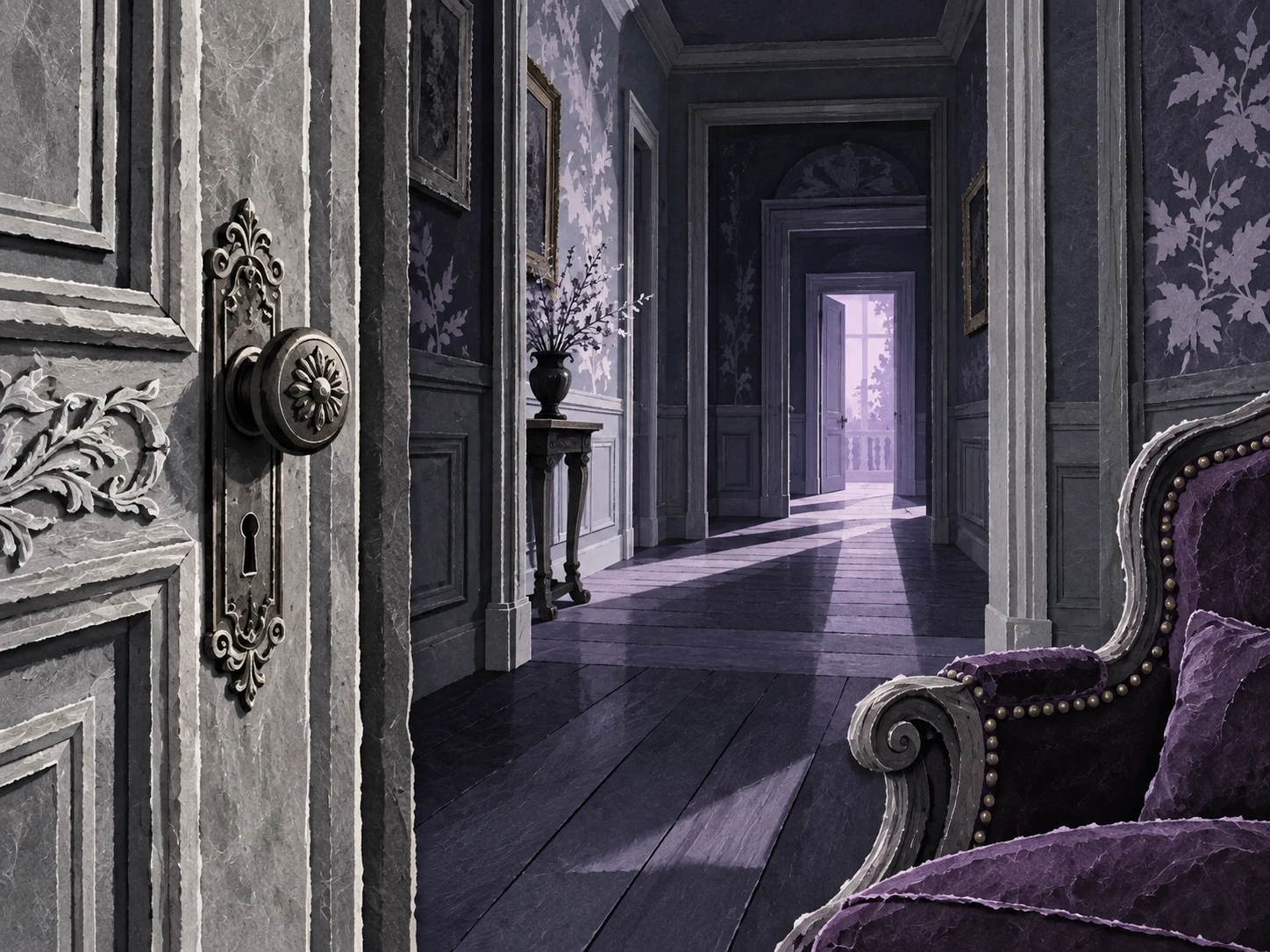
That gives us a different question about space: how does a room reach the viewer through a camera? Pattern, furnishings and the way the space is photographed can all become things to notice. A mathematically classifiable repeat would tell us only one part of that story.
This is Momo’s association, not an identification of the film’s wallpaper groups. I would watch how the frame presents the room: what repeats, what seems orderly, and what happens to that impression as the viewpoint changes. Hill House is unlikely to reward you with a tidy specimen label.
Then take the question back to an ordinary wall. Find one repeated motif and ask which slide, turn or reflection would actually preserve the pattern around it. “Floral” tells you what you are looking at. This asks how it is arranged.
References & Further Reading
The mathematical sources establish the scope of wallpaper groups; this introduction does not reproduce a proof or classify a historical object. Manufacturing and placement examples come from the V&A. The imagined motif and viewing questions are editorial examples. Film details are attributed to the production account, rather than a newly performed shot analysis.
- Victoria and Albert Museum, ‘A Brief History of Wallpaper’, updated 17 April 2024. Sections on manufacture, flock, Chinese papers, machine printing and the frieze–filling–dado scheme.
- International Union of Crystallography, ‘Space Group’, Online Dictionary of Crystallography. Defines a two-dimensional crystal pattern’s plane group, also called a wallpaper group.
- Ash Lightfoot, The Seventeen Wallpaper Groups, University of Canterbury, MATH305 Summer Research Project, 9 February 2007, pp. 1–2, definitions 2.1–2.9. Used for the plane-pattern conditions and symmetry operations; no claim of a new proof is made here.
- John Baez, ‘This Week’s Finds in Mathematical Physics (Week 267)’, 23 July 2008, University of California, Riverside. Introductory examples of p1, added reflection symmetry and the limits of what symmetry groups describe.
- Istvan Hargittai, ‘Appeal of Symmetry’, International Union of Crystallography, ‘Pólya and Escher’ section. Institutional historical discussion of the 17 plane symmetry groups and Pólya’s 1924 paper; the original paper has not been independently read for this article.
- Wallpaper Groups Explorer, UCL-hosted Group Theory Visualisations. Interface description checked 2 October 2026; linked for further exploration, not presented as a fully tested classification tool.
- British Film Institute, The Haunting (1963), film record. Year and Robert Wise’s director credit; black-and-white format is documented separately in reference 8.
- George E. Turner, ‘Elegant Chills: The Haunting’, American Cinematographer, online 13 November 2018; originally published August 1999. Black-and-white production, Scott’s sets and Wise’s account of the experimental wide-angle lens.
For the next unexpected question, follow the Journal in your RSS reader.
On screen
Films discussed
- The Haunting (1963) · Robert Wise
Further reading
Read next in the Journal
Want a recommendation shaped around your evening? Ask Momo what to watch next →