See Films Differently Film craft
How The Wizard of Oz Turned Colour into a Doorway
Why does The Wizard of Oz change from sepia to colour? See how the doorway shot worked, why the film saves Technicolor for Oz, and what it changes.
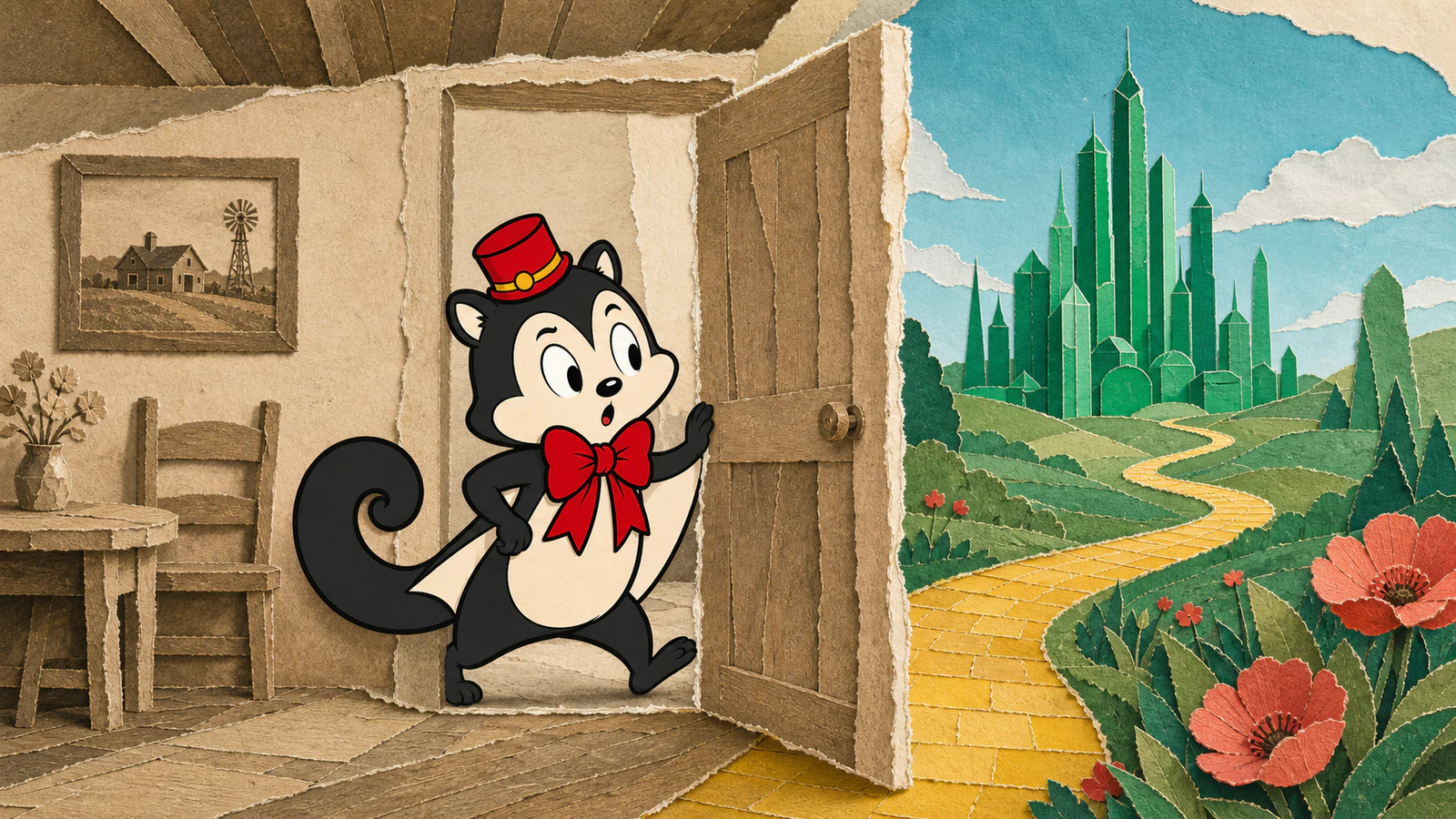
The famous change in The Wizard of Oz is often described as a switch from black-and-white to colour.
That is close, but not quite the whole trick.
Kansas appears in warm sepia rather than plain grey. Oz was photographed with a three-strip Technicolor camera. And the moment Dorothy opens the farmhouse door was designed so that colour does not merely begin after a cut. It appears inside the same shot, waiting on the other side.
The film did not simply add colour to make Oz prettier. It turned colour into a border between two worlds—and made Dorothy cross that border in front of us.
Were Colour Films Possible in 1939?
Yes. The Wizard of Oz was spectacular, but it was not the first colour film.
Filmmakers had experimented with hand-colouring, tinting and several mechanical colour systems for decades. Technicolor introduced its three-colour camera in 1932, and Becky Sharp became the first full-length feature made entirely with the three-strip process in 1935. By the end of the 1930s, colour was becoming a major selling point for Hollywood. [1] [2]
It was still difficult and expensive. The cameras were large, scarce and noisy enough to require soundproof housing. Technicolor photography also demanded intense lighting. Library of Congress production photographs show banks of lamps around the Oz sets; under them, actors in heavy costumes worked in uncomfortable heat. [3]
Colour was possible. It was not easy.
How Three-Strip Technicolor Recorded Colour
The name makes the basic idea sound more complicated than it is.
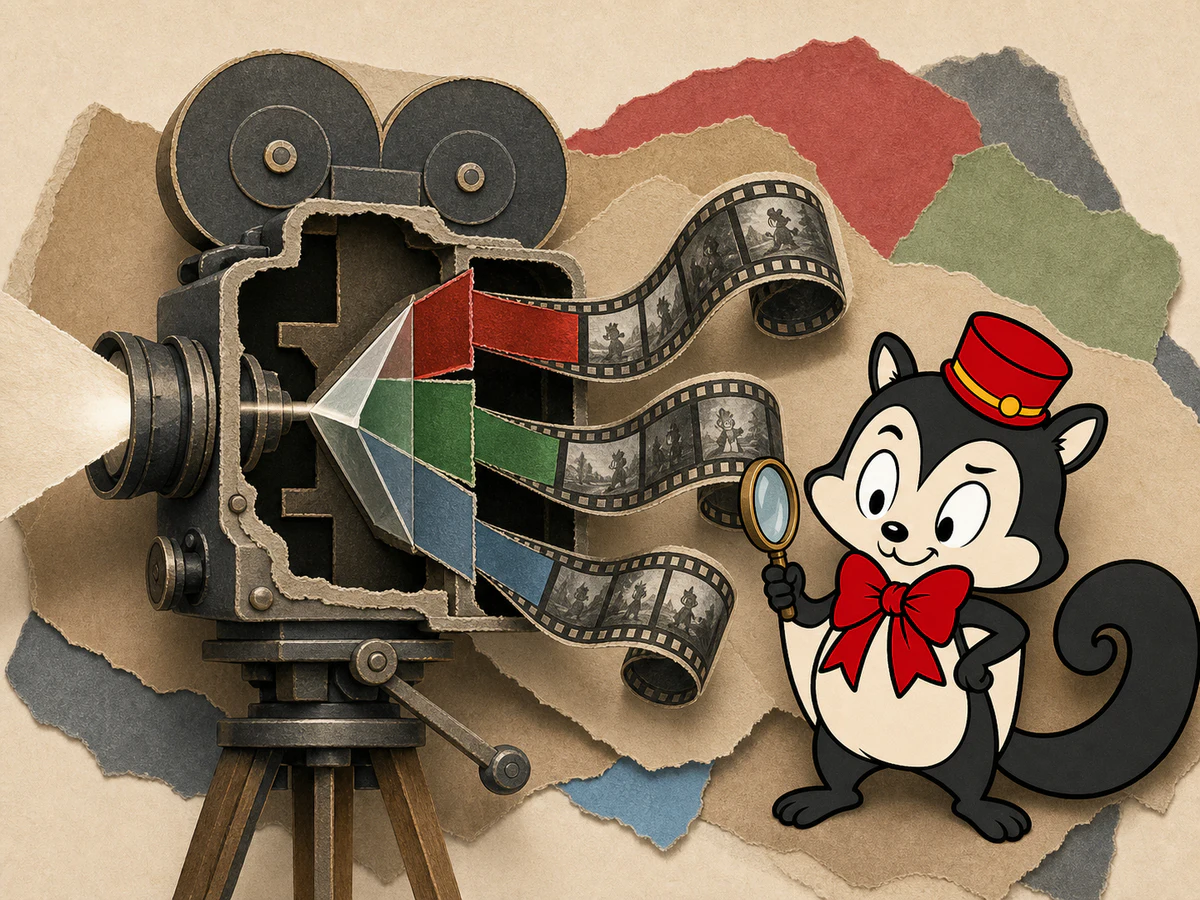
Light entered the camera through one lens. A prism then divided it so that three separate black-and-white film strips recorded different parts of the colour information: one record for green, with the other two capturing blue and red information. [1]
Those three records could later be used to make printing matrices. Dyes were transferred onto the release print in layers, rebuilding a full-colour image. The vivid result came from the dyes in the printing process; the camera negatives themselves were black-and-white separation records. [4]
So the film was not “coloured in” like a colouring book after ordinary photography. Colour was planned in the lighting, costumes, make-up, sets, camera system and printing process from the beginning.
That planning is why the yellow brick road, green Emerald City and ruby slippers feel less like isolated coloured objects than parts of one complete world.
The Doorway Trick
The smartest use of the technology lasts only a few seconds.
Dorothy walks through the damaged farmhouse and opens the front door. The interior behind her still appears to belong to sepia Kansas. Through the doorway, Munchkinland is suddenly visible in colour.
The illusion was practical. For the doorway setup, the farmhouse interior and a stand-in for Judy Garland were prepared in sepia-like shades. The stand-in opens the door and moves out of frame; Garland, now in her blue costume, enters and walks into Oz. Film historian John Fricke describes that substitution, while AFI’s production record also notes hand-colouring in the transition frames. [5]
The result matters more than the hidden substitution. The film does not cut from one finished world to another. It briefly shows both at once.
Kansas becomes a room. Oz becomes the view through an open door.
And Dorothy is the person who crosses between them.
Why Keep Kansas in Sepia?
MGM could have presented the entire story in Technicolor. By 1939, colour itself attracted audiences, and lavish fantasy was exactly the kind of production that could advertise the process.
Using less colour made the colour more powerful.
Kansas is dusty, pressured and ordinary. Dorothy loves her family, but she also feels unheard and trapped. The song “Over the Rainbow” gives that feeling a visible direction. Lyricist E. Y. Harburg later described the rainbow as the only colourful thing Dorothy had seen, a symbol that helped motivate the move from sepia into Technicolor when she reached Oz. [6]
This means the first burst of colour is not only a technical demonstration. It is Dorothy’s wish becoming visible.
Had Kansas already been richly coloured, Oz would still have looked unusual. It would not have felt like such a complete release from the life she wanted to escape.
The film spends its brightest resource at the exact moment the story opens.
Colour Changed the Props Too
In L. Frank Baum’s book, Dorothy’s slippers are silver. The film made them ruby.
The change gave Technicolor another memorable contrast. Red shoes could stand out against the yellow road and the greens of Oz in a way silver might not. AFI describes the ruby version as more magical in Technicolor. [7]
That is a small example of a larger change. Once a film is designed around colour, colour is not simply attached to objects. It helps decide which objects the audience remembers.
Remove the red from the slippers and they remain important to the plot. They lose part of their instant visual identity.
The same is true of Oz itself. The Emerald City is not merely named as green; the film can surround Dorothy with green. The yellow road does not merely guide her; it draws a continuous line through the landscape. Colour turns directions, dangers and destinations into things we recognise before anyone explains them.

What the Colour Change Does to the Story
Here is the most interesting part: the film does not say that the colourful world is the better world.
Oz is more exciting than Kansas. It is also full of false promises, frightening disguises and people who believe they need gifts from an impressive stranger. Its colour makes desire immediate, but it does not make every appearance trustworthy.
The Wizard’s spectacle is the clearest example. He looks powerful because he controls an image, a voice and a room. Once the machinery is exposed, the appearance loses its authority.
The Scarecrow, Tin Man and Lion face a similar problem. They imagine intelligence, love and courage as qualities that someone else can add to them. The journey reveals that their actions have already displayed those qualities.
Colour therefore performs two jobs at once.
First, it makes Dorothy’s wish irresistible. Then it places her inside a world where irresistible appearances keep proving incomplete.
That is why returning to sepia does not simply feel like losing the “better” image. Dorothy chooses a less spectacular place after learning that spectacle cannot tell her where she belongs.
Colour as a Door, Not Decoration
The simplest way to understand the achievement is this:
The film does not use colour to describe Oz. It uses colour to make entering Oz an event.
We see the new world before Dorothy steps into it. For a moment, the doorframe becomes a cinema screen inside the cinema screen: a bright rectangle offering another reality.
Then Dorothy walks through it, and the colour surrounds us too.
Three-strip Technicolor made that image possible. The decision to withhold colour from Kansas made it meaningful. The story then spends the rest of its running time asking whether the most beautiful-looking world is necessarily the place one should stay.
That is what changed when The Wizard of Oz used colour. It did more than show audiences new hues. It gave the story a threshold they could see.
References
- George Eastman Museum, ‘Three-Strip Camera’ (accessed 23 August 2026).
- George Eastman Museum, ‘Technicolor, 1935–1955’ (accessed 23 August 2026).
- Library of Congress, ‘To See the Wizard’, The Wizard of Oz: An American Fairy Tale exhibition.
- George E. Turner, ‘Behind the Curtain: The Wizard of Oz’, American Cinematographer, originally published December 1998.
- American Film Institute, ‘The Wizard of Oz’, AFI Catalog of Feature Films; and Ruthie Fierberg with John Fricke, ‘17 Secret Moments to Watch For in The Wizard of Oz’, Playbill, 25 May 2018.
- Library of Congress, ‘National Recording Registry Picks Are “Over the Rainbow”’, 29 March 2017.
- American Film Institute, ‘AFI Movie Club: The Wizard of Oz’, 13 May 2020.
On screen
Films discussed
- The Wizard of Oz (1939) · Victor Fleming
Want a recommendation shaped around your evening? Ask Momo what to watch next →