See Films Differently Momo Notices
I Know I Like It. I Just Don’t Know How to Explain It.
Liking a film and explaining it ask different things: jam and poster studies, a Hulot misunderstanding and a way to start describing what caught you.

Liking something, noticing what caught you and explaining your response ask different things of you. A jam tasting, a choice of posters and Monsieur Hulot offer a way to untangle them.
“I liked it” tells someone where you stand. It gives them very little to stand beside.
Ask what you liked about a film, and you might have an answer immediately: the way two people kept interrupting each other, perhaps. Or you might reach for “the atmosphere”, then realise you would struggle to say what made it. The pleasure seemed quite definite. The sentence is still wandering about.
I’d separate three jobs here. Having a response; noticing features connected with it; putting those features into words another person can use. You can manage one before you manage the next. A halting description gives us something to investigate. It needn’t turn your enjoyment into a doubtful witness.
There is a further complication. Asking for a reason may sometimes help produce a new evaluation, rather than simply recover the old one.
The jam tasted different on paper
In a 1991 study by Timothy D. Wilson and Jonathan W. Schooler, 49 undergraduates tasted five strawberry jams. Some were asked to write reasons for liking or disliking them; a control group tasted and evaluated them without that request. Everyone eventually rated their liking. The reasons group’s ratings corresponded less closely to rankings by trained taste experts.
That last measure matters. Agreement with experts was the researchers’ criterion of quality. It doesn’t establish that a particular student was wrong to prefer a particular jam. Nor were the students choosing jars to take home.
The authors proposed that asking for reasons could shift attention towards features that were easy to put into words, changing the weight those features received. They also explicitly rejected the conclusion that reflection always produces worse decisions. Their experiments involved brief reflection; a more thorough analysis could have different effects.
So I’d resist turning this into a rule against thinking. The useful question is narrower: am I describing what mattered to me, or giving extra weight to what I can readily describe?

A poster you have to live with
An expert’s opinion cannot settle whether you’ll enjoy something on your own wall. A 1993 experiment by Wilson and five colleagues used a more personal outcome.
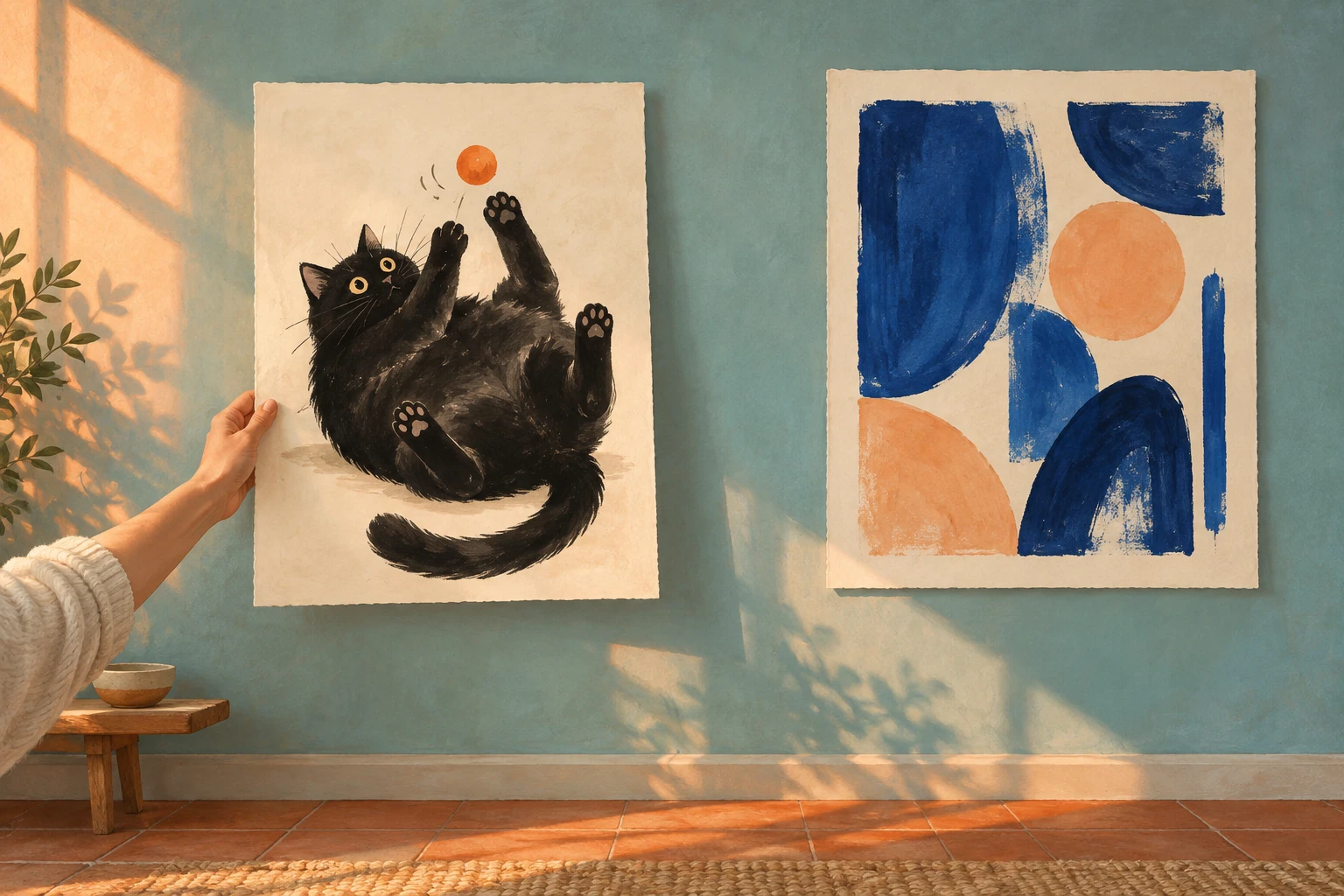
Forty-three female undergraduates evaluated posters, including reproductions of paintings and humorous pictures with cats. They were randomly assigned either to write reasons for their reactions or to answer unrelated background questions. Afterwards, each could choose a poster to take home. The reasons group was more likely to choose a humorous poster, and at follow-up was less satisfied with its choices on the study’s combined measure.
The authors suggested that verbalising reasons had temporarily changed how participants evaluated the posters. They acknowledged that the proposed return to an earlier evaluation needed more direct verification: the study hadn’t measured attitudes before the reasons task.
This small experiment doesn’t tell us that humorous posters are inferior, or that explaining a film will spoil it. The cat is not on trial. It does give us a reason to be cautious about treating a newly fluent explanation as a transparent account of an earlier response.
Hulot has arrived without an abstract
Jacques Tati’s Monsieur Hulot’s Holiday (1953) is a black-and-white sound comedy about a seaside holidaymaker whose presence brings comic disruption. I’d bring him into this question because a misunderstanding can be easier to enjoy than to explain well.
In his Criterion essay, David Ehrenstein describes Hulot being mistaken for a mourner at a country funeral. He also emphasises that Hulot shares the comedy with other people and their activities, rather than occupying the whole show.
Imagine that the funeral misunderstanding is what you particularly enjoy. “It’s sophisticated visual comedy” may be a perfectly reasonable judgement. But it leaves your friend guessing which part attracted you. Was it the mistaken identity? The incongruity of finding a holidaymaker in that role? Something about Hulot’s manner? These are questions to check against the film, rather than answers I can supply on your behalf.
“I liked the misunderstanding at the funeral; I’m still working out which part made it funny for me” gets us closer. It locates the pleasure while leaving its cause open. Your friend now has something specific to look for, even if they respond quite differently.
A description can be useful before it becomes a complete explanation.
Give the words another look at the thing
My suggestion is to start with a detail you can point to. If you reach for “atmosphere”, ask what was available to notice: a sound, a movement, the relation between people, a stretch when little happened. You may find several things, or discover that your first word was too broad.
Then keep the observation and your explanation distinguishable. “That was the moment I enjoyed” makes a smaller claim than “this feature caused my enjoyment”. The smaller claim can still help you describe your taste, recommend something or disagree with a friend.
Learning a useful term can help, too. So can another person pointing out a detail you missed. Neither requires you to preserve your first response for ever. You might change your mind for a good reason; you might become better at saying what you already liked.
I’d leave room for “I’m not sure yet”. It keeps the conversation moving without making every available phrase do duty as a diagnosis. Tell me which bit caught you. We can have another look from there.

References & further reading
- Timothy D. Wilson and Jonathan W. Schooler (1991), ‘Thinking Too Much: Introspection Can Reduce the Quality of Preferences and Decisions’, Journal of Personality and Social Psychology 60(2), 181–192. DOI: 10.1037/0022-3514.60.2.181. Study 1 and the limits stated in the general discussion.
- Timothy D. Wilson et al. (1993), ‘Introspecting About Reasons Can Reduce Post-Choice Satisfaction’, Personality and Social Psychology Bulletin 19(3), 331–339. DOI: 10.1177/0146167293193010. Methods, follow-up results and reservations about the proposed mechanism.
- The Criterion Collection, Monsieur Hulot’s Holiday. Synopsis, film information and edition details. The edition identified here restores Tati’s 1978 rerelease version and also includes the original 1953 version; these are distinct versions. The example above follows the published essay, without claiming a comparison between cuts.
- David Ehrenstein, ‘M. Hulot’s Holiday’, The Criterion Collection, 5 January 2004. The funeral misunderstanding and the comedy’s attention to people around Hulot.
The three-job distinction and the suggestions for talking about a film are Momo’s editorial proposal. The experiments did not test those suggestions or audiences watching Tati.
For the next unexpected question, follow the Journal in your RSS reader.
On screen
Films discussed
- Monsieur Hulot’s Holiday (1953) · Jacques Tati
Further reading
Read next in the Journal
Want a recommendation shaped around your evening? Ask Momo what to watch next →