See Films Differently What to watch next
After No Longer Human, Watch The Face of Another
Why watch The Face of Another after No Longer Human? Compare Yōzō’s clowning with Okuyama’s new face, and what each performance asks of other people.

Watch The Face of Another (1966) after No Longer Human if Yōzō’s clowning left you wondering whether a performance can bring someone closer to other people. Hiroshi Teshigahara’s black-and-white film gives that question a disturbing new form. Okuyama, whose face is injured in an industrial accident, accepts an experiment that gives him a new face modelled on a stranger’s. The film adapts a novel by Kōbō Abe. [3] [4]
The pairing becomes interesting when we ask what each man wants his performance to do. Yōzō tries to keep people laughing. Okuyama wants to discover what another face will let him ask of people who already know him.
Yōzō Makes the Family Laugh
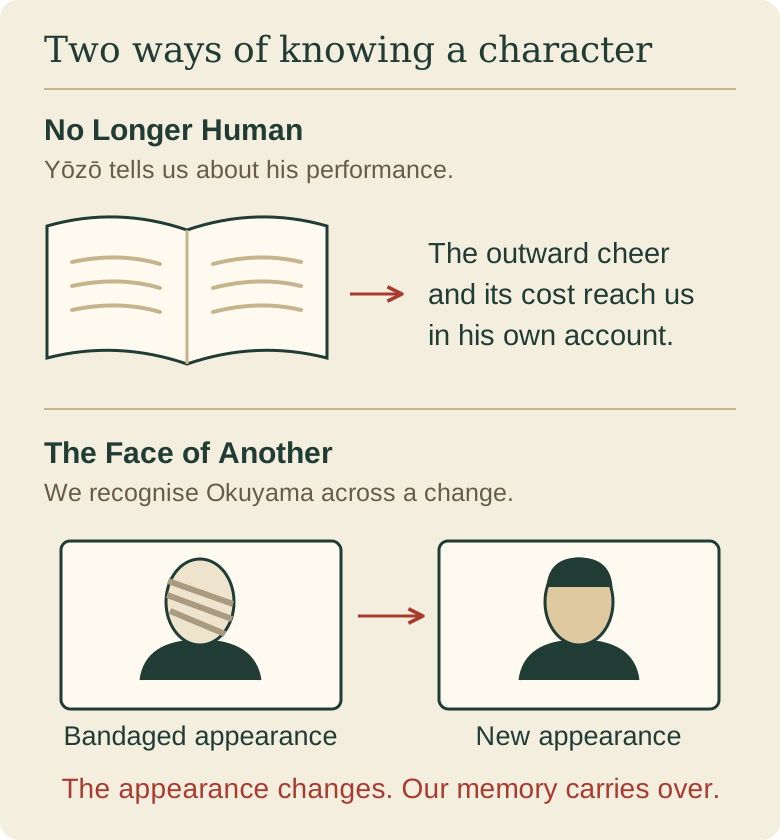
In the first notebook of Osamu Dazai’s novel, Yōzō explains that he fears other people yet cannot give up his connection to them. Clowning becomes a way to remain in their company while concealing the effort it costs him. [1]
One childhood joke makes that effort wonderfully concrete. He appears to wear a red woollen sweater beneath his summer yukata, making the family laugh at his foolishness. In fact, he has slipped his sister’s leggings over his arms to create the illusion. He has planned what they will see. [1]
The joke succeeds. Our discomfort comes from hearing how carefully the apparently carefree child has arranged it. Laughter gives him a place among the people he fears, while leaving the fear itself unspoken.
Okuyama Tries Out Another Life
For a first look at the experiment, watch Okuyama seeking accommodation. Critic James Quandt points to the repeated renting episode: Okuyama rents one apartment for his bandaged self and another for his new appearance. [4] An ordinary transaction becomes something he can try again under different conditions.
The more consequential experiment concerns his wife. Okuyama plans to approach her as another man and seduce her. Jeff Stafford’s TCM account identifies that plan as a central use of the disguise. [5] Changing his face allows him to stage an encounter within an existing marriage. It also gives him a way to imagine that he can stand outside it and inspect her response.
What the Pairing Lets Us See
Yōzō’s account places us behind a successful joke, close to the anxiety it hides. With Okuyama, we can follow someone arranging a test whose result another person will help determine. The disguise gives him a plan; it gives him much less control over what the encounter means.
The film talks through these questions as well as staging them. Quandt notes that the doctor and nurse take over some of the interior monologue of Abe’s novel. [4] Listen to those explanations, then see what happens when a carefully discussed experiment reaches someone with a history of her own.
After watching: what his wife’s answer changes · Scene spoilers
Okuyama succeeds in seducing his wife, then jealously reproaches her. She tells him that she knew he was her husband from the beginning, and leaves. The film synopsis at Eiga.com records this sequence. [6]
Her answer changes the scene we thought we understood. Okuyama has treated the encounter as a test of how she would behave with a stranger. She says that she recognised the man. What he calls betrayal therefore rests on an account of the encounter that she rejects.
I find that reversal more unsettling than the mechanics of the mask. He can change what she sees, but he cannot decide what she knows or make her experience match the one he has prepared for her. Her reply gives the apparent subject of his experiment an interpretation of her own.
That is the reason I would put this film after No Longer Human. Yōzō’s clowning asks us to feel the cost of being accepted through a performance. Okuyama’s experiment makes us attend to the person on the receiving end: someone who may recognise, answer or refuse the part he has assigned her. The two works leave us with a performance seen from different sides.
Criterion’s film page links to The Criterion Channel’s listing. Check the viewing conditions for your location and account.
References
- Osamu Dazai, Ningen Shikkaku (人間失格), Aozora Bunko, first notebook. The discussion above paraphrases the Japanese text.
- New Directions, No Longer Human, by Osamu Dazai, translated by Donald Keene. Publisher’s character description and English-edition information.
- The Criterion Collection, The Face of Another, synopsis, film information and credits.
- James Quandt, “The Face of Another: Double Vision”, The Criterion Collection, 9 July 2007. The discussion of adaptation and repeated apartment rentals supplies the film detail; the comparison with Dazai here is Monocurator’s reading.
- Jeff Stafford, “The Face of Another”, Turner Classic Movies, 13 November 2006. Okuyama’s plan to seduce his wife under the disguise.
- “Tanin no kao” (他人の顔), Eiga.com, film synopsis, accessed 8 September 2026. Used for the encounter and the wife’s account of recognising her husband; the comparison here is Monocurator’s interpretation.
For the next unexpected question, follow the Journal in your RSS reader.
On screen
Films discussed
- The Face of Another (1966) · Hiroshi Teshigahara
Further reading
Read next in the Journal
Want a recommendation shaped around your evening? Ask Momo what to watch next →