Version guide
Nosferatu: Which Film and Restoration Should You Watch?
Choose between the 1922, 1979 and 2024 Nosferatu films, then find a restoration of Murnau’s silent original by its tinting, score, subtitles and runtime.
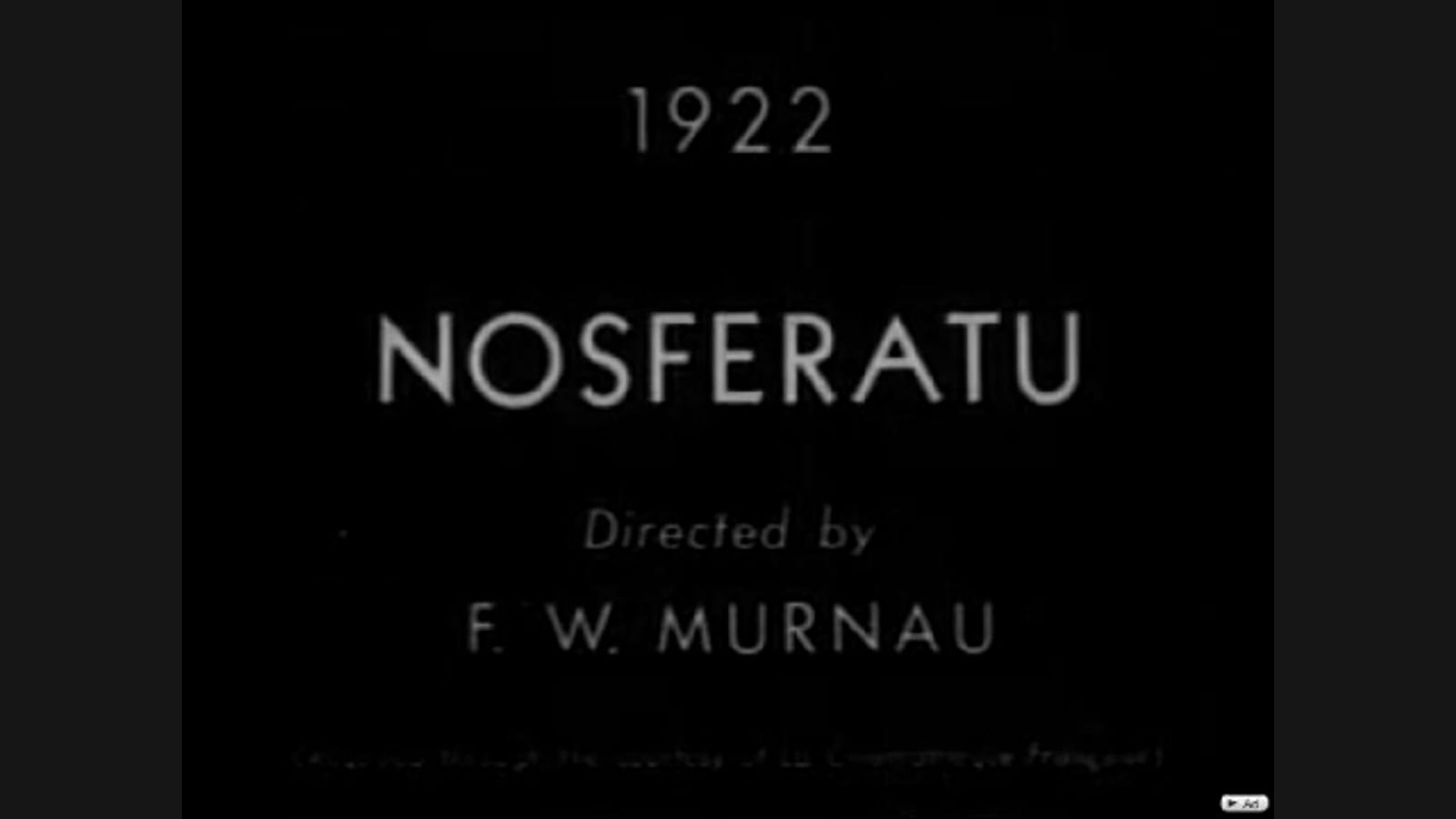
Start by choosing the film. For Gothic horror centred on a young woman and a vampire’s fixation, choose Robert Eggers’ Nosferatu (2024). For a vampire who evokes pity as well as fear, try Werner Herzog’s Nosferatu the Vampyre (1979). Choose F. W. Murnau’s Nosferatu (1922) for the silent original, where shadow, intertitles and musical accompaniment shape the threat.
If Eggers’ film brought you here, the 1922 original can be a rewarding next viewing: follow what happens to the vampire’s shadow, the spaces he enters and the rhythm of his approach when images and accompaniment carry the threat.
Choose your Nosferatu film, or jump to a restoration of the 1922 film.
Choose your Nosferatu film
Robert Eggers, 2024: the film with Bill Skarsgård
Focus Features’ official film record identifies Eggers as writer and director, with Bill Skarsgård, Lily-Rose Depp and Nicholas Hoult among its cast. Its Gothic horror centres on the obsession between a young woman and the vampire pursuing her. This is a separate production from Murnau’s film.
Nosferatu (2024): theatrical or Extended Cut?
The Extended Cut runs 3 minutes 28 seconds longer than the theatrical version in Universal’s US UHD and Blu-ray specifications. Choose the theatrical cut to see the version released in cinemas, or the Extended Cut if you want the longer home-video presentation.
| 2024 cut | UHD / Blu-ray runtime | What the label identifies |
|---|---|---|
| Theatrical | 2:12:17 | The cinema-release cut |
| Extended Cut | 2:15:45 | The longer cut released for home viewing |
Those timings belong to Universal’s February 2025 US disc release. Its DVD specification lists 2:12:25 and 2:15:53, preserving the same gap. For a digital rental or stream, check the cut named in that service’s listing; these disc timings do not establish which version a service supplies.
Universal lists deleted scenes separately from the Extended Cut among the extras. A deleted scene appearing in the bonus menu therefore does not establish that it has been restored to the feature. Look for the Extended Cut in the edition’s feature options when that is the version you want.
The restoration, intertitle and musical-accompaniment choices further down this guide concern the 1922 silent original.
Werner Herzog, 1979: the film with Klaus Kinski
Choose Nosferatu the Vampyre if you are looking for Herzog’s interpretation, with Klaus Kinski, Isabelle Adjani and Bruno Ganz. The BFI’s introduction draws attention to the pity Kinski’s vampire can evoke alongside his menace. That gives this sound-era interpretation a different point of comparison with Murnau’s original. It belongs beside Murnau’s and Eggers’ films in a viewing comparison, rather than among editions of the 1922 footage.
The BFI’s record describes an English-language presentation of the 1979 film. Check the language of the edition you are considering instead of assuming that the year and title settle that choice.
F. W. Murnau, 1922: the silent original with Max Schreck
Choose this for the original Orlok and a film built around silent images, intertitles and musical accompaniment. The Murnau Foundation’s account identifies Max Schreck and the 1922 premiere, and describes the film’s lasting use of shadow. It also records the restoration discussed below.
For a first viewing, our recommendation is the tinted 2005–06 Murnau Foundation restoration. Its restoration credit, title language and score give you a useful way to identify a copy even when sellers list slightly different running times.
Choose a restoration of the 1922 film
Best first restoration: begin with the tinted 2005–06 restoration prepared for the Friedrich-Wilhelm-Murnau-Stiftung. The Foundation’s February 2025 digital-cinema catalogue identifies its DCP at 95 minutes 4 seconds (95:04), with German intertitles, optional English and French subtitles, and Hans Erdmann’s original music reconstructed by Berndt Heller.
Use those five details together: restoration credit, tinting, intertitles, score, and runtime. Nosferatu has circulated in different prints, transfer speeds, title languages, reworkings, and score combinations. A listing at 94, 95, or 97 minutes does not by itself prove a different cut, and “the longest version” or “the HD version” is not a reliable identity test.
Why this is the best first restoration of the 1922 film
Confirmed facts: the Murnau Foundation commissioned Luciano Berriatúa’s 2005–06 restoration. Its current DCP catalogue records a tinted 95:04 presentation with the Erdmann/Heller music. Filmportal separately records a 95-minute digitised version and a 64-minute examined version. Eureka lists a 97-minute tinted home-video presentation of the Foundation restoration, while Kino lists its restored edition at 94 minutes.
Editorial judgment: Monocurator recommends the 2005–06 restoration first because its tinting, original German intertitles, and reconstructed original-release score make its historical presentation choices unusually legible. An alternative score can be an excellent second viewing, but it changes the film’s rhythm and emphasis.
The 1922 first-viewing checklist
Look for most of these identifiers:
- Film: Nosferatu – Eine Symphonie des Grauens, directed by F. W. Murnau
- Restoration: Friedrich-Wilhelm-Murnau-Stiftung, restored in 2005–06 by Luciano Berriatúa
- Runtime: around 94–97 minutes; the Foundation DCP is exactly 95:04
- Image: tinted rather than uniformly black and white
- Intertitles: original German titles, with subtitles if needed
- Music: Hans Erdmann’s 1922 score reconstructed by Berndt Heller
The Nosferatu Film page connects this recommendation to its Guide, people, related films, and evidence. It does not claim that any surviving presentation is an untouched premiere print.
The 1922 version map: tint, score and runtime
| Presentation | What changes | Runtime | How to use it |
|---|---|---|---|
| Murnau Foundation 2005–06 restoration DCP | Restored tinting and German intertitles; Erdmann score reconstructed by Heller | 95:04 | Preferred first viewing |
| Eureka home-video presentation | Foundation restoration; tinted; original German intertitles; optional English subtitles | 97 min | A distributor presentation of the restoration, not runtime proof of a new cut |
| Kino Lorber restored edition | Foundation restoration; tinted; Erdmann/Heller score | 94 min | Another distributor listing of the restoration |
| Filmportal examined version | A separately catalogued examined version | 64 min | Evidence of a shorter version, not the recommended reference presentation |
| Die zwölfte Stunde (1930) | Sound-era re-edit with changed names, added and discarded material, and recorded music | 70 min | A historical reworking, not a restoration of the 1922 release |
The Film page’s version map lists these presentations separately. The 94-, 95:04-, and 97-minute timings remain associated with the same restoration family unless a source establishes a different cut.
Tinting is not modern colourisation
Murnau photographed the film on black-and-white stock, but silent-film presentation was not necessarily colourless. The preferred restoration is tinted: whole passages carry a colour wash. That is different from assigning new colours to individual faces, costumes, or objects.
For the difference between colouring the light and dark areas of a print, see tinting versus toning.
The colour shifts help organise night, interior space, landscape, and threat. A uniformly black-and-white copy can still contain Murnau’s images, but it removes one documented element of the restored presentation. For a first viewing, do not reject the tinted version as a modern novelty.
The score is reconstructed, not a surviving recording
Hans Erdmann composed the music associated with the film’s original release. The restoration does not contain a surviving soundtrack recording from 1922. It uses Berndt Heller’s reconstruction of Erdmann’s music, performed by the Saarbrücken Radio Symphony Orchestra.
That distinction matters. A reconstructed composition can be historically grounded without being the exact sound heard in every 1922 cinema. Silent films were performed in venues, and alternative accompaniment remained part of their life.
For a first viewing, Erdmann/Heller is the clearest historical anchor. On a later viewing, another score can reveal how music redirects the same images. Score choice is a presentation difference even when the picture source is closely related.
Why the listed runtimes disagree
Silent-film duration depends on more than missing scenes. Transfer or projection speed changes the length of the same footage. Intertitles, logos, restored inserts, distributor accounting, and synchronization with a score can produce smaller differences.
The reviewed public sources do not publish a frame-per-second specification that lets us calculate every 94–97 minute variation. The safe conclusion is therefore narrow: the Foundation DCP is documented at 95:04; Eureka and Kino list presentations of the Foundation restoration at 97 and 94 minutes. Those numbers alone do not prove three cuts.
A fall to 64 or 70 minutes deserves closer inspection because the sources identify separate objects. Even then, the reason is not simply “shorter is incomplete.” Filmportal’s 64-minute entry is a separately examined version; Die zwölfte Stunde is a deliberate sound-era re-edit.
The 1930 reworking is a different object
Die zwölfte Stunde: Eine Nacht des Grauens was created in 1930 from Murnau material as a synchronized sound-film reworking. Filmportal records a 70-minute version overseen by Waldemar Ronger. Character names were changed, newly shot scenes and material discarded by Murnau were added, and recorded music was placed on the soundtrack.
That makes it useful evidence of how silent cinema was repackaged after sound arrived. It does not make it a restoration of the 1922 premiere. If an edition runs about 70 minutes, uses different character names, and has a fixed synchronized soundtrack, treat it as this later re-edit rather than the best first route into Murnau’s film.
How to settle into Murnau’s film
If silent cinema still feels unfamiliar, the Trail Silents that don’t feel like homework begins with shorter, quicker films before moving toward larger experiences. Nosferatu is not currently one of its stops, so use the Trail as preparation rather than as a claim that this film is included.
Once the film begins, let the tint changes and music orient you before trying to decode every title card. Watch thresholds—windows, doors, hatches, corridors, and the edge between land and sea. Browse F. W. Murnau films in the catalogue to connect those choices to his other films covered here.
Heads-up: frightening vampire imagery, blood references, plague, mass death, coffins, and a self-sacrificial ending.
Find an edition of Murnau’s film
Use the Film page’s Ways to watch and read as an edition-identification route, not as a promise of live availability. Before paying, check the restoration credit, tinting, intertitles, score, format, region, and runtime.
The reviewed product pages help distinguish editions, but stock, shipping, streaming access, and territorial rights can change. No current availability is asserted here.
A two-presentation route through the 1922 film
- First: the tinted 2005–06 Murnau Foundation restoration, about 95 minutes, with German intertitles and the Erdmann/Heller score.
- Later: a reputable alternative-score presentation to hear how strongly accompaniment can redirect the same nightmare.
The 1930 reworking is an optional historical comparison after you know Murnau’s film. Return to the film choices above if you want to continue with Herzog or Eggers.
Frequently asked questions
What is the best version of Nosferatu (1922)?
Choose the 2005–06 Murnau Foundation restoration. Its official DCP runs 95:04, restores tinting and German intertitles, and uses Erdmann’s music reconstructed by Heller.
Why is one version 94 minutes and another 97?
Distributor accounting, title cards, score synchronization, and transfer speed can affect duration. The reviewed sources associate the 94- and 97-minute listings with the Foundation restoration; runtime alone does not establish different cuts.
Is the tinted version colourised?
Not in the modern object-by-object sense. Silent prints commonly used scene-wide tints, and the restoration preserves a documented colour plan.
Is Die zwölfte Stunde a restored version?
No. It is a 1930 sound-era re-edit with changed names, added material, discarded material, and recorded music.
Which score should I choose?
Start with Erdmann’s original-release music reconstructed by Heller. Alternative scores are valid interpretations for later viewings.
Where to go next
- Open the Nosferatu Film page for its Version map, Sources, related films, and commerce routes.
- Continue to The Cabinet of Dr. Caligari for another expressionist nightmare.
- Continue to M to hear Fritz Lang turn sound itself into a threat.
- Continue to The Phantom Carriage for another silent encounter with death and layered imagery.
- Compare the restoration problem with Metropolis: Which Restoration Should You Watch?.
Sources and checked dates
-
Murnau Foundation silent-film DCP catalogue — 2005–06 restoration, tinting, 95:04 runtime, German intertitles, subtitle options, and Erdmann/Heller music. Checked July 29, 2026.
-
Murnau Foundation: “100. Geburtstag Nosferatu” — restoration commission, Luciano Berriatúa, Berndt Heller, Hans Erdmann, and 1922 premiere context. Checked July 29, 2026.
-
filmportal.de: Nosferatu — original format, 95-minute digitised version, 64-minute examined version, and production credits. Checked July 29, 2026.
-
filmportal.de: Die zwölfte Stunde — 1930 sound reworking, 70-minute runtime, changed roles, added footage, discarded material, and recorded music. Checked July 29, 2026.
-
Eureka Entertainment: Nosferatu — 97-minute tinted Foundation restoration, German intertitles, optional English subtitles, and Region B product details. Checked July 29, 2026.
-
Kino Lorber: F. W. Murnau’s Nosferatu — 94-minute tinted Foundation restoration, Luciano Berriatúa restoration credit, and Erdmann/Heller score. Checked July 29, 2026.
-
BFI Player: Nosferatu the Vampyre — 1979 film, Werner Herzog, principal cast and the English-language presentation identified by this record. Checked 6 September 2026.
-
Focus Features: Nosferatu — Robert Eggers’ 2024 film, writer/director and principal cast. Checked 6 September 2026.
The film-choice introduction was added on 6 September 2026. Its two new sources were checked on that date; the original restoration references retain their individual checked dates above.
The recommendation of the Murnau Foundation restoration is Monocurator’s editorial judgment. The runtimes, restoration credits, title languages, tinting, and score details are attributed facts. Edition availability changes by country, seller, service, and format.
Continue exploring on Monocurator
Want a recommendation shaped around your evening? Ask Momo what to watch next →