See Films Differently Momo Notices
Four Screen-Free Hobbies for People Who Don’t Want to Make Things
Compare four screen-free hobbies by equipment, setup, space and clearing up: Klondike, window birdwatching, a paper short story and postcards.
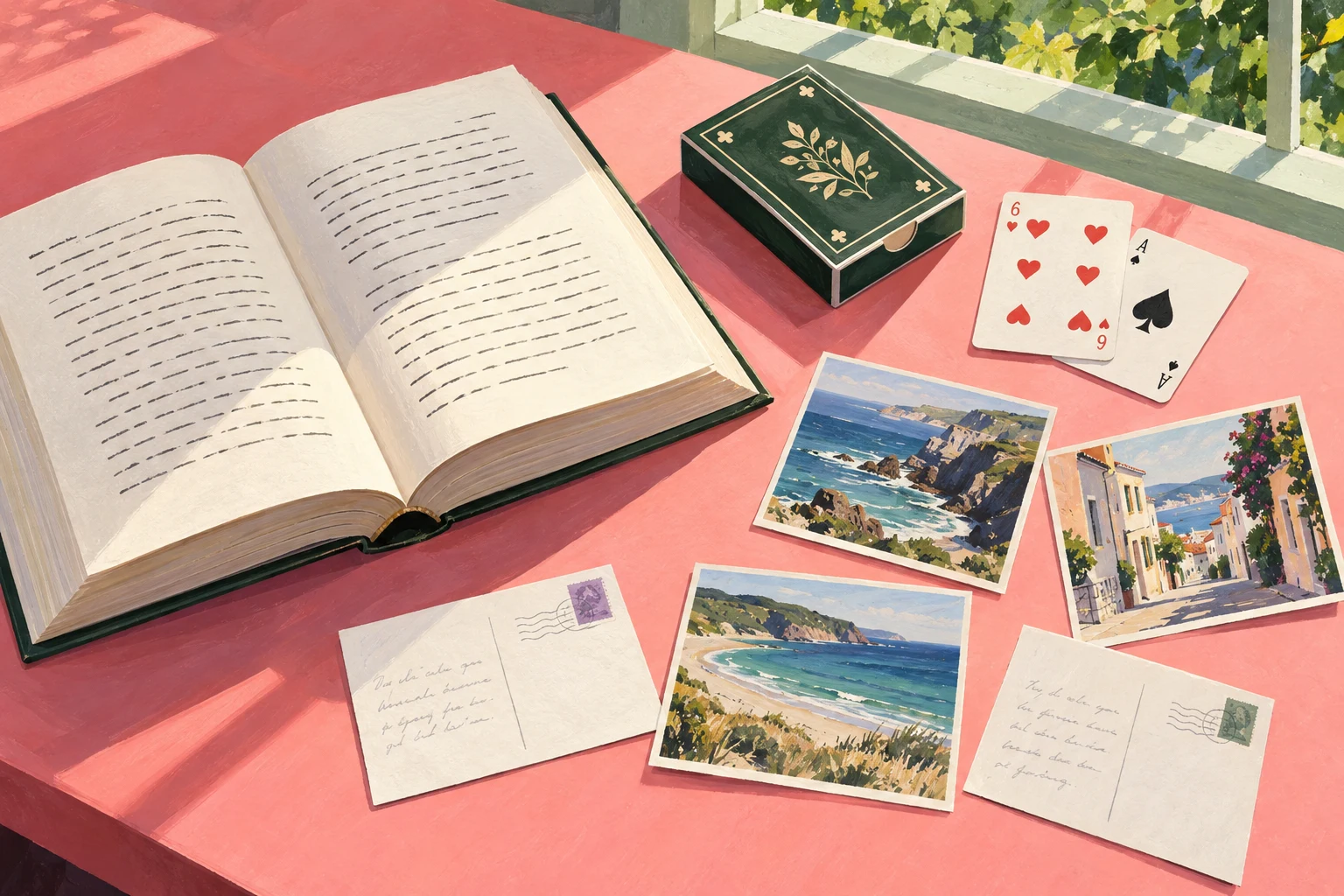
You want to put the screen away. You do not especially want to draw, knit, glue, paint or produce a charming object by Sunday evening.
That still leaves plenty to do.
The useful question is less “Which hobby sounds wholesome?” than what can you begin with the space, attention and belongings you have? Here are four small options, compared by what the first attempt actually requires.
| Activity | What you need | Preparation and clearing up | Can you do it alone? | The practical catch |
|---|---|---|---|---|
| Physical Klondike | A 52-card pack and a clear surface | Deal seven columns; gather the pack afterwards | Yes | You need table space and rules to follow |
| Watch birds from a window | A usable view; a paper guide is optional | Choose the view; nothing to make or store | Yes | A bird may decline your appointment |
| Read one paper short story | A borrowed or owned book and adequate light | Choose one story; return the book | Yes | “Short” varies considerably |
| Sort a few postcards you own | The cards and a clear surface | Pick one category; put them away safely | Yes | Sorting can quietly become shopping or storage |
None is guaranteed to relax you, improve your health or become a permanent passion. The point is to make a first attempt small enough to judge honestly.
If you want rules: deal one game of Klondike
A physical pack of cards gives your hands a sequence of decisions without asking them to manufacture anything.
Bicycle’s Klondike rules specify one player, a standard 52-card pack, seven tableau columns, four foundations and a stock. Its published version turns three cards from the stock at a time. [1] Other patience games arrange the pack differently, so this is one concrete starting setup rather than a definition of solitaire as a whole.
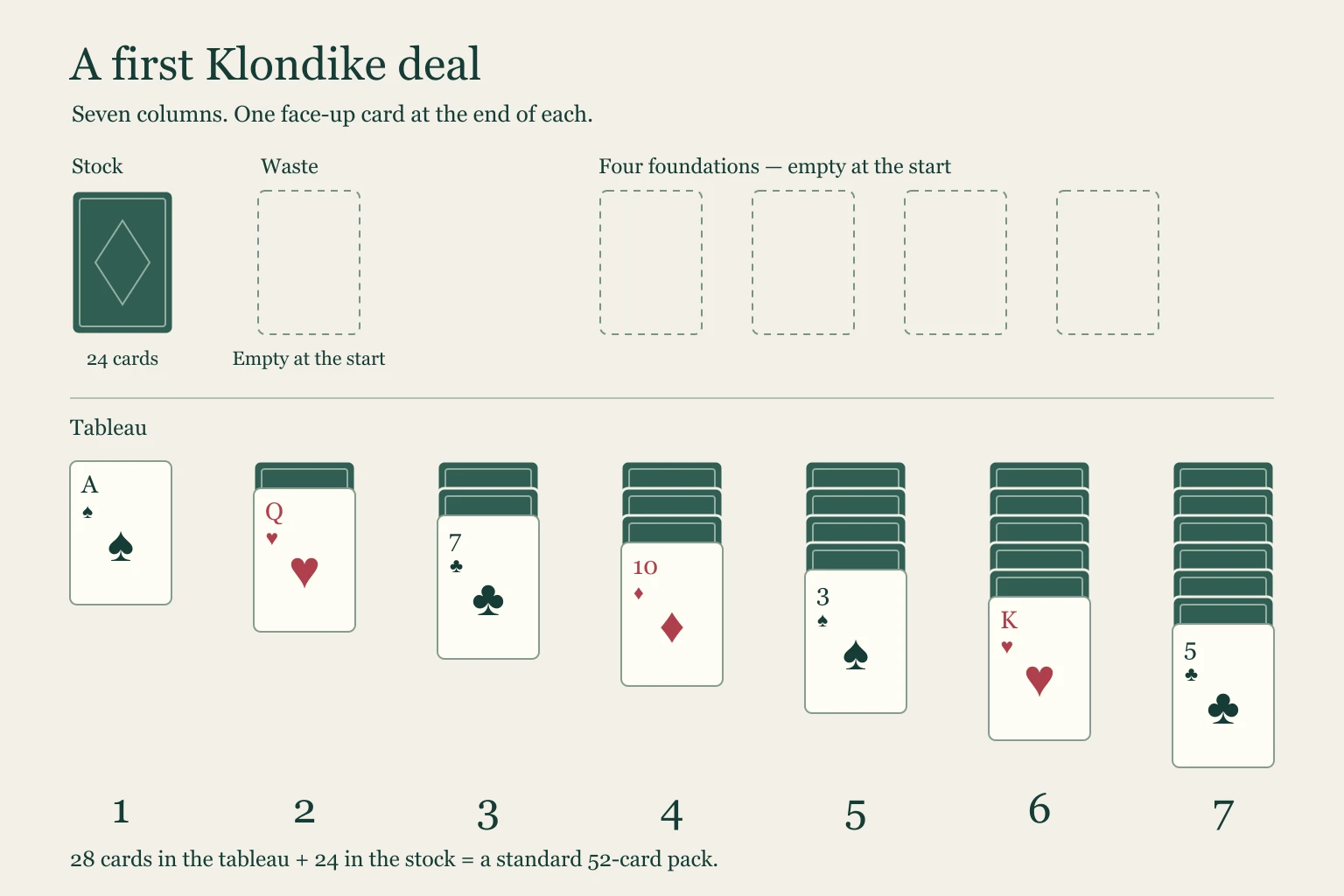
The equipment is modest. The surface is the important part: seven columns spread. A crowded café table may offer enough atmosphere and too little Klondike.
For a first attempt, deal one game and return the cards to their box when it ends. Do not add a promise about playing every night. You are testing whether following and noticing a physical arrangement is satisfying.
Choose this when you want decisions and a visible structure. Skip it tonight if learning rules feels like receiving homework from a deck of cards.
If you want to notice rather than perform: use a window
Birdwatching can begin before the expedition, specialist vocabulary and impressive binoculars.
The RSPB suggests watching from a window, garden or permitted outdoor place, and paying attention through both looking and listening. Its family activity is estimated at one to two hours, but that is the plan for that activity, not a minimum period for every glance outside. [2]
Try ten minutes at one window. Note a route, repeated movement or sound. If you use a printed guide, treat an uncertain identification as uncertain. “Small brown bird” is an observation; confidently promoting it to the wrong species adds drama without knowledge.
There may be no birds in the allotted ten minutes. That is not a personal rejection. It is the limit of arranging an activity around another animal’s timetable.
Choose this when you want an outward-looking activity with almost no clearing up. It works badly when the view is unsafe, inaccessible or simply unpromising. A walk may offer more, but a walk and a window are different amounts of preparation.
If you want a complete experience: read one short story on paper
“Read a book” is poor advice when choosing the book becomes the whole evening.
Choose one paper collection you already own or can borrow. Read a single story. Before starting, check its length instead of trusting the word short to organise your time.
The activity needs adequate light and access to a physical copy. It produces no finished object, requires no materials beyond the book and can stop at a real ending. That last feature matters if you want a bounded first attempt rather than another indefinitely scrolling supply of things.
This is an editorial arrangement, not a claim that paper reading works the same way for everyone or that it is medically preferable to a screen. Large print, audiobooks and digital accessibility tools may be the usable choices for a particular reader. “Screen-free” is a preference here, not a test of virtue.
Choose one story because you want to enter somebody else’s arrangement of words. Do not assign yourself a reading programme before you know whether you like the first page.
If you want to handle objects you already have: sort a few postcards
Collecting can sound expensive because buying is highly visible. Begin at the other end: with a small group of things already in your possession.
Take out five or ten postcards. Sort them by place, date, subject, sender or whichever distinction makes you look twice. You do not need to glue them into a book, write catalogue numbers or decide what your collection means.
The limit is part of the activity. A handful can go back safely. An entire cupboard can turn a quiet half-hour into an archive emergency.
Choose this when the pleasure is in comparison: two seaside pictures that present the same coast differently, handwriting from different years, or several ways to advertise one town. Stop if the exercise mainly makes you want to buy more. Acquiring an object and noticing an object are separate hobbies, however eagerly shops may introduce them.
If the cards are fragile or personally important, handle and store them with appropriate care. This first trial is a sorting suggestion, not conservation advice.
Which one should you try first?
Pick by the inconvenience you can tolerate.
- Have a table and want rules? Try Klondike.
- Want almost no setup and have a useful view? Watch and listen at the window.
- Want a definite ending? Choose one paper short story.
- Want to compare physical details? Sort a few postcards you already own.
The first attempt need not prove that you are “a birdwatcher” or “a card player”. It only needs to tell you whether you want a second attempt.
Momo offers a film after the screen-free bit
A black-and-white film is not a screen-free hobby. I would not smuggle it into the table and hope nobody notices.
I will offer one afterwards.
In Buster Keaton’s silent comedy Sherlock Jr. (1924), a projectionist studies a detective book and tries to apply what he has read when a watch goes missing. Another character takes advantage of his distraction. [3] The BFI describes the projectionist dreaming his way into the film on screen. [4]
That makes it a playful companion to our modest experiments. Reading instructions and doing the thing are different activities. Keaton’s projectionist discovers this with rather more jeopardy than your pack of cards requires.
The film does not prove that Klondike, birdwatching, reading or sorting postcards will suit you. It provides a splendid warning about becoming attached to the role before mastering the evidence.
Try one activity first. Then, if the screen has earned its return, let Momo put the projectionist back on duty.
References & Further Reading
The first two sources establish the specific published activity arrangements described above. The paper-story and postcard trials, comparison table and selection advice are Monocurator’s editorial suggestions. No therapeutic outcome or personal trial is claimed.
- Bicycle Cards, ‘Klondike’, rules for the stated one-player, 52-card version and its layout.
- RSPB, ‘Go birdwatching’, family activity guidance covering windows, gardens, outdoor places, looking and listening.
- American Film Institute, Sherlock Jr., AFI Catalog of Feature Films. Film record, silent black-and-white physical properties and opening synopsis.
- British Film Institute, Sherlock Jr., film record and editorial description. AFI and BFI give different runtimes, so no universal runtime is stated here.
For the next unexpected question, follow the Journal in your RSS reader.
On screen
Films discussed
- Sherlock Jr. (1924) · Buster Keaton
Further reading
Read next in the Journal
Want a recommendation shaped around your evening? Ask Momo what to watch next →