See Films Differently Film craft
What Is a Jump Cut? Why the Picture Seems to Skip
How a jump cut makes missing time visible, why it differs from fast cutting and elliptical editing, and what Breathless helped filmmakers discover.
A film can leave out hours without giving us a jolt. A jump cut can make us notice the loss of a second.
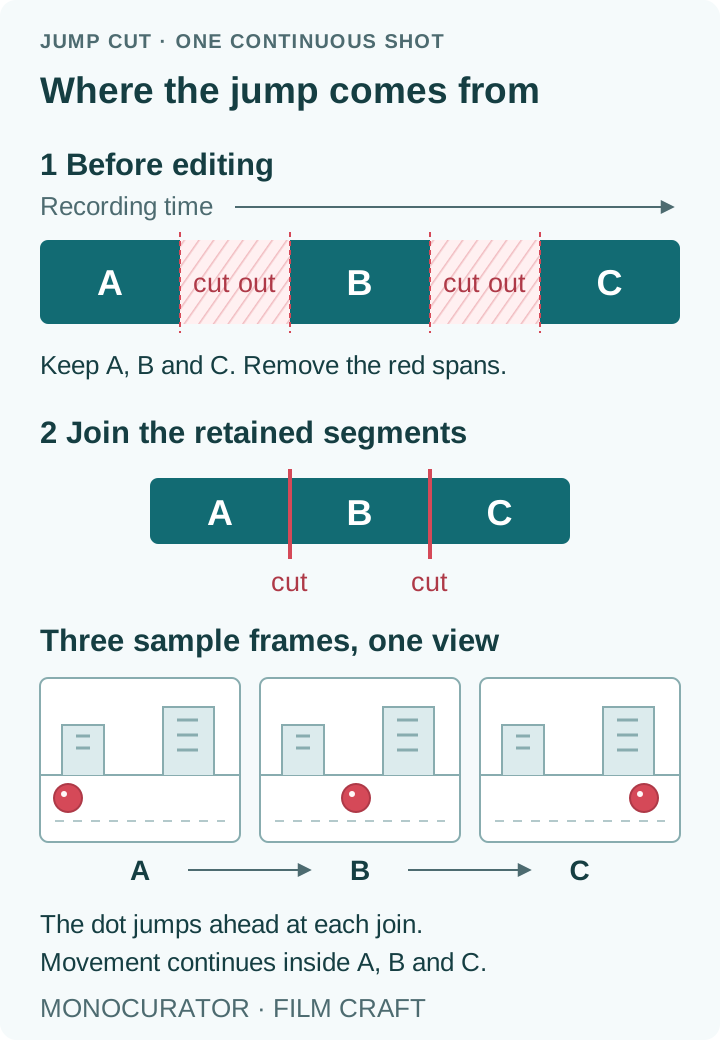
Imagine a simple piece of footage: a hand writes a word on a sheet of paper. The camera stays in one place. Now remove the middle of that action and join the remaining pieces. The pen abruptly appears farther along the line; several letters have arrived without being written.
We can still understand the action. What has changed is our experience of watching it. The paper offers a stable reference, making the missing movement conspicuous.
That is one straightforward way to make a jump cut. By removing part of an action and joining similar views, an editor creates a visible discontinuity. Columbia University’s Film Language Glossary describes the removal of frames from a sequence and the way the result can draw attention to filmmaking itself. [1]
The term names a relationship across a cut. It does not tell us how fast the whole scene must be, how many seconds have disappeared, or whether the result should feel funny, impatient or unsettling.
Fast cutting is a different question
Think of another imaginary sequence: a hand writes, a clock ticks, someone waits at a door. Give each view only a moment, and the editing may feel brisk. But the number of cuts alone does not make them jump cuts. We have moved between distinct things to look at.
Now return to the sheet of paper. Let the first section run for a while, make the jump, then hold on the finished word. A single break can remain conspicuous in an otherwise unhurried passage.
It helps to separate pace from continuity. Pace concerns how the passage unfolds; the jump concerns a particular join. In its discussion of rhythm, Yale’s Film Analysis guide treats cutting as one contributor alongside movement, speech and sound. Counting edits gives us only part of the picture. [2]
Even Breathless (1960), so closely associated with jump cuts, is not one continuous rush. In his Criterion essay, Dudley Andrew places its abrupt interruptions alongside unusually extended takes. The two coexist within the film. [3] Calling the editing “fast” would flatten precisely that difference.
Missing time does not always make a jump
Suppose a film shows someone leaving home and then arriving at work. We do not need to see the entire journey. Time has been omitted, but the change of location helps us understand the gap.
This broader practice is called elliptical editing. Yale defines it in terms of parts of an event being left out; jump cuts are one way of producing that omission. [2] They are not its only form.
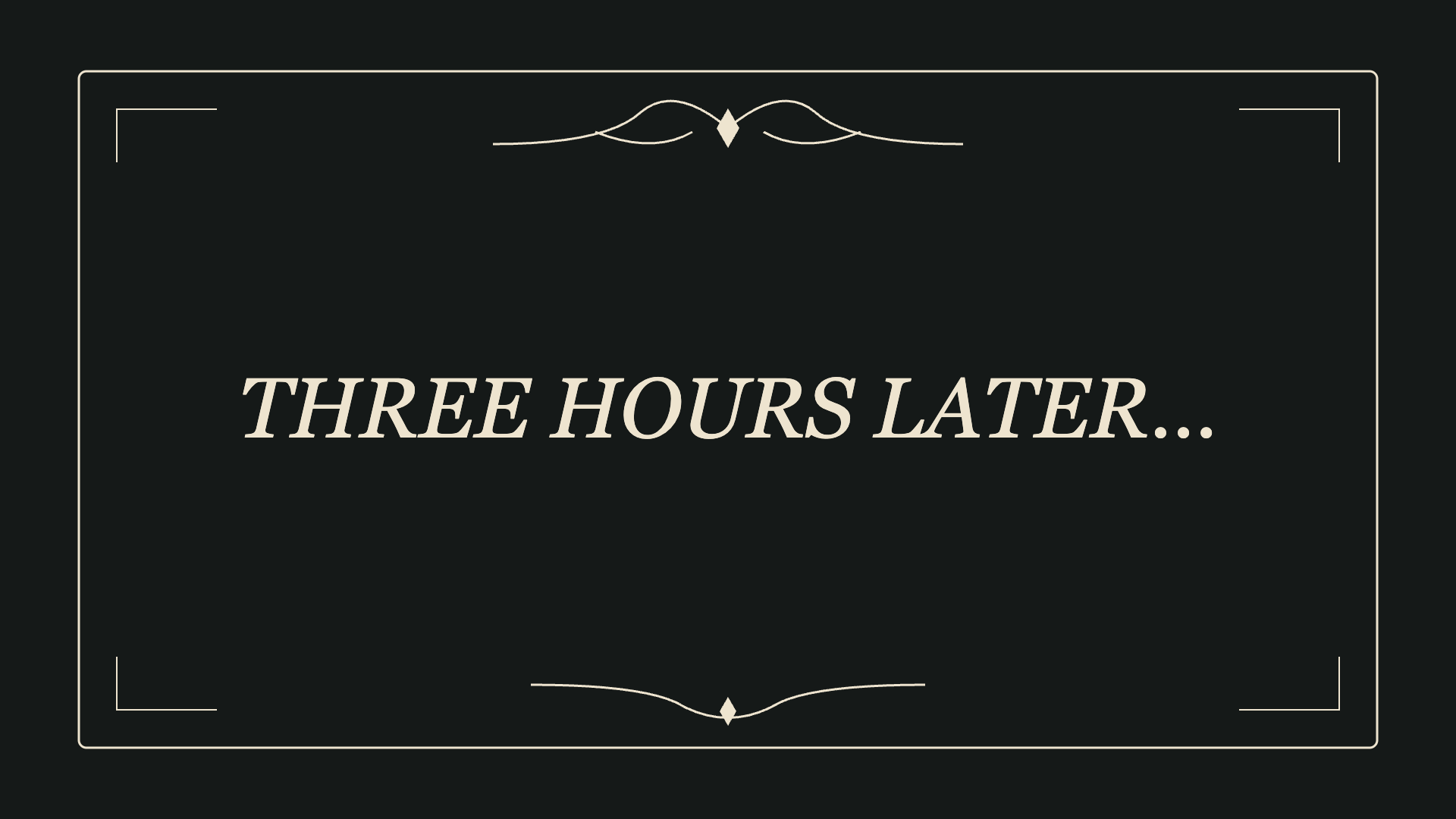
An intertitle can even announce the gap. A card saying “THREE HOURS LATER…” marks elapsed time; it does not make either adjoining edit a jump cut by itself.
In the imaginary writing example, the gap occurs while much of the view remains familiar. That similarity invites a close comparison. A moment ago the pen was here; now it is there. The surface on which we measure the change has stayed in front of us.
This is why “the film skips ahead” is not quite enough to identify the technique. Look also at what remains recognisable across the cut, and whether that resemblance makes the missing interval stand out.
The same position can hold a different feeling
Breathless offers a well-known starting point. Columbia uses an extract from it to illustrate the term. [1] For Godard’s account of shortening the film and a specific passage discussed by a contemporary critic, see Monocurator’s guide to its jump cuts.
Another filmmaker’s response opens up a different possibility. In remarks published by Criterion, Hou Hsiao-hsien recalled seeing Breathless while editing The Boys from Fengkuei. It encouraged him and his collaborators to use jump cuts. He described discovering that editing from the same position could express the characters’ emotions, without requiring the conventional progression from a distant view to a close-up. [4]
That is a useful alternative to treating a jump cut simply as an announcement of rebellion. Remaining with a similar view can also make the differences within it matter. A framing does not have to become closer every time a feeling becomes more complicated.
Return to the half-written word. Its meaning may be perfectly clear after the edit. Yet the hand has done something we were not allowed to watch. A jump cut can preserve that small disagreement: we know what happened, and still feel the break.
References & Further Reading
-
Columbia University, ‘Jump Cut’, Film Language Glossary. Definition and an example from Breathless; page undated.
-
Yale University, ‘Part 4: Editing’, Film Analysis. Especially ‘Rhythm’ and ‘Elliptical Editing’; page undated.
-
Dudley Andrew, ‘Breathless Then and Now’, The Criterion Collection, 28 February 2014.
-
Hillary Weston, ‘Hou Hsiao-hsien on the Films That Changed His Life’, The Criterion Collection, 20 October 2015. Edited and condensed remarks from Hou’s conversation with Kent Jones, translated from Mandarin by Vincent Tzu-Wen Cheng.
The writing-hand and journey examples are imagined demonstrations. The readings of their effects are Monocurator’s interpretation.
For the next unexpected question, follow the Journal in your RSS reader.
On screen
Films discussed
- Breathless (1960) · Jean-Luc Godard
- The Boys from Fengkuei (1983) · Hou Hsiao-hsien
Further reading
Read next in the Journal
Want a recommendation shaped around your evening? Ask Momo what to watch next →