See Films Differently Film craft
What Is Deep Focus? Meaning and Film Examples
What is deep focus in film? Learn how it differs from shallow focus, deep-space staging and rack focus, with clear examples from Citizen Kane.
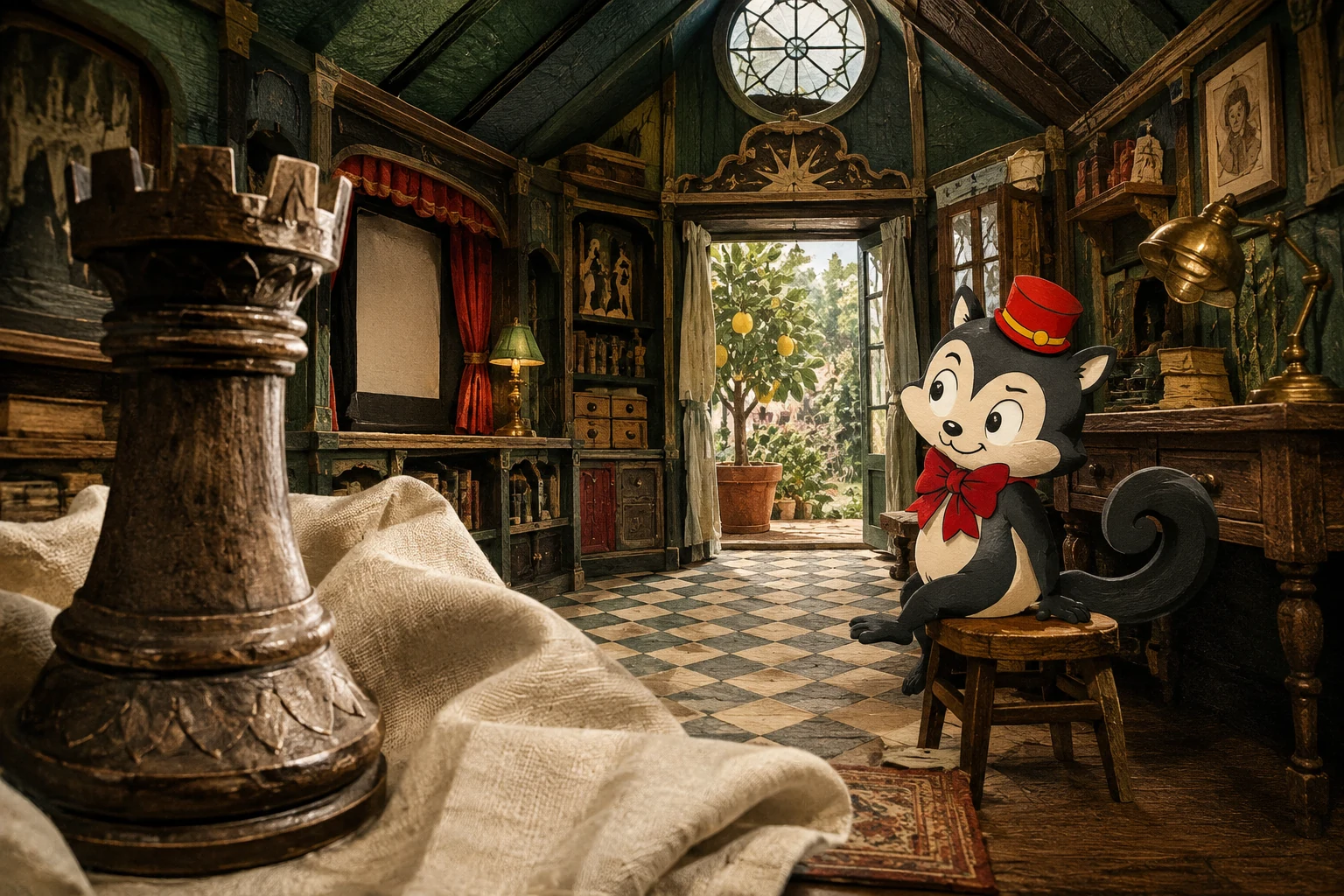
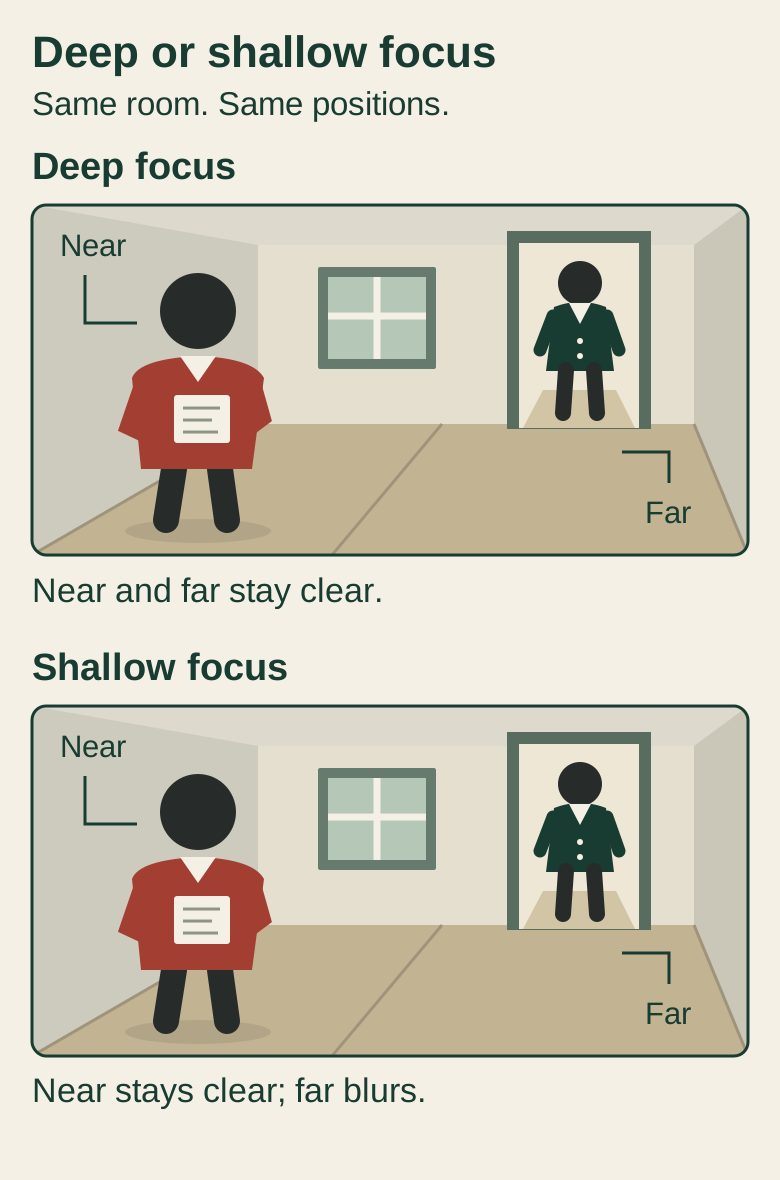
Deep focus is a way of making a film image in which subjects at widely separated distances—from the foreground to the background—appear sufficiently sharp at the same time. A face close to the camera and a person across the room can both remain clear enough to follow. It gives the filmmaker a way to show relationships between things near and far within one composition. [1] [2]
To recognise it, look beyond the nearest person. Can you also make out important details or actions farther into the scene? A large room alone does not make a shot deep focus: the question is how much of its depth remains sharp.
Deep focus and depth of field
Depth of field is the range of distances that appears acceptably sharp in a photograph or moving image. At an ordinary lens setting, focus is best at a particular distance; subjects a little nearer or farther away can still look sharp enough. They have not all become part of one perfectly focused plane. [1]
Deep focus describes the use or appearance of sharpness across a substantial depth in the film image. Depth of field describes the optical range that can help produce it. That distinction also leaves room for effects work: filmmakers can assemble separately photographed elements to make near and distant subjects look sharp together.
A deep-focus example in Citizen Kane
In an early childhood scene in Orson Welles’s Citizen Kane (1941), young Charles plays in the snow while adults inside discuss arrangements for his future. As the view retreats into the room, he remains visible through the window. The settled composition has three distinct layers:
- Foreground: his mother and the banker, Thatcher, sit at the table.
- Middle ground: his father stands farther back on the left.
- Background: Charles is a small figure playing outside, framed by the window. [3]
The adults’ conversation and the child’s activity remain available in the same image. His distance matters: the person whose future is being decided occupies much less of the screen than the people making the decision. The window keeps him visible while separating him from their discussion.
Here, the contrast between the adults’ business and the child’s play gains force because the background stays legible. A blurred shape in the window could establish that someone was outside; a clear figure allows his activity to remain part of the scene.
Deep focus vs deep space, shallow focus and rack focus
These terms answer different questions about an image. Deep-space staging or composition concerns where people and objects are arranged: some close to the camera, others farther away. Those different distances do not all have to be sharp. [2]
Imagine an actor near the camera and another at the far end of a corridor. That is an arrangement in depth. If the distant actor is blurred, the shot can still have deep-space composition without deep focus. The term describes the layout, independently of which parts the lens makes clear.
Shallow focus keeps a narrow range of distances acceptably sharp while others fall into blur. It can isolate a face from a busy room, keep a background action indistinct, or make a small change of expression easier to notice. It is a different way of allocating information, with its own expressive uses. [4]
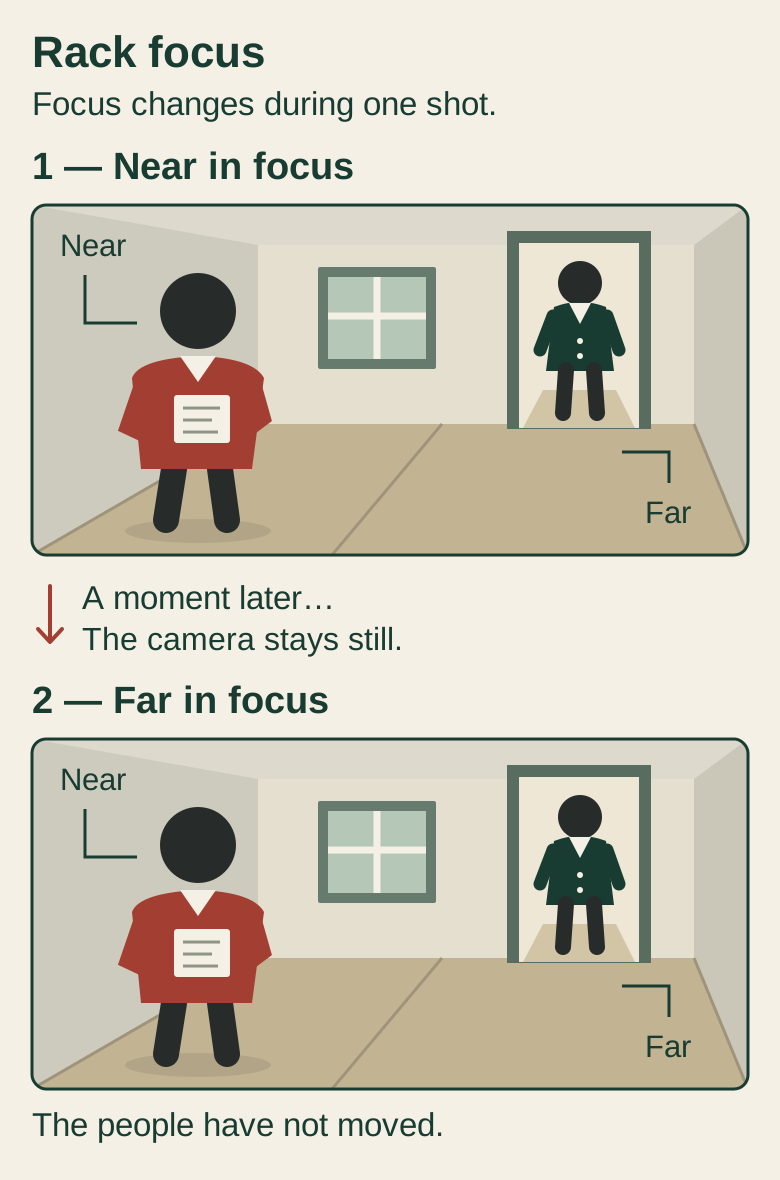
Rack focus means shifting focus during a shot, usually from a subject at one distance to another. In the imagined corridor, the near actor might become blurred as the distant one becomes sharp. The camera need not move: the change is in the focus setting. [5]
That makes rack focus particularly useful for revealing information in an order. A deep-focus composition can keep two actions readable together; a rack focus can make the second action clear after the first. A film can use both approaches, and a shot with considerable depth of field can still include a focus adjustment.
Does deep focus require a wide-angle lens?
Wide-angle lenses are often useful for deep-focus work, but they do not guarantee it. ‘Wide-angle’ concerns how wide a view the lens takes in. A wide view can still contain a blurred background, especially when the focus is close and the lens opening is large. Conversely, substantial depth of field is possible with other lenses. Focus distance and aperture matter alongside focal length. [1] [6]
The aperture is the opening in the lens that admits light. Making it smaller—often called stopping down—generally increases depth of field when the other conditions stay the same. It also admits less light, so obtaining the desired sharpness has consequences for exposure. [4]
In his February 1941 article ‘Realism for Citizen Kane’, cinematographer Gregg Toland described a combination of smaller apertures, increased illumination, sensitive film stock and coated lenses. He also noted that standard lenses could provide substantial depth when stopped down. Light supported the exposure needed for the chosen aperture; simply adding light was not a separate way to bring every distance into focus. [6]
The practical work therefore involves coordinating the actors’ positions with focus, lighting and lens choice. A wide-angle lens is one possible tool within that work.
A sharp background can also be constructed
Toland’s account explains important photographic methods used on Citizen Kane. It does not establish that every celebrated image in the film was captured by a single lens recording all the apparent distances at once.
Consider another layered composition: Kane types close to the camera, with Jed Leland farther back and Bernstein in the distance. Film historian David Bordwell identifies this particular shot as back-projection: Welles performed in front of previously filmed footage of Joseph Cotten and Everett Sloane. The foreground performance and the projected background were brought together in the finished shot. [3] [7]
This creates an important distinction between the visual result and its production. The image lets us read people at different apparent distances together, but that does not mean the lens held all three actors sharp across one physical room. Calling it a deep-focus effect describes what appears on screen; explaining how it was made requires evidence about the particular shot.
How attention is guided in deep focus
Keeping several distances clear gives us more visible information, but the filmmaker can still give some of it greater emphasis. A bright window, a moving figure, a prominent face or an off-screen voice can draw attention even when other parts of the image remain sharp.
In the childhood composition, Charles is small, yet the window gives his activity a distinct frame. The adults occupy much more space, and their discussion gives us a reason to attend to them. Sharpness makes both parts available; framing, scale and action shape how they compete for attention. The shot does not become neutral because the background is clear.
For an introduction to the film, see our Citizen Kane viewing guide. For help choosing an edition, see which version of Citizen Kane to watch.
When the childhood scene arrives, there is room to follow the adults and still notice the child outside. What they are saying concerns him; what he is doing continues at a distance. Deep focus allows that relationship to remain in view.
References
- Nikon, ‘Photography Glossary’, ‘Depth of Field’ and ‘Wide-Angle Lens’.
- Yale Film Analysis, ‘Part 2: Mise-en-scene’, ‘Deep Space’.
- Leigh Singer, ‘20 inspired visual moments in Citizen Kane’, BFI, 29 April 2016, items 7 and 16.
- Nikon, ‘Understanding Maximum Aperture’.
- Canon Europe, ‘Filming parkour with the EOS R6 V’, ‘Parkour video: tracking the action’, on Giulia Gartner’s use of rack focus.
- Gregg Toland, ‘Realism for Citizen Kane’, American Cinematographer, February 1941; republished August 1991. ASC web presentation: 1 September 2023.
- David Bordwell, On the History of Film Style, second edition, 2018, p. 224, figure 6.153 and accompanying discussion of effects work.
On screen
Films discussed
- Citizen Kane (1941) · Orson Welles
Continue exploring on Monocurator
Want a recommendation shaped around your evening? Ask Momo what to watch next →