Film craft
Why Does a Ceiling Feel Low? From Rooms to Citizen Kane
Separate measured ceiling height, perceived space and mood. Research and Citizen Kane reveal how rooms and pictures give different evidence.

Includes a discussion of a scene after Kane’s electoral defeat.
If a station ceiling feels low, a tape measure would answer only part of the question. It could establish the distance above the floor. It would not establish how high the ceiling looks, or why the space feels uncomfortable.
Those are three different claims: a physical dimension, a judgement of that dimension and a response to the room. Keeping them separate makes the question more interesting. It also saves us from giving the ceiling sole responsibility for a bad journey.
On screen, there is another complication. We occupy the camera’s chosen view of a room. Citizen Kane makes that distinction unusually useful: a filmmaker can make an overhead boundary prominent without supplying a reliable measurement of it.
Looking low and measuring low
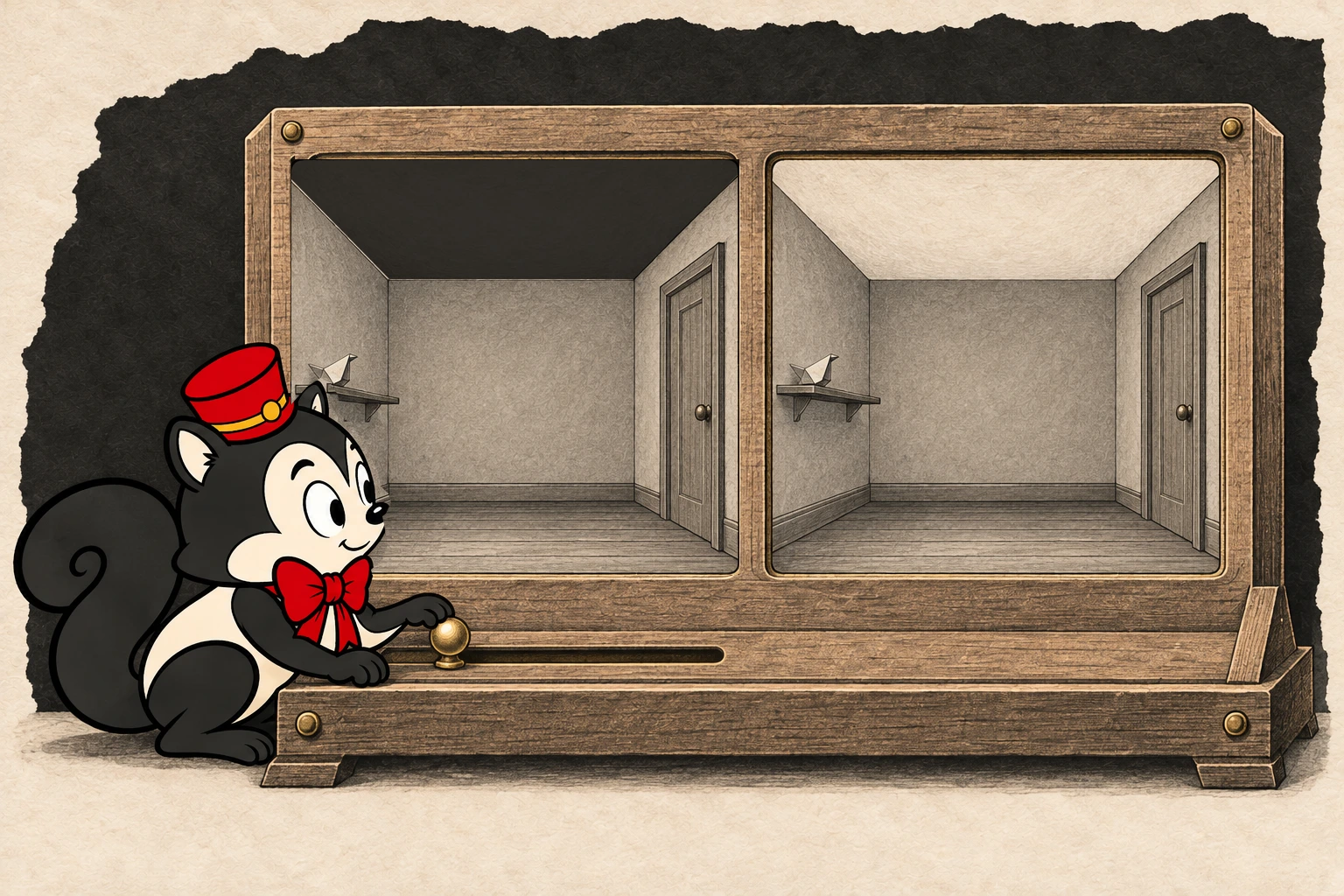
In a 2010 study, Daniel Oberfeld, Heiko Hecht and Matthias Gamer asked observers to judge the height of virtual rooms while varying their dimensions and surface lightness. Their two experiments had 12 and 20 participants. Lighter ceilings increased judged height; wall lightness also mattered. The results did not support a simple explanation based only on the contrast between ceiling and walls. [1]
The useful finding is modest: the judgement could change with the appearance of the surfaces. The simulated architecture did not have to change every time the room looked different.
Lightness here concerns how light or dark a surface appears. It should not be collapsed into the colour of the paint, or the total amount of illumination. The researchers varied greyscale surfaces in stereoscopic displays; they were not testing passengers in a station. [1]
That gives us a reason to inspect the surfaces before deciding that the ceiling must be unusually close. It does not let us diagnose a particular room from a photograph, or promise that repainting it will make everybody comfortable.
A processing result is not a mood prescription
Another often-cited paper, by Joan Meyers-Levy and Rui Zhu in 2007, compared rooms with eight- and ten-foot ceilings. It examined associations with freedom and confinement, and how participants categorised or remembered information. Attention to ceiling height was part of the experimental design. [2]
That is a different question from how high a room appears. It is also different from whether somebody likes being there. In a separate mood check reported in the paper, the researchers found no treatment difference in positive or negative mood. [2]
I would be wary of turning this into a decorating commandment: high ceilings for happy thoughts, low ceilings for misery. The evidence concerns particular tasks and conditions. A feeling of confinement, a style of information processing and an unpleasant emotion are not interchangeable results.
For an actual station, measurements and a description of the situation would still be needed. The word low can start an investigation. It cannot finish one.
Citizen Kane puts a roof over power
Orson Welles’s black-and-white Citizen Kane (1941) offers a more deliberate arrangement. [3] Writing about the production, cinematographer Gregg Toland described many sets with ceilings lower than their real-world counterparts, combined with unusually low camera positions looking upwards. Some floors could be opened to put the lens at floor level. [4]
The roof was part of what the image could show. It also changed the practical work: Toland describes muslin ceilings that allowed microphones to sit above them, outside camera range. [4] What looks like a room’s solid upper limit could be a fabric surface serving both photography and sound recording.
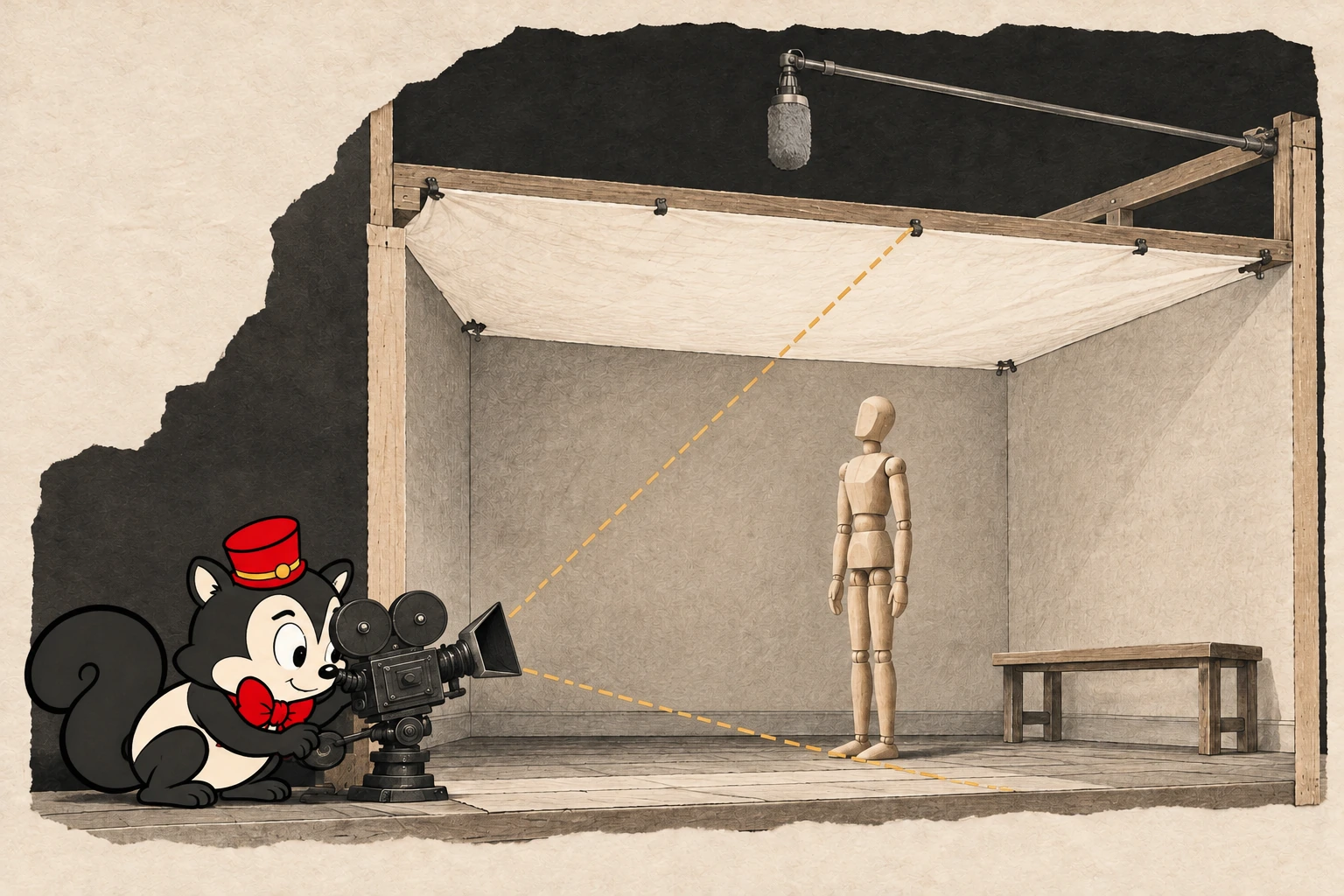
Consider the scene following Kane’s electoral defeat. In his BFI analysis, Leigh Singer identifies a camera placed in a special trench and reads the resulting composition as hemming Kane in from above and below. [5]
That example complicates the usual shorthand that looking up at someone simply makes them powerful. A figure can loom while the surrounding room supplies a boundary to that apparent stature. The ceiling participates in the judgement of the person underneath it.
I find that more revealing than saying the shot proves the room is cramped. The composition can make us attend to a limit; it does not tell us how much headroom Welles had on the set. Nor does Singer’s reading establish how every viewer must feel. It offers a specific relation to examine: the figure, the roof and the space permitted around them.
The lens and the position do different work
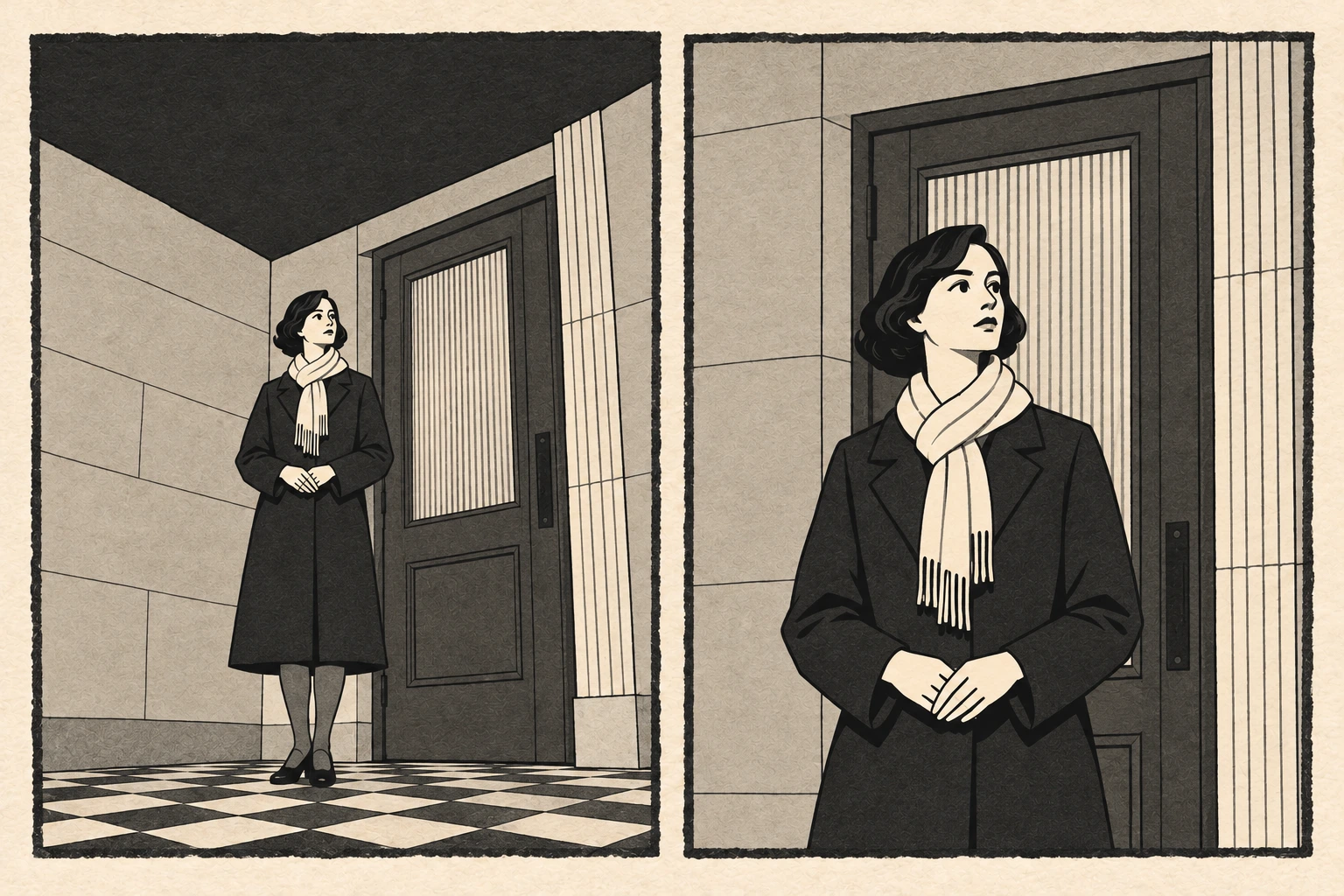
Camera position matters alongside lens choice. Sony’s optical guide distinguishes angle of view from perspective: focal length and image format determine how much enters the picture, while the camera’s distance from subjects affects their apparent size relationships. [6]
A wider view can include the ceiling-wall junction. Moving the camera can change the relationship among a nearby person, the floor and that junction. Neither operation changes the room’s actual height.
Then ask what the framing leaves out. If the upper boundary stays outside the picture, we have less visual information about it. Including it gives the room a visible termination. That is a choice about the image, rather than evidence that the building has shrunk.
Black and white retains tonal differences, edges and perspective. It does not make every ceiling oppressive. In Kane, the constructed set and the selected viewpoint give those features a particular job.
Three questions to keep apart
When a room feels low, I would keep three questions open: how high is it, how high does it appear, and what is making this situation feel enclosing? An answer to one may help with another, but they need not arrive together.
When watching Citizen Kane, look for the upper boundary as well as the face. Does the composition give the person room, or place a visible limit around them? You can consider that without pretending to survey the set.
Our Citizen Kane guide offers a way into the film. For a different question about its image, the deep-focus guide examines what happens when foreground and background remain legible together.
A ceiling has a height. A picture gives it a position. The person beneath it still has a situation to contend with.
References
- Daniel Oberfeld, Heiko Hecht and Matthias Gamer, “Surface lightness influences perceived room height”, The Quarterly Journal of Experimental Psychology 63(10), 2010, pp. 1999–2011. DOI: 10.1080/17470211003646161. Author-hosted full paper; experiments 1 and 2 distinguish simulated dimensions from height judgements.
- Joan Meyers-Levy and Rui Zhu, “The Influence of Ceiling Height: The Effect of Priming on the Type of Processing That People Use”, Journal of Consumer Research 34(2), 2007, pp. 174–186. DOI: 10.1086/519146. University-hosted paper; experimental conditions, processing tasks and the separate mood check in note 1.
- The Criterion Collection, Citizen Kane, film information and synopsis; year, director and black-and-white classification.
- Gregg Toland, “Realism for Citizen Kane”, American Cinematographer, February 1941; republished August 1991, online presentation 1 September 2023. Production-participant account of ceilinged sets, camera positions and muslin.
- Leigh Singer, “20 inspired visual moments in Citizen Kane”, British Film Institute, 29 April 2016, item 14. The specific post-defeat composition is discussed through this published analysis; direct playback is not claimed.
- Sony, “Focal length, angle of view and perspective”, Lens Basics, sections on angle of view and perspective.
For the next unexpected question, follow the Journal in your RSS reader.
On screen
Films discussed
- Citizen Kane (1941) · Orson Welles
Continue exploring on Monocurator

Further reading
Read next in the Journal

Want a recommendation shaped around your evening? Ask Momo what to watch next →