See Films Differently Film analysis
Backrooms and The Exterminating Angel: What Makes a Room a Trap?
An open doorway can still fail as an exit. Buñuel's dinner party and the Backrooms premise ask what makes movement mean freedom.

A locked door gives a frightening situation a fairly clear shape. There is a barrier, something beyond it, and perhaps a key. Remove the lock and the problem can become harder to understand. What, exactly, would count as finding a way out?
Luis Buñuel’s The Exterminating Angel (1962) makes that uncertainty the centre of a dinner party. Its wealthy guests remain in a room they cannot leave, without an ordinary locked-door explanation. The Mexican black-and-white film turns the habits of an exclusive social gathering into an increasingly desperate confinement. [1]
Kane Parsons’ Backrooms offers a useful comparison. In A24’s description of the 2026 feature, a doorway in a furniture showroom’s basement leads to an apparently endless network of connected rooms. [2] One premise prevents a departure; the other offers more places to go without promising an outside. They suggest two different ways to make movement stop meaning freedom.
This article discusses the confinement and deterioration of the gathering in The Exterminating Angel. It compares that film with the premise of the 2026 Backrooms feature and Parsons’ account of the idea’s origins, rather than treating every online Backrooms story as one continuous plot.
A doorway that will not become a departure
In her Criterion essay, film scholar Marsha Kinder describes a striking arrangement: the guests gather along the room’s curtained opening as though about to pass through, then become distracted. Rubbish can be thrown into the neighbouring space. People remain behind. [3]
That is a more particular problem than a small room or an obstructed corridor. The adjoining space can be reached by an object. Calling the opening an exit does not make it usable by the guests. A drawing of the floor plan would record a connection while failing to explain the action they cannot perform.
The distinction matters to the viewer, too. A visible padlock would invite us to look for a tool or for the person withholding a key. Here, choosing a practical task is itself difficult. During the guests’ confinement, we can see where a departure ought to happen, but the film withholds a dependable account of what would make it happen.
It is tempting to supply a rule: they are too polite, too accustomed to privilege, too afraid to act first. Such readings can illuminate the gathering. Turning one into a complete escape mechanism is a different claim. The room does not become an ordinary prison merely because we have found a persuasive metaphor for it.

More rooms are not necessarily more freedom
Backrooms shifts the difficulty from crossing a visible threshold to finding a meaningful route. A24’s synopsis establishes connected rooms, not a conventional cell. [2] From that premise, an unpleasant possibility follows: being able to continue walking need not tell you whether you are getting nearer to leaving.
Parsons makes an important distinction in his conversation with James Wan for A24. Discussing the original internet premise, he describes an accidental, mundane entrapment, rather than a punishment assigned according to someone’s guilt. He also separates the community’s many different additions from his own adaptation. [4]
That original conception changes the sort of explanation worth looking for. If the trap is not a judgement on its occupant, confession or moral improvement need not purchase release. The person may desperately want an answer to “Why me?” while the imagined environment supplies no personal reason.
This is a comparison of premises, not a claim that Buñuel directly influenced Parsons. Buñuel concentrates attention on a departure that fails in front of us. The Backrooms idea lets the distance travelled grow while leaving its usefulness uncertain. While the dinner guests remain confined, the first offers a recognisable destination without an effective action; the second can offer action without a recognisable destination.
The frightening gap is between a possible-looking movement and a movement that actually changes the situation.
What would make an escape attempt believable?
Consider an ordinary lift that has stopped between floors. A working intercom would not guarantee a quick or safe release. It would, however, give the person inside a specific next action and a way for someone outside to respond. That information changes the situation without making the space larger.
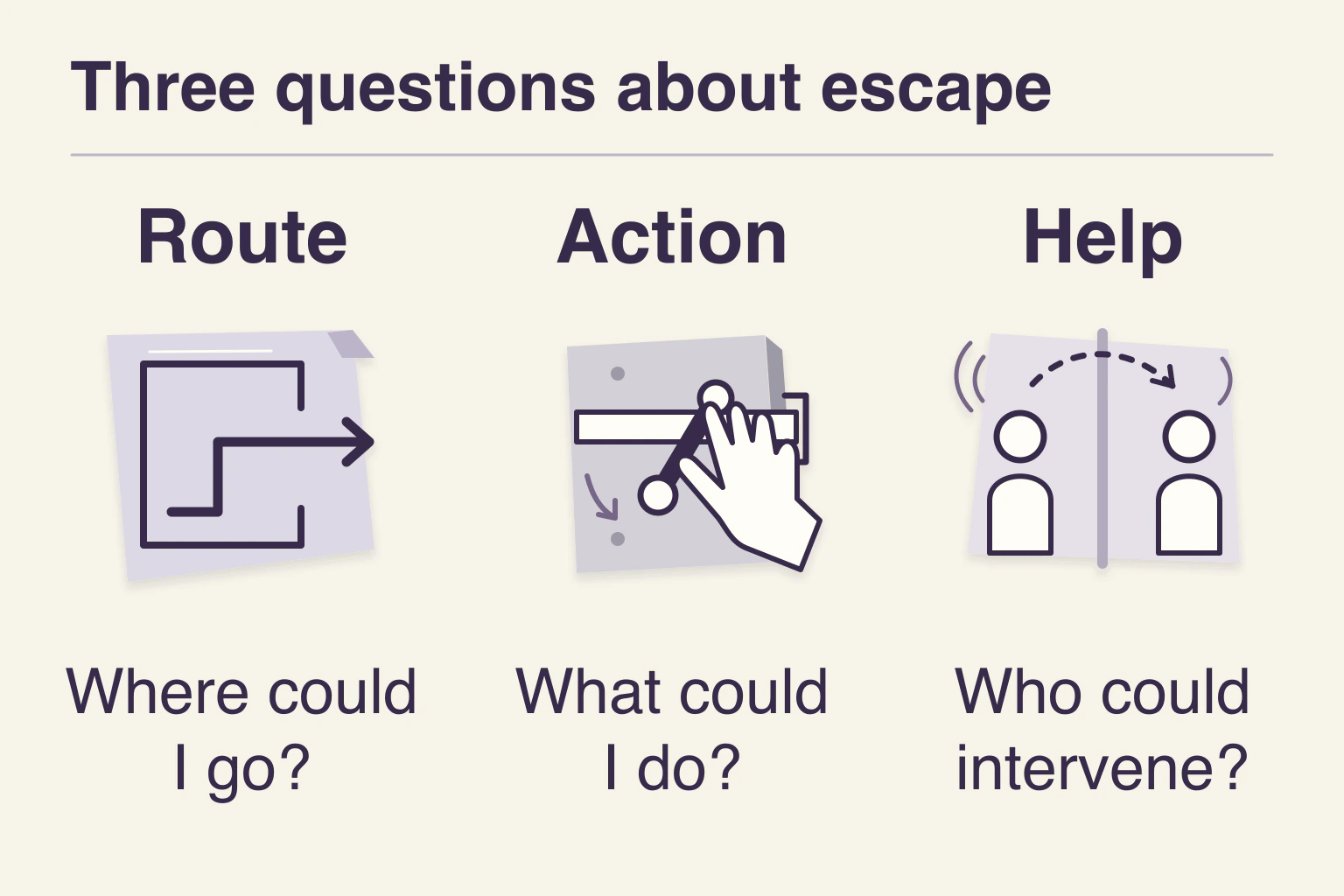
As a way of reading these films, I would separate three questions:
- Where could I go? Is there a route towards an identifiable outside?
- What could I do? Is there an action whose effect I can test?
- Who could intervene? Can anyone beyond the confinement recognise the problem and help?
These are questions for the story, not a psychological test or a universal explanation of fear. A character might know the route and still lack the means to use it. An attempted rescue might fail. A detailed explanation might make a danger worse by revealing how little can be changed.
The questions also stop “claustrophobic” from doing all the work. A spacious room can provide no usable way to leave. A very small space can have a clear, expected end to the stay. Dimensions matter, but they do not tell us who controls the departure.
The people outside are part of the room
Buñuel’s confinement is social as well as spatial. In his Criterion essay, filmmaker Alex Cox emphasises how the immobility spreads beyond the dinner guests to the wider city. The people outside do not simply provide a reassuring reserve of ordinary solutions. [5]
That enlarges the trap without enlarging the room. If the outside world cannot act on the situation, identifying its physical location is less useful. Being near other people no longer guarantees that they can become rescuers.
The guests are also a particular group, with status and expectations of service. Treating them as interchangeable people in a puzzle would discard the social arrangements Buñuel has chosen to confine. The satire asks what their cultivated behaviour can sustain when departure and assistance stop being available.
Yet reading the gathering as satire should not make its bodily needs disappear. Kinder describes the guests breaking into a wall to reach water pipes. [3] Whatever explains their inability to leave, thirst requires something less elegant than an explanation. The room must now provide what the guests once expected to obtain elsewhere.
This is where duration changes confinement. An interruption can become a threat as water, food and care become harder to secure. The trap has consequences even while its cause remains elusive. We do not need to solve the mystery before understanding why staying matters.

Watch what the next doorway promises
When watching The Exterminating Angel, watch the opening and the people around it separately. What can pass through? What action is begun and abandoned? What, if anything, can the people outside change?
Bring a different question to the Backrooms premise: does entering another room supply any evidence of progress? More visible space and more available movement can still leave the essential relation unresolved—the connection between this place and somewhere one can actually leave it behind.
A room becomes a trap through more than its walls. A door has to lead somewhere, an action has to make a difference, or someone has to be able to answer. These stories make those ordinary expectations uncertain. The next opening can remain perfectly visible while offering very little reassurance.
References
- The Criterion Collection, The Exterminating Angel (1962), synopsis, film information and credits. Identifies Luis Buñuel, Mexico and black-and-white presentation.
- A24, Backrooms, official synopsis and credits for Kane Parsons' 2026 feature. The premise used here is the showroom-basement doorway and connected rooms.
- Marsha Kinder, “The Exterminating Angel: Exterminating Civilization”, The Criterion Collection, 9 February 2009. Published scene analysis supplies the guests at the opening, the thrown rubbish and the search for water; direct film playback is not claimed.
- Kane Parsons and James Wan, “Thirty Thousand Square Feet”, The A24 Podcast, 6 May 2026, published transcript. Parsons distinguishes the original premise, community additions and his adaptation. The transcript was read; listening to the episode is not claimed.
- Alex Cox, “The Exterminating Angel: My Life As An Entomologist, Or Bugs Are My Business”, The Criterion Collection, 27 November 2008 as displayed on the essay page. Critical account of the widening confinement; the film index displays the adjacent date, 28 November.
For the next unexpected question, follow the Journal in your RSS reader.
On screen
Films discussed
- The Exterminating Angel (1962) · Luis Buñuel
- Backrooms (2026) · Kane Parsons
Continue exploring on Monocurator

Further reading
Read next in the Journal

Want a recommendation shaped around your evening? Ask Momo what to watch next →