See Films Differently Cinematography
Was Birdman Filmed in One Shot? Long Takes and Hidden Cuts
Birdman joins separate takes to look continuous. Compare its hidden cuts with Rope and Touch of Evil, and see what long takes do with space, time and suspense.
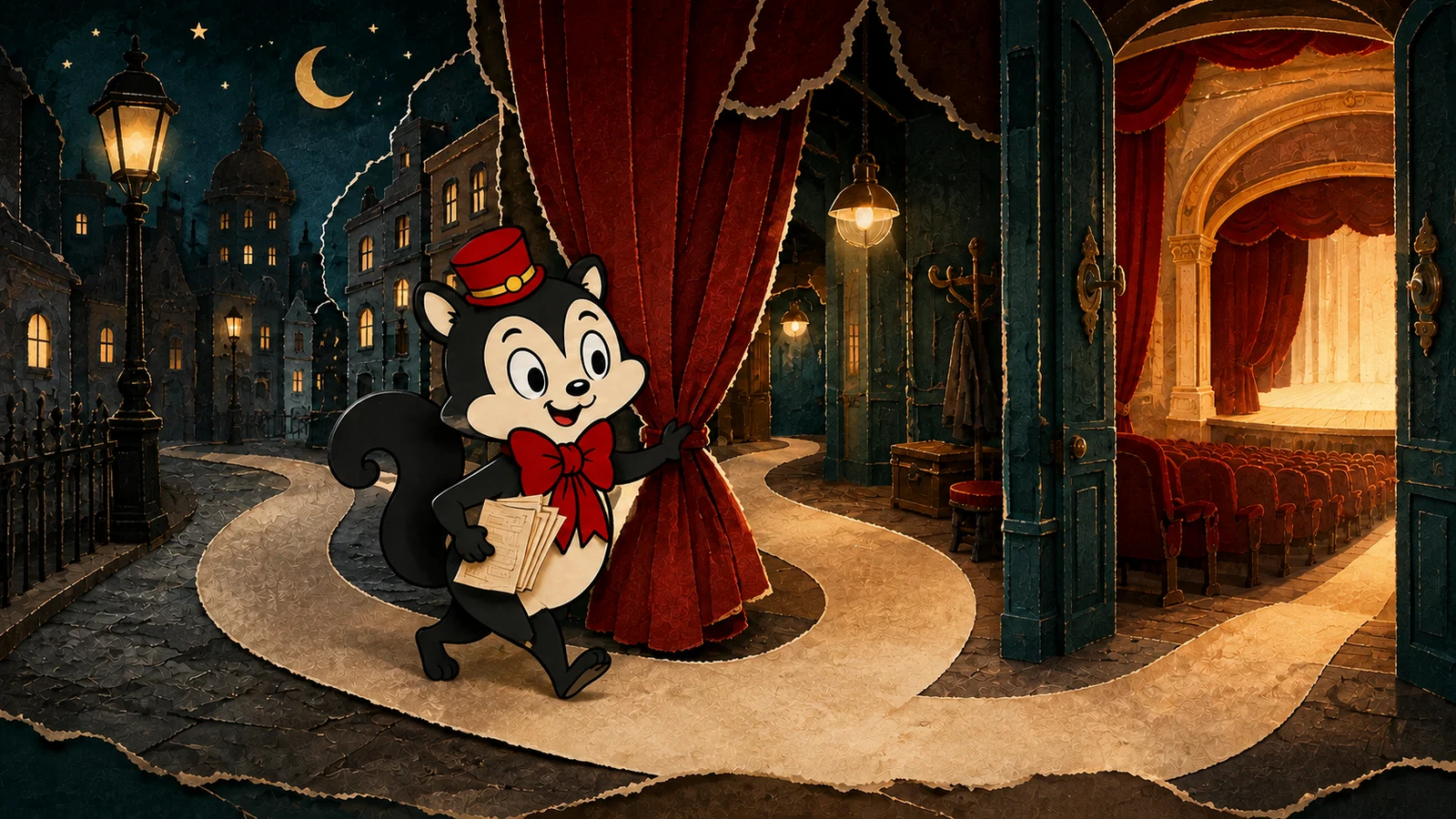
No. Birdman (2014) was filmed in separate takes that were joined, with visual effects helping to conceal the transitions. Its continuous-looking images are a constructed flow, not one uninterrupted recording of the entire feature. [1] [2]
Alejandro González Iñárritu’s film follows Riggan Thomson through a Broadway theatre as the actor’s attempt at a comeback unravels. Digital filmmaking did not invent the long take. It made certain camera journeys easier to execute and gave filmmakers more ways to join, reshape and repair them afterwards. What it could not supply was a reason to keep watching: a performance developing, a space becoming legible, a danger approaching while somebody talks.
For a black-and-white comparison, Orson Welles’s Touch of Evil (1958) offers something more useful than an earlier endurance record. Its opening makes camera movement carry a piece of knowledge through a street. A short detour through Alfred Hitchcock’s Rope (1948)—a Technicolor film, not a black-and-white one—shows how filmmakers were already manufacturing continuity before digital stitching.
What, exactly, is continuous?
A long take is an extended piece of filming made without stopping the camera. It need not move: an actor sitting still can hold a shot. A sequence assembled to resemble one take is a different production achievement, even when the result looks equally continuous.
There is also the time inside the story. Ordinary cuts between two speakers can preserve one uninterrupted conversation. Conversely, a seemingly unbroken camera movement can carry us across a gap of several hours.
Birdman does precisely that. Visual-effects supervisor Ara Khanikian describes a transition that turns a night-time view of buildings into the following day before returning to Riggan’s dressing room. Digital scenery and a virtual camera connect the stages of the move. The image keeps travelling while the story skips time. [2]
So three different questions matter: did the camera keep recording, does the finished image reveal a join, and does the action occupy continuous story time? Answering one does not answer the others.
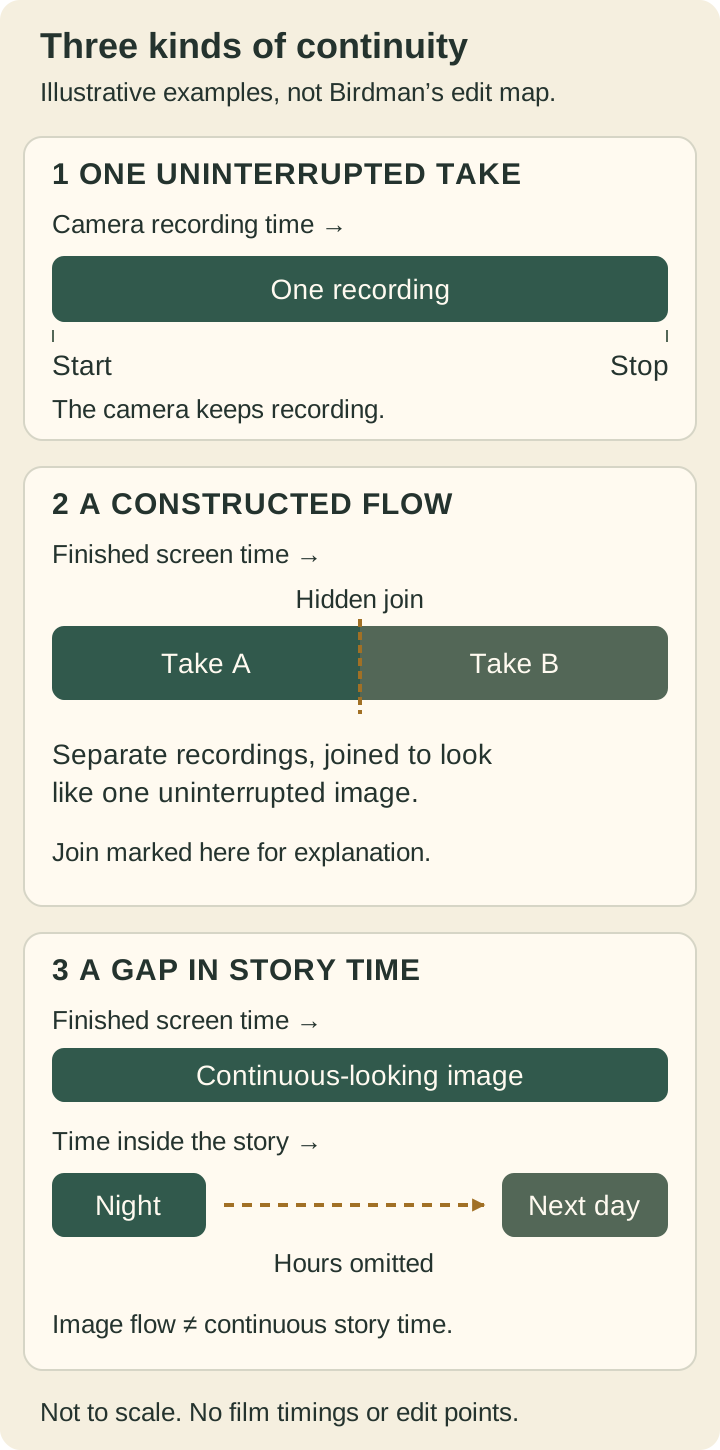
This distinction also makes Birdman more interesting than a hunt for concealed edits. Its camera can seem unable to leave the theatre’s pressures behind even when hours disappear. Cinematographer Emmanuel Lubezki describes the filmmakers’ aim as keeping us close to Riggan’s emotional situation, with camera movement planned around the characters from the outset. [1]
Getting a camera through a doorway
Consider the physical problem of following someone along a narrow corridor, then moving between two people. The route must accommodate more than an actor. There is a camera, its support, an operator and the work of keeping the intended subject in focus. A clear passage for the character may be too tight for the equipment following them.
Lubezki used the small ALEXA M for close handheld work on Birdman, and an ALEXA XT on Steadicam—a stabilising camera support—for other moves. He credits the M’s size, long recording times and a clear video feed for the director with making this production workable. He also describes lighting largely from lamps and fittings within the sets, with exceptions, rather than placing conventional lighting units around every camera position. [1]
That changes what can fit into a room and how freely it can be photographed. It does not make the room organise itself. Turn towards a mirror and the camera may reveal its own crew. In Birdman, Rodeo FX reconstructed reflections to remove that evidence. [2] Keeping equipment out of sight was partly a problem to solve during filming and partly work for visual-effects artists afterwards.
Nor did editing disappear. Editors Douglas Crise and Stephen Mirrione were involved before shooting; rehearsals were recorded and edited to test pacing. Decisions that might normally wait for the cutting room were being tried while the movements could still be changed. [3]
Rope: a room that moved around the camera
Rope belongs in this comparison because it separates the age of a technique from the tools used to achieve it. Hitchcock was constructing a largely continuous-looking apartment drama in colour in 1948. Digital compositing was not required to conceal an edit.
Some joins disappear when a foreground object fills the image. Others are ordinary cuts. Editor Vashi Nedomansky’s published shot analysis counts five concealed joins and five conventional cuts. Calling every cut hidden erases part of the film’s actual construction. [4]
The recording constraint was specific, too. Virginia Yates’s contemporary production report describes rehearsals in nine-minute sections, tied to the Technicolor film lengths available, which it reports as no more than 952 feet. That is evidence about this production’s working conditions, not a ten-minute law for every film camera. A film magazine—the camera’s film container—holds a finite supply; how long it lasts depends on the load, format and running speed. [5]
The apparatus also occupied substantial space. Yates describes walls suspended from overhead tracks and furniture moved aside for the camera, then restored before it came back into view. Cinematographer Joseph Valentine identified lighting, particularly camera and microphone shadows, as a major difficulty. A wall that failed to move quickly enough caused a collision and stopped filming for the day. [5]
The apartment therefore has two kinds of movement. On screen, people cross a room and converse. Outside the frame, that apparently stable room is being rearranged around them. The actors’ blocking—their planned positions and movements—has to work with this less visible choreography.
Running out of stock requires a stop with that camera load. Moving a wall successfully requires timing, labour and rehearsal. Those are different constraints. One sets a physical limit on the current recording; the other makes a possible shot expensive or risky to get right.
The following sections discuss the complete opening sequence of Touch of Evil.
Touch of Evil: the route was already possible
Ten years later, Touch of Evil opens with a genuinely uninterrupted crane shot lasting more than three minutes. Welles, cinematographer Russell Metty and camera operator Philip Lathrop take the view from a small object to an overhead street perspective, then down towards people moving through the town. The camera travels rather than merely enlarging something from a fixed position. [6]
This was not a lightweight camera wandering wherever it pleased. Lathrop recalled that lighting and making the shot took all night. His testimony brings the achievement back to its working conditions: the route could be filmed, but it had to be prepared, illuminated and coordinated. [7]
The comparison with Birdman is not proof of direct influence. It shows that linking people and places through camera movement was already available. The more revealing question is what this particular journey makes us notice.
A bomb, a car and people with somewhere to be
The opening supplies crucial information immediately: a bomb is set and placed in a car’s boot. The car’s occupants arrive without seeing it. As the vehicle travels through the border town, its path intersects with Mike and Susan Vargas walking along the street. The camera moves between the car and the couple, then accompanies the action towards a border checkpoint. [6]
That creates an unequal distribution of knowledge. We have been shown the threat; the people continuing their evening have not. A conversation is therefore doing two jobs. For a character, it is an ordinary exchange. For a viewer remembering the bomb, it also consumes time before something dangerous may happen.
The bomb does not need another close-up to remain part of the scene. Its absence from view gives memory a job. The camera can attend to a face or a passing encounter while the earlier information continues to qualify what we see. The interest is not simply whether the camera will manage to keep rolling. It is how long ordinary life can continue around something we know is there.
Space matters just as much. Following a route lets us relate the walking couple to the moving car through changes in their actual positions. Their proximity is continually revised: sharing a street is not the same as remaining safely apart. The shot gives us enough geography to consider who may be near the danger without turning the town into a diagram. [7]
A conventionally edited sequence could also establish that relationship. Cuts might alternate between the car, the pedestrians and the checkpoint. Welles’s choice offers another rhythm: the camera’s changes of attention happen within a shared stretch of movement. We are not repeatedly sent back to the bomb for reassurance that it still matters.
At the checkpoint, the car pauses and conversation continues. Its passenger mentions a ticking sound; later, as the Vargases move towards a kiss, an explosion is heard off screen and the long take gives way to a cut. [6] The held shot and its ending work together. The film has not rejected editing as an inferior art. It has delayed a cut until a change in the situation makes it forceful.
Welles himself resisted treating the opening purely as a display. In remarks reproduced by the BFI, he acknowledged its conspicuous virtuosity but connected that visibility to the plot it had to communicate; he preferred impressive shots that drew less attention to themselves. [8] That is his stated preference, not a requirement that we fail to notice the camera. We can admire the execution and still ask what each change of position contributes.
Sound helps locate that moving viewpoint. In his memo to Universal, Welles described music coming from successive establishments as the camera passed through the streets. [9] Such changes can make nearby places audible before we have inspected them visually. The opening’s credits and soundtrack differ between versions; the existing Touch of Evil version guide explains those differences. They need not become a second subject here.
More freedom to join; reasons still needed to continue
Digital tools extend the places where one performance or location can be joined to another without an obvious interruption. Khanikian also describes adjusting the speed of portions of Birdman to refine its rhythm. [2] Apparent continuity can therefore be carefully edited at more than the join itself.
That extra freedom does not mean an unsatisfactory passage is automatically repairable. Mirrione recalls Iñárritu’s insistence on making the filmed takes work rather than relying on additional invisible edits. When the camera needed to attend to a different performer, the solution could still be to change its direction and shoot again. [10]
This is where the earlier films remain useful. A scene’s duration can allow an actor to develop a reaction without interruption. It can also expose a pause that feels empty. A mobile camera can reveal a meaningful relationship between people, or arrive at a new angle merely because it can. Recording longer does not decide between those results.
Modern systems expand the practical options for continuing, joining and revising a shot. The dramatic work still includes deciding who leads the movement, whose response deserves attention, what must remain visible and when staying in the same stretch of action stops helping. Cutting is one possible answer, not a confession that the long take has failed.
When you watch Touch of Evil
Keep three small questions in mind during the opening:
- When the camera leaves the car, what keeps the bomb present in your thoughts?
- As the car and the Vargases move, when does their proximity become important?
- Which pauses belong to ordinary street life, and which acquire urgency because of what you know?
The Touch of Evil film page provides a spoiler-light introduction to the rest of the film.
You do not need to time the shot or find it more impressive than Birdman. Notice instead how a routine stop becomes difficult to wait through. The camera has connected an object, several people and a length of street; the bomb disclosed at the beginning changes the meaning of the time they spend there.
References
The production testimony below supports the technical account; the discussion of attention, proximity and waiting is Monocurator’s interpretation of the described scenes. Retrospective shot analyses are identified separately from accounts by the people who made the films.
- ‘Emmanuel Lubezki ASC, AMC on “Birdman”’, ARRI, 22 October 2014. Interview: camera choice, lighting and the intended relationship between movement and character.
- Ian Failes, ‘Rodeo helps Birdman soar with invisible fx’, fxguide, 28 October 2014. Interview with visual-effects supervisor Ara Khanikian: joins, mirror work, the night-to-day transition and timing adjustments.
- Bryan Abrams, ‘Invisibly Invaluable: Birdman Editors Douglas Crise & Stephen Mirrione – Part I’, The Credits, Motion Picture Association, 6 January 2015. Editors’ testimony on preparation and rehearsal editing.
- Vashi Nedomansky, ACE, ‘Alfred Hitchcock: Hiding the Cuts in Rope’, VashiVisuals, 3 October 2013. Retrospective editing analysis distinguishing concealed joins from ordinary cuts.
- Virginia Yates, ‘Rope Sets A Precedent’, American Cinematographer, July 1948; republished 17 January 2023. Contemporary production report with Joseph Valentine’s testimony. Used for working conditions, not its pre-release claims about total running time or an entirely unbroken film.
- George E. Turner, ‘A Cop Gone Wrong: Touch of Evil’, American Cinematographer, September 1998; republished 25 May 2023. Retrospective account describing the opening’s action and camera route.
- Bob Fisher, ‘Philip H. Lathrop, ASC Steps into the Spotlight’, American Cinematographer, February 1992; republished 19 May 2023. Lathrop’s recollections of operating on Touch of Evil, alongside a description of its opening.
- Matthew Thrift, ‘16 incredible long takes’, BFI, 13 July 2015. Reproduces Welles’s remarks about the opening’s conspicuous technique; not used to establish equipment limits.
- Orson Welles, memo to Edward I. Muhl concerning Touch of Evil, 5 December 1957; transcription hosted by Wellesnet. Opening paragraphs describe the proposed street-music treatment. The consulted page is a transcription, not an archival facsimile.
- Bryan Abrams, ‘Invisibly Invaluable: Birdman Editors Douglas Crise & Stephen Mirrione – Part II’, The Credits, Motion Picture Association, 7 January 2015. Editors’ testimony about additional joins, performance choices and retakes.
On screen
Films discussed
- Birdman (2014) · Alejandro González Iñárritu
- Rope (1948) · Alfred Hitchcock
- Touch of Evil (1958) · Orson Welles
Continue exploring on Monocurator
Want a recommendation shaped around your evening? Ask Momo what to watch next →