See Films Differently Momo Notices
Why Are Pigeons So Good at Living in Cities?
How ledges, feeding and a domestic history help pigeons live in cities, with local research and Momo’s rooftop detour to On the Waterfront.
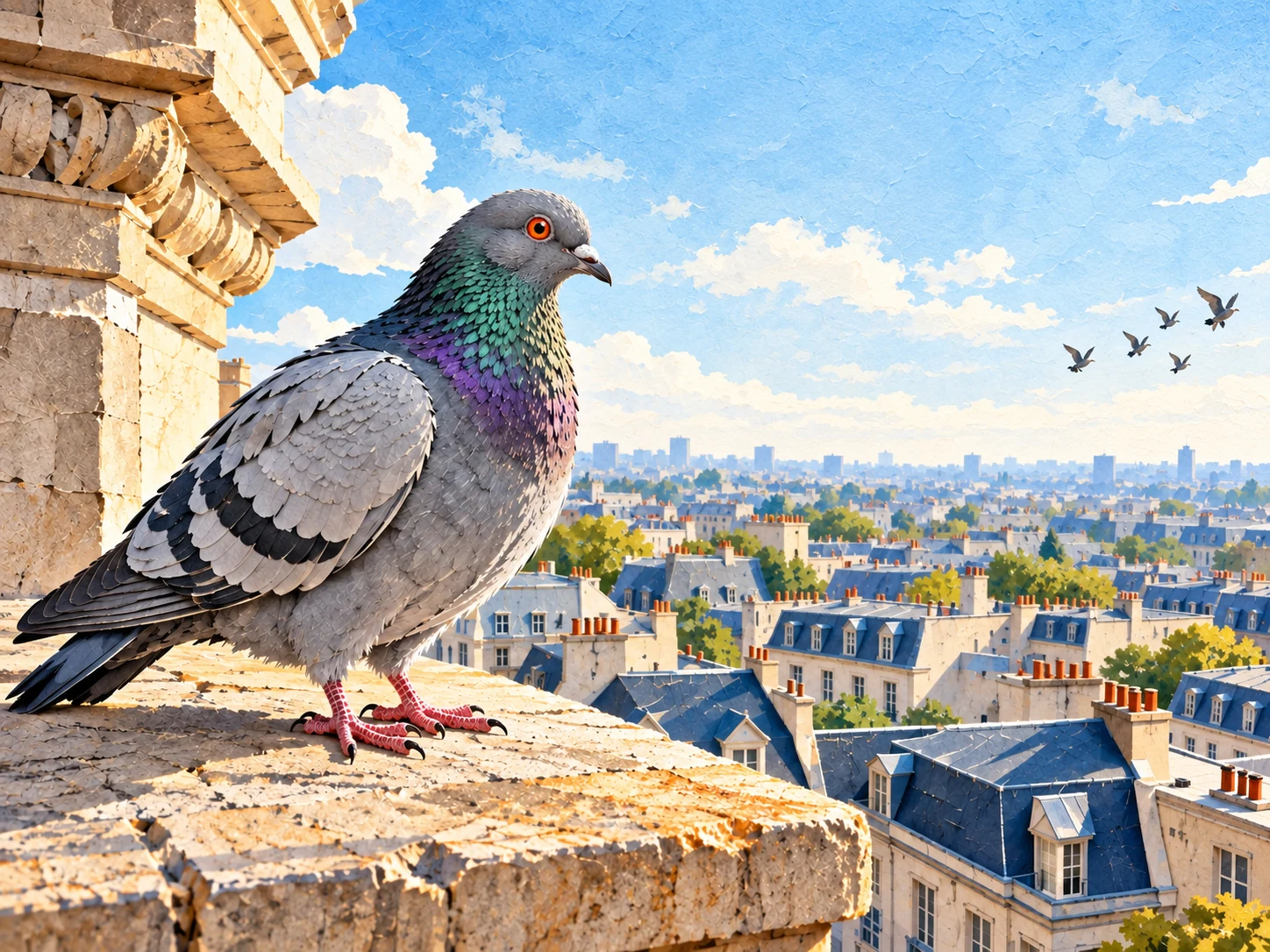
A pigeon on a station roof can look like the final, unofficial touch added by the city itself. Yet the bird did not begin with stations, takeaway crusts or bronze statues. The familiar feral pigeon belongs to the same species as the rock pigeon, Columba livia, a bird associated with cliffs, ledges and open ground. [1]
That ancestry makes a useful start, but “pigeons think buildings are cliffs” is too neat to carry the whole explanation. City pigeons also belong to a long history of domestication and escape. Their food is concentrated by human activity. Their shelter is designed for people but happens to contain countless edges, cavities and covered platforms. A pigeon succeeds in a city because several human-made advantages meet traits it already has.
Momo’s planning verdict is therefore awkward: the pigeon did not submit the application, but we built much of the habitat.
How a building does the work of a cliff
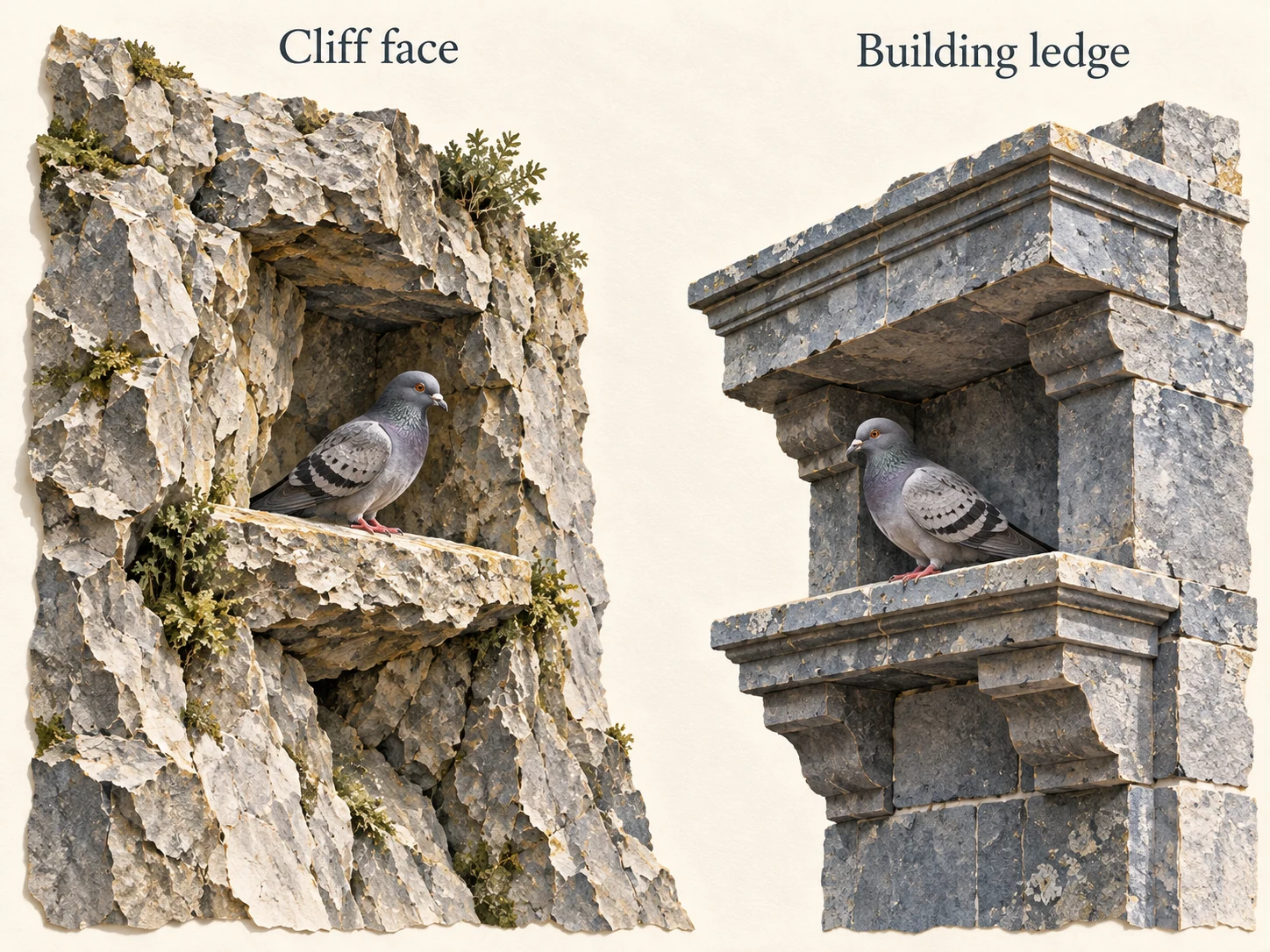
Rock pigeons naturally use rocky cliffs. Cornell’s species account records city birds nesting on buildings and window ledges, as well as on barns, towers, bridges and natural cliffs. It also describes them feeding on the ground in open areas. [1]
The resemblance between a façade and a cliff is functional rather than picturesque. A ledge can provide height. An overhang can provide cover. A bridge or ventilation structure can supply a recess. Pavements and squares leave open ground below. None of this means every building is equally suitable, or that a tower block is simply a mountain wearing windows.
One city-scale study makes the distinction clearer. Researchers surveyed rock pigeons across Singapore and combined their counts with landscape and genomic data. In that setting, intentional feeding and high-rise buildings were the most reliable predictors of high pigeon density. The authors describe tall buildings as offering nesting conditions that resemble the species’ rocky habitat, while stressing that their model covered one particular city and a limited set of environmental variables. [2]
So the city provides more than a visual imitation of rock. It brings nesting surfaces and food into the same repeated network.
The urban food supply is partly a human schedule
Pigeons are ground foragers whose ordinary diet includes seeds and grains. Urban populations can also use discarded food and food deliberately supplied by people. [1] The Singapore study found intentional feeding to be a reliable predictor of local pigeon density. [2]
That result should not become a universal law for every neighbourhood. It does show why “they will eat anything” is a poor explanation. Availability has a geography and a timetable. A regularly fed square differs from a street where an occasional chip lands. Nesting space close to a dependable feeding point differs from a suitable ledge with little food nearby.
The birds still have to learn where resources are and move between roosting, nesting and feeding sites. Their success is active behaviour inside a landscape we keep modifying, rather than passive dependence on rubbish.
Cities inherited a domestic bird
Feral pigeon populations descend largely from domestic birds, and domestic breeds ultimately derive from the rock pigeon. A genetic study of domestic breeds and two free-living populations found that racing homers had probably made a substantial contribution to the sampled North American feral population. The authors also found the European and North American free-living samples strongly differentiated. That is a useful warning against giving every city flock one tidy origin story. [3]
Humans have selected pigeons for appearance, racing, homing and other uses, transported them, housed them and released or lost them. The exact history cannot be reduced to one escape event or one original city. What matters here is the direction of the relationship: people helped make pigeons cosmopolitan before complaining that pigeons were everywhere.
This also explains some of the extraordinary variation in an urban flock. Blue-grey birds with dark wing bars may stand beside red, black, pale, checked or white-marked birds. That mixture is a visible trace of domestic breeding, although colour alone cannot reconstruct an individual bird’s family history. [1]
Living close to people also involves behaviour. A study of 519 feral pigeons across New York City found shorter flight-initiation distances at sites with more pedestrian activity and hard urban surfaces: in those places, people could approach more closely before a bird moved away. The observation cannot tell us whether habituation, sorting among individuals or evolutionary change produced the pattern. It does show that a city flock’s response to people varies with the urban setting. [4]
“Pest” describes a conflict, not the whole animal
Cities have real reasons to manage large congregations. Concentrated feeding can contribute to overcrowding, poor conditions for the birds, fouling and leftover food that attracts other animals. Hong Kong’s Agriculture, Fisheries and Conservation Department describes these animal-welfare and environmental-hygiene problems while also identifying ledges, air-conditioning units and ducts as substitutes for rocky habitat. [5]
The useful word there is conditions. New York City’s complaint guidance focuses on excessive droppings, odour and unsanitary conditions on property. Its subject is a condition at a place, rather than a biological definition of a bad bird. [6]
Calling pigeons pests can name a practical conflict. It can also hide how the conflict was assembled: buildings that offer shelter, repeated feeding, dense public space and a bird population with a domestic history. Treating every pigeon as an invading villain makes the city seem strangely innocent.
The reverse mistake is to turn them into flawless urban mascots. A crowded colony can be bad for residents and for the birds themselves. In a one-year Barcelona intervention, reducing food supplied by people was followed by a 40 per cent fall in pigeon density in two treatment districts, while a control district did not change. The result does not promise the same percentage elsewhere, and the captured birds’ body condition also declined. It does show why management can address a resource instead of treating disgust as a biological explanation. [7]
Momo’s film association: the pigeon already has a room
In Elia Kazan’s black-and-white On the Waterfront (1954), rooftop pigeons are not scenery placed behind the human drama. The AFI synopsis identifies pigeon racing as a shared hobby, records Terry Malloy tending pigeons on the roof and later describes him showing Edie a prize bird. [8]
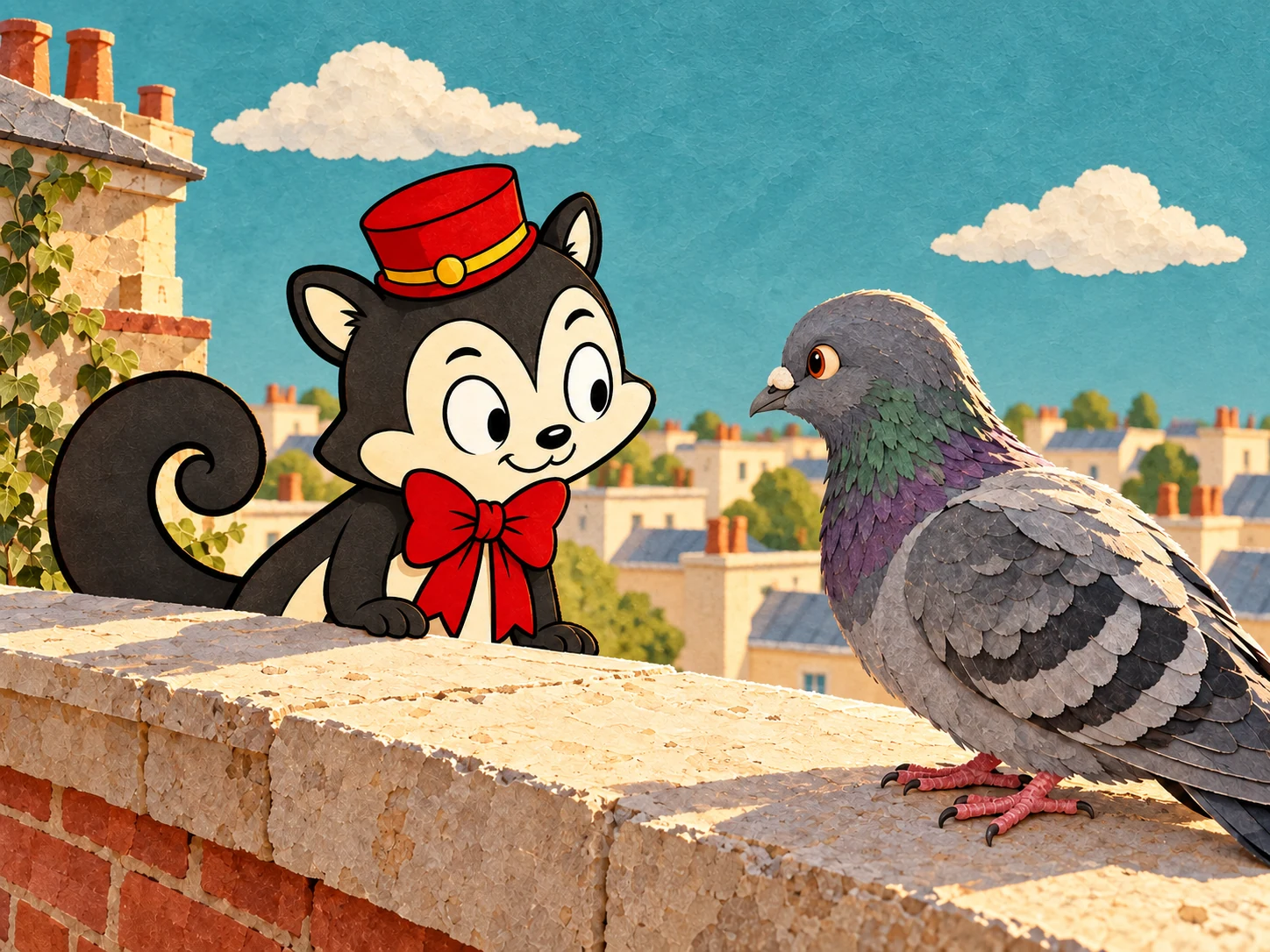
Monocurator already uses the film in its article about shipping containers and waterfront labour. The connection here has a different job. The rooftop coop shows pigeons inside a human practice: kept, tended, raced and given a place above the street. The film does not explain urban ecology, and it should not be made to. It makes the longer relationship visible.
Momo would like the record to show that the pigeon has a hobby, a housing history and better rooftop access than most critics.
The city pigeon is successful partly because it can use our structures and resources. It is also there because human beings spent a very long time bringing pigeons close. The bird on the cornice is not outside urban history. It is one of the things that history left sitting above us.

References & Further Reading
- Cornell Lab of Ornithology, ‘Rock Pigeon Overview’, All About Birds. Species account for habitat, nesting, food, domestication history and plumage variation; page undated, accessed 2 October 2026.
- Qian Tang, Gabriel W. Low, J. Y. Lim, Chyi Yin Gwee and Frank E. Rheindt, ‘Human activities and landscape features interact to closely define the distribution and dispersal of an urban commensal’, Evolutionary Applications, 11 (2018), 1598–1608. Singapore-specific distance-sampling and genomic study.
- Sydney A. Stringham et al., ‘Divergence, Convergence, and the Ancestry of Feral Populations in the Domestic Rock Pigeon’, Current Biology, 22 (2012), 302–308. Genetic study of 70 domestic breeds and two free-living populations; local ancestry findings are not universalised to every feral population.
- Elizabeth J. Carlen, Richard Li and Kristin M. Winchell, ‘Urbanization Predicts Flight Initiation Distance in Feral Pigeons (Columba livia) across New York City’, Animal Behaviour, 178 (2021), 229–245. Observational study of 519 pigeons; it does not distinguish habituation, sorting or evolutionary change.
- Agriculture, Fisheries and Conservation Department, Hong Kong, ‘“Don’t Feed Feral Pigeons” Information’. Government account of feral-pigeon habitat, feeding and management concerns; accessed 2 October 2026.
- NYC311, ‘Pigeon Droppings or Odor’. Official complaint guidance concerning excessive droppings, odour and unsanitary property conditions; accessed 2 October 2026.
- Juan C. Senar et al., ‘Reducing the Availability of Food to Control Feral Pigeons: Changes in Population Size and Composition’, Pest Management Science, 73 (2017), 313–317. One-year Barcelona intervention in two treatment districts and one control district.
- American Film Institute, On the Waterfront, AFI Catalog. Film record, black-and-white format and synopsis documenting the rooftop pigeon-racing and tending scenes.
The distinction between a pigeon’s biological capacities and the human conditions that make those capacities useful is Monocurator’s editorial synthesis.
For the next unexpected question, follow the Journal in your RSS reader.
On screen
Films discussed
- On the Waterfront (1954) · Elia Kazan
Further reading
Read next in the Journal

Want a recommendation shaped around your evening? Ask Momo what to watch next →