Momo Notices
Why Is The Apartment Both Funny and Sad?
The Apartment is funny and sad because the same machinery creates its jokes and hurts Bud and Fran. Earl Grey offers a way into its dark comedy.
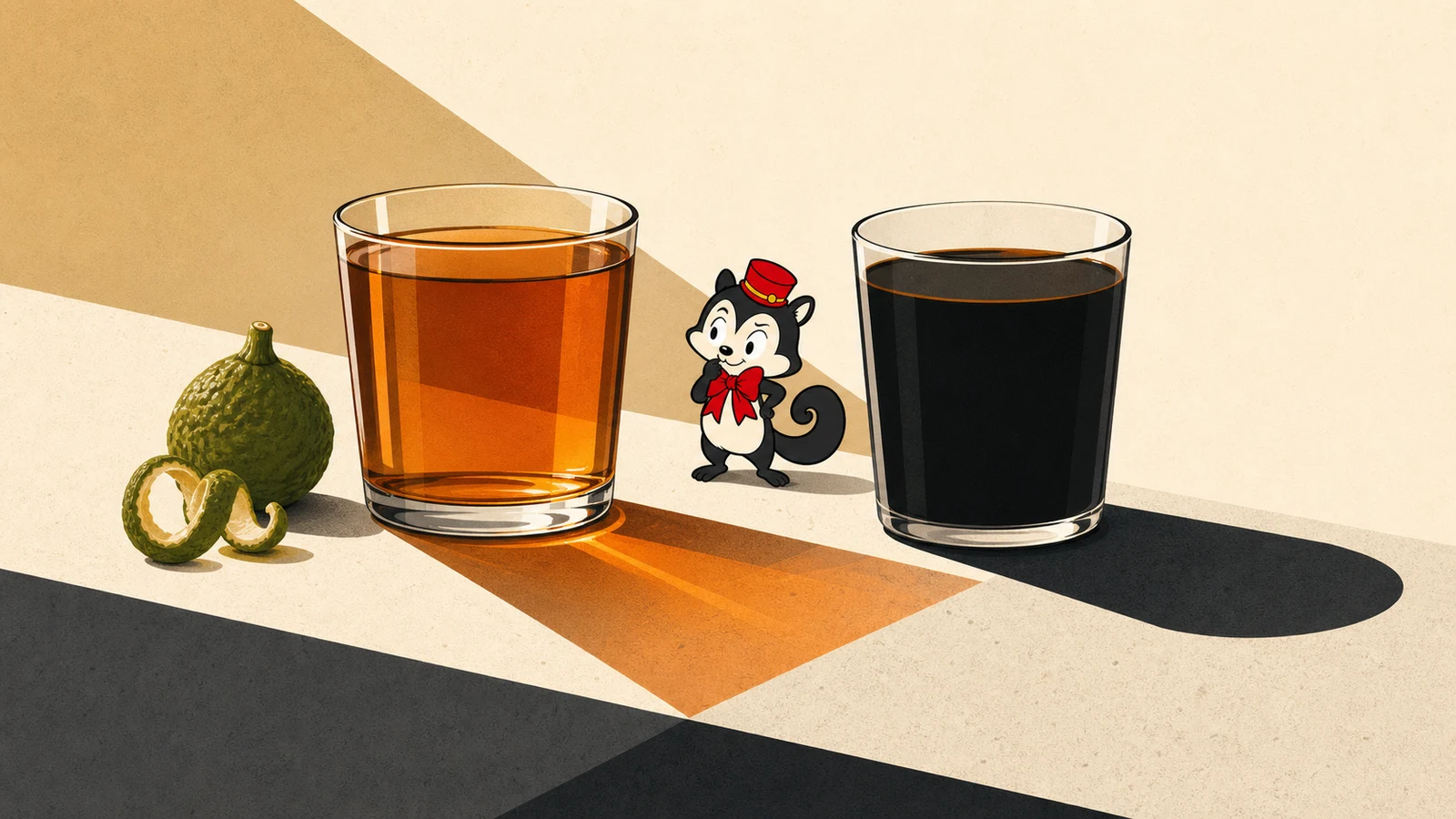
An amber drink and a black one. On bergamot, and the way it lets light and shadow remain in the same cup.
Pour tea into a clear cup and the reddish-brown liquid lets the light through. Set black coffee beside it and the bottom disappears.
The colour suggests one answer, and visual colour can shape how an aroma is perceived. [9] I find tea the darker drink.
That contradiction is also the way into Billy Wilder’s The Apartment: a film whose bright comic movement makes its pain easier to miss, then harder to forget.
Why The Apartment Is Both Funny and Sad
The short answer: the same arrangement produces the laughs and the hurt. Bud Baxter lends executives his apartment because he wants their help at work. His exclusion from his own home creates comic inconvenience, but it also exposes how the company takes his time, space and dignity. Fran’s story turns the same system of convenience into loneliness.
That is what dark comedy means here. Wilder does not pause a bleak story to add jokes. He lets quick dialogue, physical comedy and romantic-comedy momentum reveal how casually people can be used. The film is funny and sad at once because its lightness and its damage share a cause.
The tea comparison is not a detour from the film. Earl Grey gives the argument a flavour: bergamot brings brightness forward without removing the black tea beneath it. Before returning to Bud, Fran, the apartment key and the cracked mirror, it helps to see how that contrast exists in the cup.
Light-roast coffee has an acidity that announces itself as soon as it touches the tongue. Aromas recalling citrus, berries, peach, and flowers reach the nose before the coffee is swallowed. Roast and bitterness are still present, but acidity draws a clear edge around the flavour. The liquid is black; the taste is bright.
In tea, bitterness, astringency, and sweetness occupy nearly the same ground. Astringency dries the tongue and the insides of the cheeks; sweetness appears between those dry edges. Aromas recalling malt, honey, wood, flowers, and ripe fruit meet the astringency and sweetness, then remain after the tea is swallowed. [8] The liquor is lighter than coffee, but the taste holds darkness.
Tea Begins with a Leaf; Coffee Begins Inside a Fruit
What we call a coffee bean is a seed matured inside a coffee cherry.
As the fruit ripens, sugars, lipids, proteins, chlorogenic acids, caffeine, trigonelline, and other compounds accumulate in the seed. They become part of the material from which roasting will make coffee’s flavour and aroma. [3] [4]
Postharvest work changes the seed as well. The duration of contact with the fruit, microbial fermentation, and the rate of drying all affect the composition of green coffee. [5]
Then the seed meets heat. Reactions between sugars and amino compounds, the breakdown of sugars, and other thermal reactions form aromas that were not present in green coffee. [6] A lighter roast more readily leaves acidity and fruit- or flower-like characteristics at the front; a darker roast brings bitterness, smoke, char, and the character of roasting itself forward.
Coffee’s brightness comes from fruit-like qualities that were not erased before the liquid turned black.
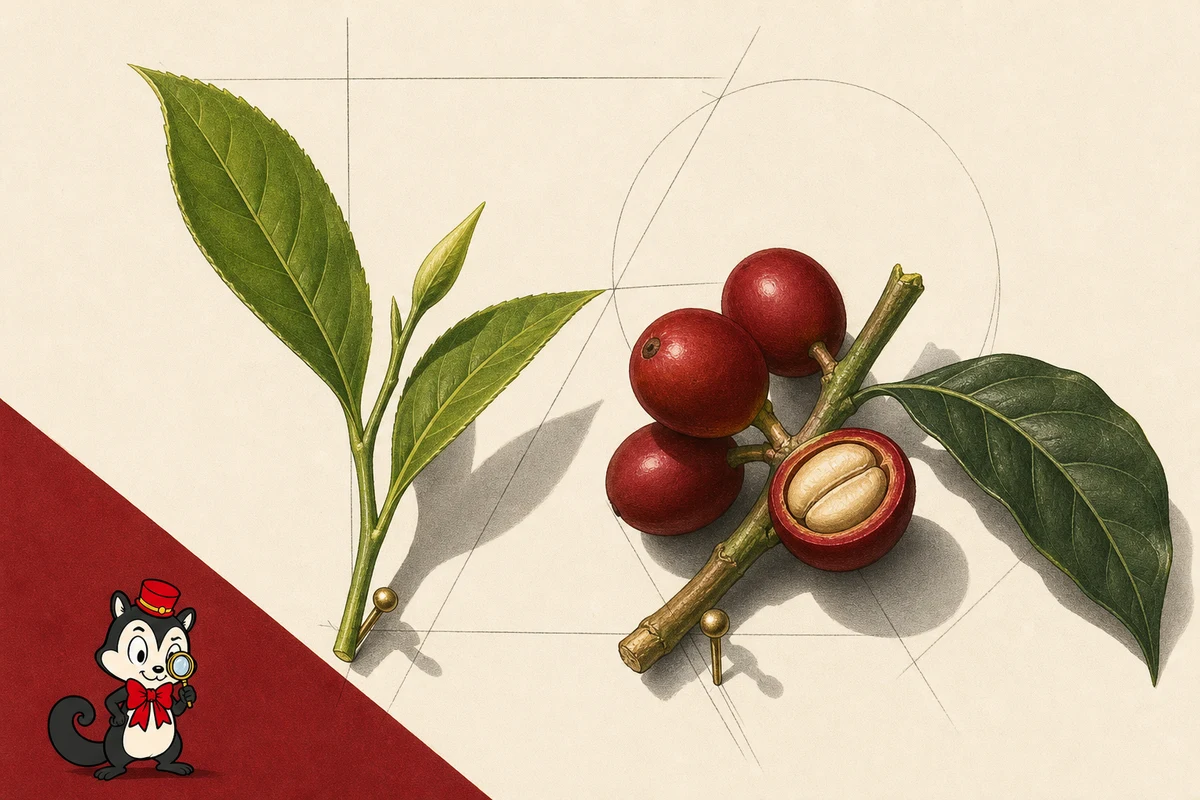
Tea begins with the young leaves and buds of Camellia sinensis.
The leaves are withered, rolled, enzymatically oxidised, and dried. Once rolling breaks their cells, catechins meet enzymes and oxygen. The resulting reactions form theaflavins, thearubigins, and many related compounds that help shape the liquor’s reddish-brown colour, astringency, body, and aroma. [1] [2]
Black tea is not simply the taste of a leaf transferred into hot water. It is a drink made by transforming the leaf.
Tea begins with a leaf; coffee begins inside a fruit.
In tea, processing reshapes bitterness, astringency, sweetness, colour, and aroma. In coffee, a seed matured inside fruit passes through postharvest processing, fermentation, drying, and finally intense heat, while acidity and fruit-like aromas can remain perceptible.
The two drinks start in different parts of a plant and travel through different processes before reaching the cup.
Color does not decide the light and dark of taste.
What Bergamot Adds
Earl Grey holds both impressions in one cup.
Bergamot carries vivid citrus alongside aromas recalling flowers, peel, green notes, and a trace of resin. It is rounder and more intricate than a simple lemon aroma, with a contour that can approach perfume.
That aroma is not made by limonene alone. Linalyl acetate and linalool soften the citrus with a floral character, while major and trace odorants together give bergamot its distinctive peel, green, and aromatic detail. [7]
It is not one powerful note, but a combination.
The Earl Grey I like leaves the tea clearly present beneath the bergamot. Bergamot is already fragrant when I bring the cup close. When I drink, citrus and flowers meet the tea’s bitterness, astringency, and sweetness.
However brightly the bergamot rises, the astringency and finish of the tea do not disappear. Citrus and flower move into the tea without covering its flavour. The darkness of the tea and the brightness of bergamot remain in the same mouthful.
Earl Grey is not black tea converted into a citrus drink.
It keeps the darkness of the tea and introduces another kind of brightness.
The result is not halfway between light and dark. It is neither one nor the other. The two impressions make each other more distinct.
How The Apartment Makes Comedy Hurt
An Earl Grey in which the tea remains firmly beneath the bergamot resembles one film more than it resembles another drink.
The Apartment, directed by Billy Wilder and released in 1960.
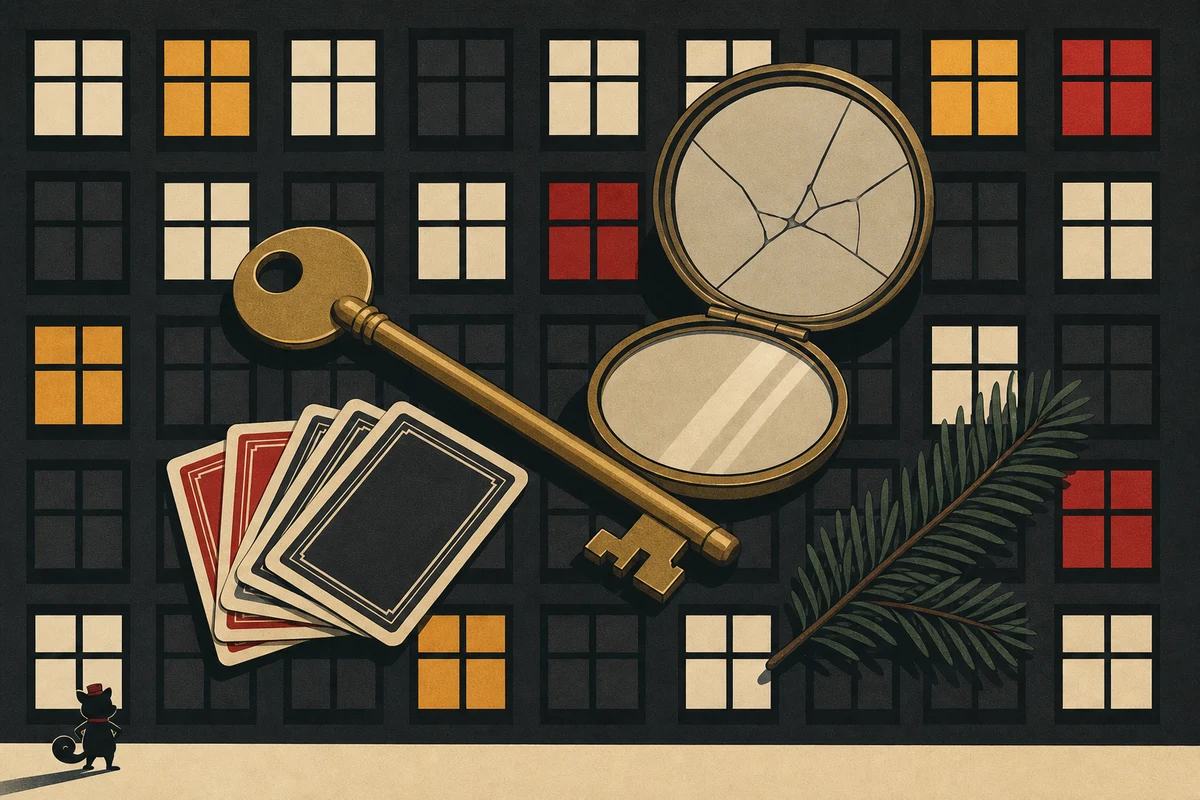
Bud Baxter lends his apartment to company executives because he wants their help advancing his career. They use it for affairs, leaving Bud to walk cold New York streets when he cannot return to his own home.
Fran, the woman he loves, is also being used for the convenience of a married executive. At the centre of the story are corporate exploitation and the loneliness of two people.
The film moves lightly.
The dialogue is quick. Jack Lemmon’s body is always in motion. Even the brutal regularity of the insurance company’s enormous office becomes comic. Christmas in New York is bright, and the film never gives up the pace of romantic comedy.
Wilder does not decorate a dark story with jokes.
The machinery that produces the comedy is the same machinery that hurts people.
Bud being locked out of his own apartment and pushed around by the executives’ schedules is funny. It is funny because, in exchange for promotion, he has surrendered his time, his home, and his dignity.
The repetition of executives using the apartment creates comic rhythm while showing how a company uses a person.
The same mechanism brightens the film and darkens the story.
Fran’s cracked compact mirror works in the same way.
The instant Bud sees it, he knows who she has been seeing. Wilder does not pile explanation onto the discovery. One small mirror reveals both the despair beneath Fran’s smile and the destination of Bud’s love.
Lightness is not time away from the film’s darker material.
It is the method by which Bud’s compromises proceed at the speed of everyday life, and Fran’s loneliness passes unnoticed behind a smile. [10]
Even when the two finally face each other, the film keeps its comic ease. It ends not with an inflated declaration of love, but with the small action of dealing cards.
Their loneliness and their delight in escaping it are not reduced to one or the other.
The resemblance to Earl Grey is not that bright things and dark things happen to sit beside each other.
Brightness does not cover the darkness. It makes its shape clearer.
As Earl Grey cools, the bergamot that first filled the air becomes quieter. The tea’s astringency and sweetness move forward.
The order changes, but both were in the cup from the beginning.
By colour alone, coffee is darker. Once taste and aroma enter the question, my answer is tea.
Earl Grey does not resolve the contradiction.
It makes the contradiction into a cup of tea.
References
- M. Aaqil, C. Peng, A. Kamal, T. Nawaz, F. Zhang, and J. Gong (2023), “Tea harvesting and processing techniques and its effect on phytochemical profile and final quality of black tea: A review,” Foods 12(24), 4467.
- B. Abudureheman, X. Yu, D. Fang, and H. Zhang (2022), “Enzymatic oxidation of tea catechins and its mechanism,” Molecules 27(3), 942.
- R. D. De Castro and P. Marraccini (2006), “Cytology, biochemistry and molecular changes during coffee fruit development,” Brazilian Journal of Plant Physiology 18(1), 175–199.
- C. Geromel et al. (2006), “Biochemical and genomic analysis of sucrose metabolism during coffee (Coffea arabica) fruit development,” Journal of Experimental Botany 57(12), 3243–3258.
- F. De Bruyn et al. (2017), “Exploring the impacts of postharvest processing on the microbiota and metabolite profiles during green coffee bean production,” Applied and Environmental Microbiology 83(1), e02398-16.
- L. Poisson, I. Blank, A. Dunkel, and T. Hofmann (2017), “The chemistry of roasting—Decoding flavor formation,” in B. Folmer (ed.), The Craft and Science of Coffee, 273–309, Elsevier.
- M. Sawamura, Y. Onishi, J. Ikemoto, N. T. M. Tu, and N. T. L. Phi (2006), “Characteristic odour components of bergamot (Citrus bergamia Risso) essential oil,” Flavour and Fragrance Journal 21(4), 609–615.
- C. Schuh and P. Schieberle (2006), “Characterization of the key aroma compounds in the beverage prepared from Darjeeling black tea,” Journal of Agricultural and Food Chemistry 54(3), 916–924.
- C. Spence (2020), “Olfactory-colour crossmodal correspondences in art, science, and design,” Cognitive Research: Principles and Implications 5, 52.
- B. Wilder (Director) (1960), The Apartment [Film], The Mirisch Company; United Artists. See also the BFI film record.
Continue exploring on Monocurator
Want a recommendation shaped around your evening? Ask Momo what to watch next →