どんな作品か
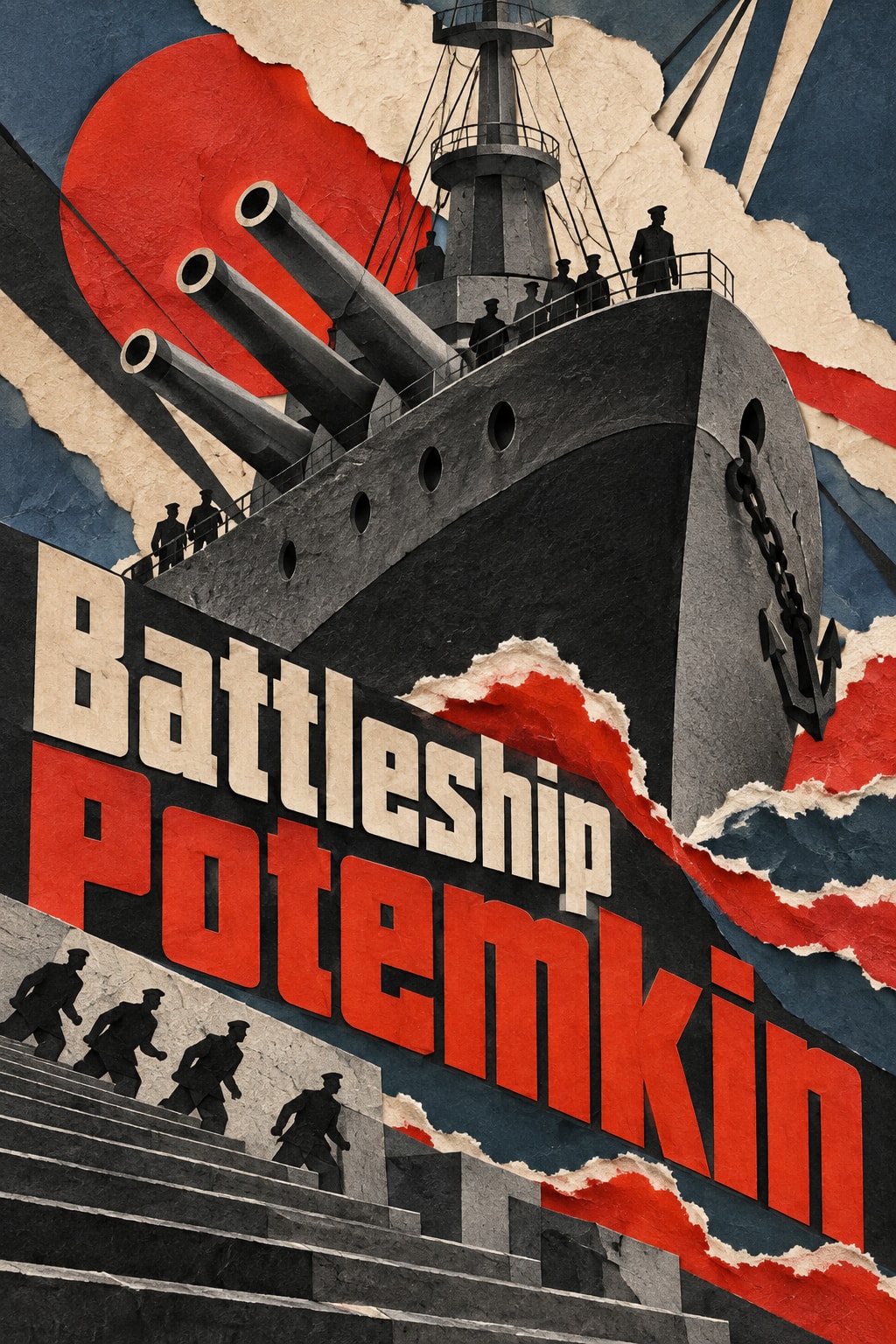
Battleship Potemkin turns conflict aboard a naval ship into cinema built from collision: faces, machinery, crowds, and movement gain force through the way they are cut together. Its energy comes less from a single hero than from people responding as a group. Even when its politics feel distant, the visual grammar remains direct, urgent, and easy to recognise in later action filmmaking.
無理なく楽しむために
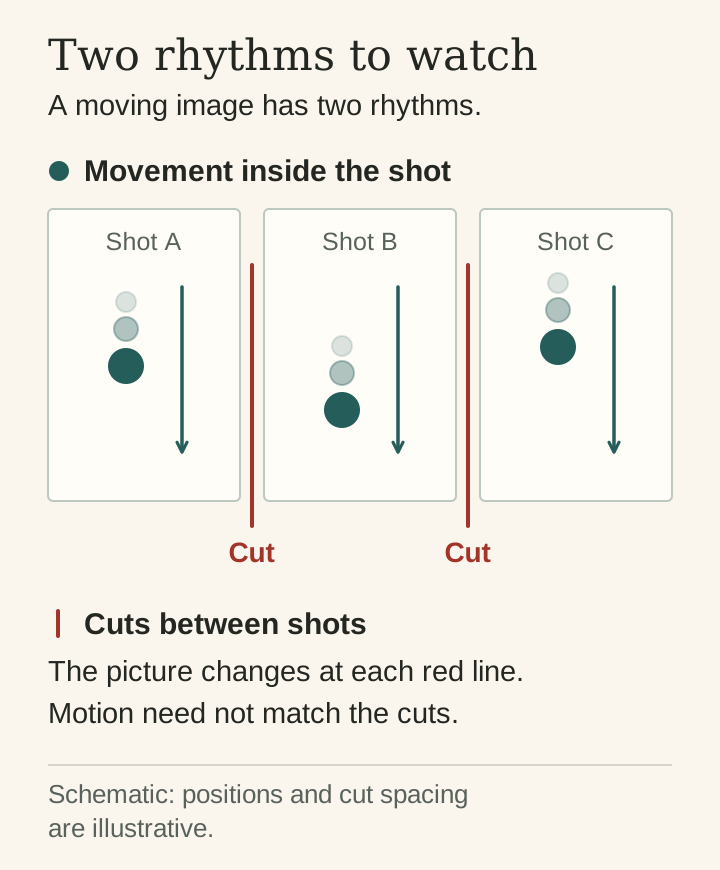
Think of the film as five movements rather than a character-led drama. Names matter less than the pressure created by cutting between sailors, officers, machinery, and crowds. Its revolutionary politics are explicit, so there is no need to mistake it for neutral history. Watch how editing changes your sense of speed and danger—that technique is the main event.
観る前の注意
ノートを開く ↓ ノートを閉じる ↑
I feel the film thinking in cuts. A face does not stay only a face; placed beside a boot, a rifle, or a moving crowd, it becomes part of an argument. That force can be exhilarating and unsettling at once. Potemkin is useful precisely because it makes persuasion visible—you can admire the craft while staying alert to its purpose.
— Momo

クレジットと版
版の見取り図
機関提供の無料視聴
Official institutional presentation
Mosfilm 1930 restoration presentation
1925 film · Mosfilm lists a 1930 restoration · 72 minutes · silent · 1:1.37.
- Destination
- Mosfilm
- Viewing region
- Where Mosfilm’s official player is available. Playback availability may vary by territory and by the official player. No worldwide availability claim is made.
- Music
- Mosfilm credits Dmitri Shostakovich and Nikolai Kryukov. No reuse rights are claimed for the hosted music, recording, restoration, or master.
- Subtitles
- The Mosfilm film page does not document subtitle options; available controls may vary in the official player.
- Master
- The 1930 restoration and hosted Mosfilm master remain separate from the underlying U.S. public-domain film.
Rights note. The underlying 1925 film is in the U.S. public domain; the U.S. Copyright Office records that works published in 1925 entered the public domain on January 1, 2021.
This finding concerns the underlying film in the United States, not every restoration, score, subtitle file, recording, or master.
This is a link to Mosfilm, not permission to download, redistribute, edit, or rehost its presentation.
Watch on Mosfilm’s film page. Monocurator does not embed, copy, or rehost the presentation. Checked 2026-07-27.
次の一本へ
次はもっと穏やかな作品、短い作品、それとも風変わりな作品? 似た作品をMomoに相談する → (英語のページが開きます)
Momoはただいま勤務中。 Momo Cinemaへ → (英語のページが開きます)