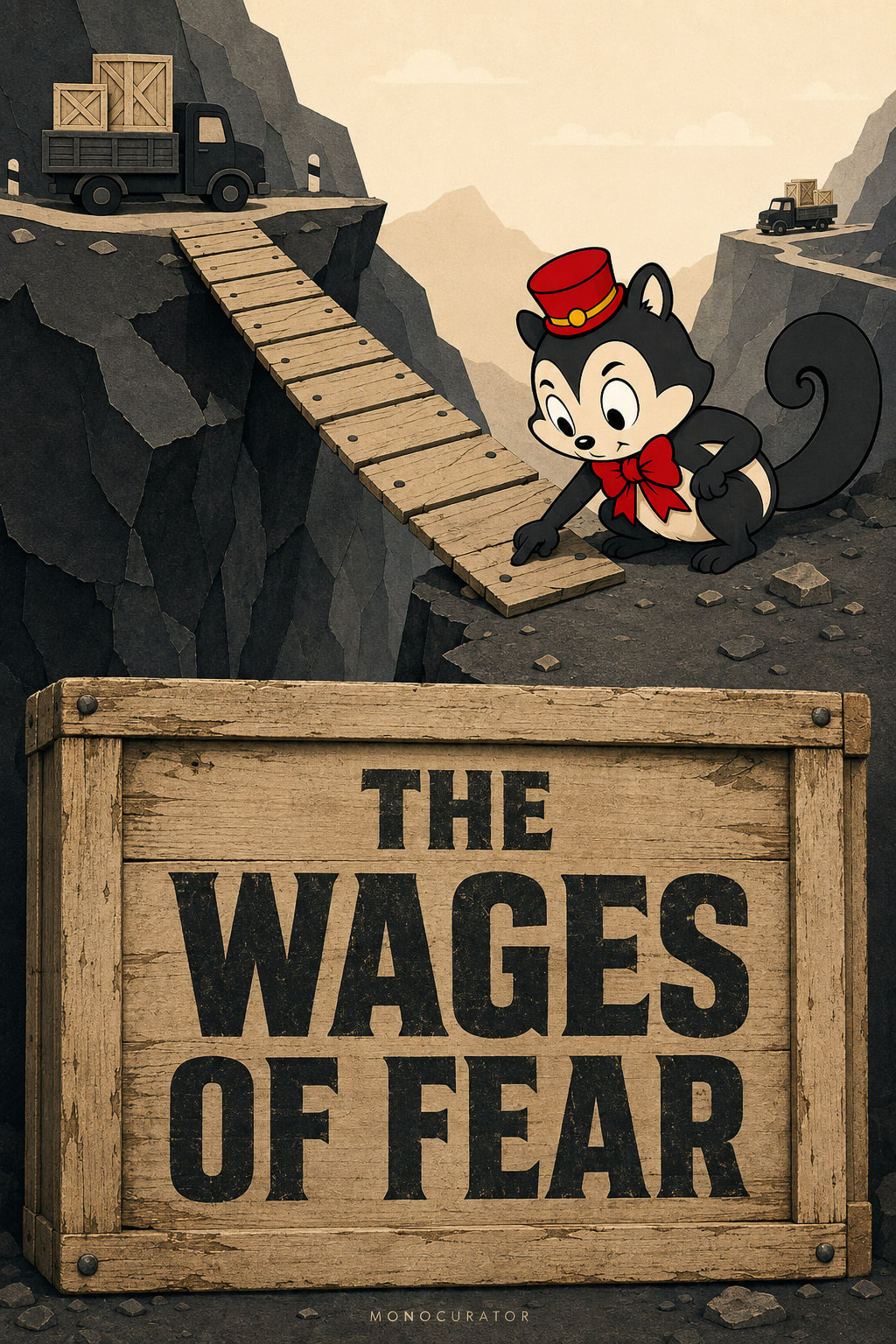
THE WAGES OF FEAR lettering on a timber crate below a mountain bridge and two cargo trucks, with Momo crouching to check a bridge plank.

Image: Monocurator · source · Original Monocurator artwork

The Wages of Fear

Le Salaire de la peur

1953 · France · Directed by Henri-Georges Clouzot · 152 min

TenseBleak Great first watch · Moderate Thriller

The Wages of Fear builds suspense slowly because its long first act proves why four men would accept a near-suicidal drive; once the trucks move, every bump has a human cost.

The Wages of Fear, Sorcerer, or the 2024 remake?

The Wages of Fear (1953), Sorcerer (1977), and The Wages of Fear (2024) are three separate films. All involve transporting explosives, but their characters and approaches differ. A restoration of Clouzot’s original is a presentation of the 1953 film; the later films tell the story afresh.

Which film are you choosing?
FilmThe story and its approach
1953 The Wages of Fear Henri-Georges Clouzot

Four men trapped in Las Piedras accept an oil company’s dangerous driving job. The long opening makes their need for money part of the suspense before the trucks leave town.

Criterion’s essay on the original
1977 Sorcerer William Friedkin

Four fugitives carry explosives through a jungle. Separate backstories introduce the men, and Tangerine Dream’s electronic score gives the journey a different atmosphere.

Criterion’s Sorcerer record
2024 The Wages of Fear Julien Leclercq

The Netflix remake turns the premise into a desert rescue mission with a 24-hour deadline. Franck Gastambide and Alban Lenoir play brothers drawn into the dangerous assignment.

Netflix’s guide to the remake

Friedkin described Sorcerer as another approach to Georges Arnaud’s novel, rather than a remake of Clouzot’s film. Start with the 1953 original, then watch Sorcerer to see how the same premise changes with different men and a different landscape. Neither makes the other redundant.

What to expect

The Wages of Fear earns its suspense before the engines start. Henri-Georges Clouzot first establishes a town where heat, poverty, boredom, and corporate power have trapped people without useful choices. The dangerous driving job therefore feels both voluntary and coerced. Once the trucks are moving, ordinary obstacles become terrifying exercises in weight, distance, and patience. Clouzot stretches time without losing clarity: a rough surface, a turn of the wheel, or a drop of liquid can reorganize the entire scene. The film remains gripping because physical danger and economic desperation are never separate problems.

How to ease in

The first section is long and intentionally abrasive. It explains why the drivers accept a task that no sensible person would take, so resist the temptation to skip ahead to the trucks. Once the journey begins, keep track of the two vehicles and the distance between them. The suspense often depends on what one crew knows that the other cannot yet see.

Heads-up

A quick, non-exhaustive note Includes sustained explosive peril, fatal accidents, fire aftermath, violence, death, poverty, racist and colonial-era attitudes, and harsh treatment of women.
Momo's Note Who is Momo? →

Four men, two trucks, and a road where every bump can end the film.

The road is frightening because Clouzot keeps making danger practical. Someone must reverse, clear an obstacle, judge a distance, or decide whether to help.

Open the note ↓

The road is frightening because Clouzot keeps making danger practical. Someone must reverse, clear an obstacle, judge a distance, or decide whether to help. Courage never becomes clean or noble for long; it is another unstable load the men are trying to carry.

— Momo

Momo with notes about this film

Credits & versions

Credits
Cast
Yves Montand — Mario · Charles Vanel — Jo · Peter van Eyck — Bimba · Folco Lulli — Luigi
Production
Louis Wipf
Cinematography
Armand Thirard

Version map

Criterion 4K digital restoration152 min · restoration · USCriterion lists this restored presentation at 152 minutes. BFI lists its restored original French theatrical presentation at 153 minutes; the one-minute difference is treated as measurement or catalogue rounding, not proof of a different cut.Runtime reference · Checked 2026-08-02
BFI restored original French theatrical presentation153 min · restoration · GBBFI lists 153 minutes alongside Criterion's 152-minute listing; the one-minute difference does not establish a separate cut.Checked 2026-08-02
1955 U.S. shortened releasetheatrical cut · USCriterion documents cuts made for the 1955 U.S. release but does not state its runtime.Checked 2026-08-02

Where to go next

Want a gentler, shorter, or stranger next film? Ask Momo for something like this →
Momo is on shift. Visit Momo Cinema →
Continue through the catalogue →