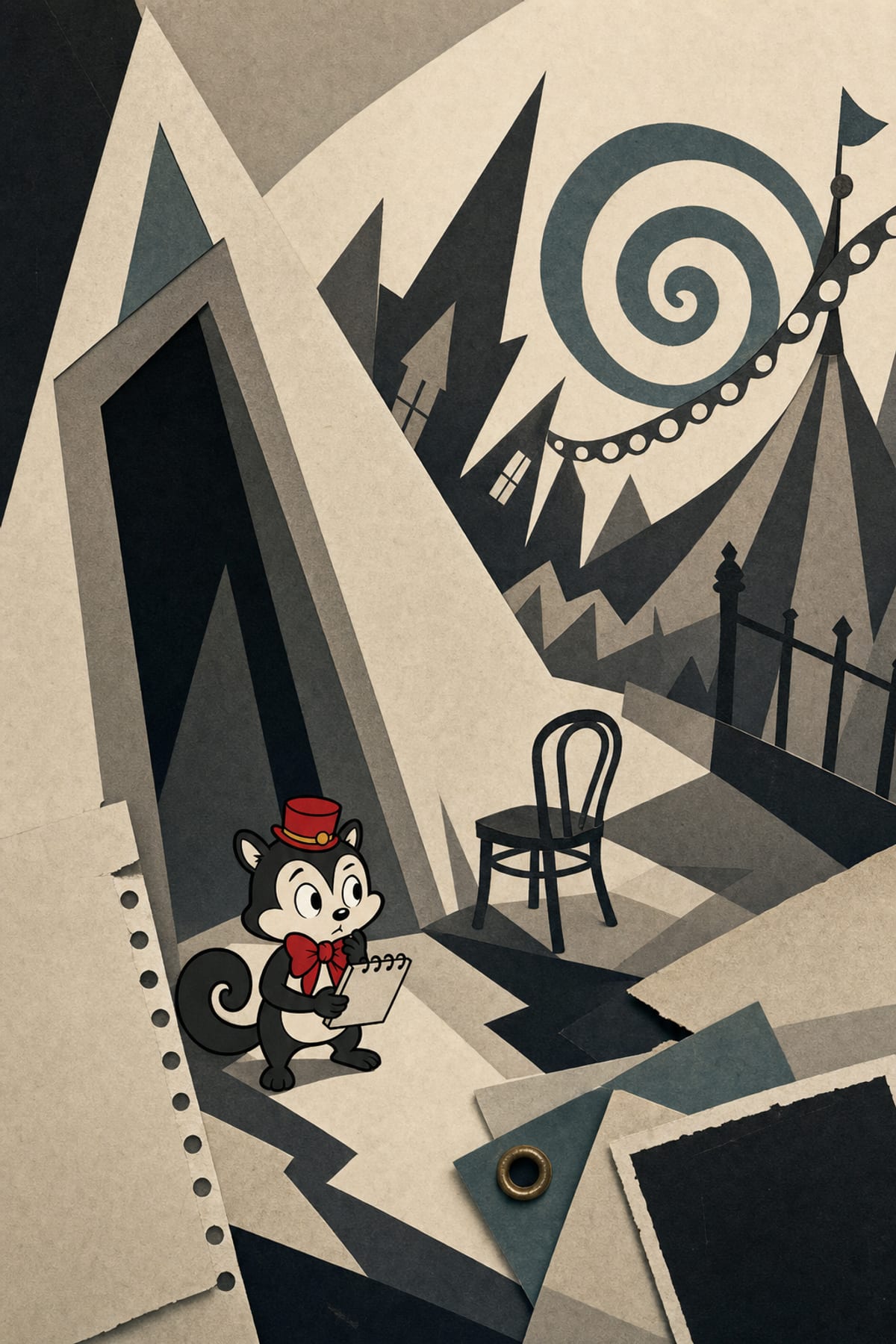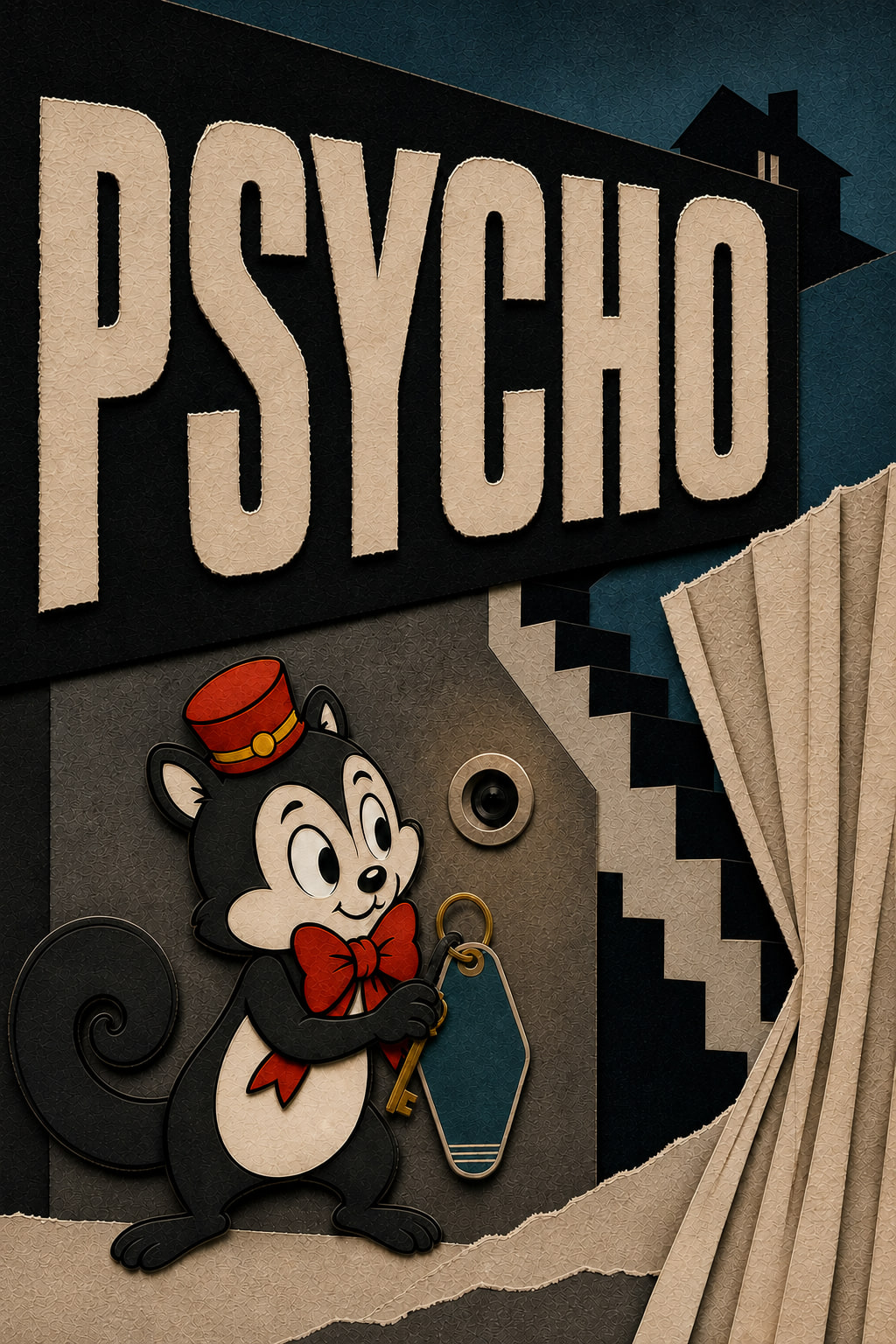
PSYCHO lettering built into a paper collage: Momo holds a motel key beside a peephole, staircase, curtain and dark house.

Image: Monocurator · source · Original Monocurator artwork

Psycho

1960 · United States · Directed by Alfred Hitchcock · 109 min

TenseMysteryBleak Great first watch · Easy Horror

Psycho is a 109-minute Hitchcock thriller that turns a theft, a roadside motel, and shifting points of view into a story where ordinary acts of looking feel dangerous.

How was Psycho’s shower scene made?

The scene’s force comes from decisions made at different stages: planning each camera view, joining fragments in the edit, and adding Bernard Herrmann’s music. Together, they control what we see and what we supply for ourselves.

Explore the framing, editing, and music Scene spoilers

How do separate shots create the attack?

In her Fresh Air interview, Janet Leigh recalls drawings displayed for cast and crew showing the planned angles and close-ups. She knew which part of her performance each camera position would record. Even when her face was outside the frame, she still had to express fear through her body.

Leigh describes the knife moving, a cut to part of Marion’s body, and the weapon drawing back. The viewer connects the separately photographed actions and imagines the contact. Editing makes those fragments feel like one event, with little time to inspect the space between them. That is why a close-up can carry more force than a distant view of the whole room.

  1. Space

    The curtain leaves room for a threat.

  2. Fragments

    Movement and reaction meet through cuts.

  3. Aftermath

    The drain dissolves into a still eye.

A schematic of changing attention and pace; the blocks are illustrative.

Why leave so much curtain in the frame?

Before the burst of cutting, the composition leaves a broad area behind Marion. Documentary director Alexandre O. Philippe points out this apparently empty space in his BFI interview. Our attention can move beyond her to the approaching figure. The curtain gives the threat a place to appear before Marion responds; the frame has prepared a second centre of attention.

What does Herrmann’s music add?

AFI records that Hitchcock initially wanted the scene without music, before Herrmann supplied its accompaniment. The score uses string orchestra alone, as LA Phil’s programme notes explain. The high violin attacks add another repeated jolt alongside the cuts. I hear their sharp entries pulling the scattered images into a single pulse of alarm. Leigh recalled that the combined editing and music frightened her when she saw the finished film, despite knowing how it had been shot.

Why does the drain become an eye?

The drain-to-eye transition is a dissolve: one image overlaps the next. Their circular shapes connect as the pace changes, before the camera withdraws from Marion’s face. The BFI interview follows this transition. After the abrupt fragments, that sustained gaze gives us time to recognise what has happened. The shower continues running when Marion can no longer react.

Watch · Rent · ReadWatchRentRead U.S. search links, not availability claims · Disclosure

What to expect

Psycho turns ordinary spaces into sources of unease through exact framing, suggestive sound, and a constant awareness of who is watching whom. Alfred Hitchcock guides attention so confidently that even quiet conversations seem charged. The film's lasting power is not only in its shocks, but in how it shifts our expectations and makes curiosity itself feel dangerous, all with lean, darkly playful storytelling.

How to ease in

If the famous moments are already familiar, watch how patiently the film earns them. The opening rooms, small lies, and long drives teach us to scan ordinary details for risk. Avoid reading a full plot summary beforehand. Let the changes in point of view do their work, and listen to how silence, rain, plumbing, and music alter the same quiet spaces.

Heads-up

A quick, non-exhaustive note Contains murder, brief bloody violence, voyeurism, sexualized threat, and dated ideas linking gender presentation with mental illness.
Momo's Note Who is Momo? →

The shower, the house, the shift that rewired horror.

The house and motel seem to be watching one another. I love how Hitchcock turns that simple arrangement into a map of curiosity: windows, peepholes, doors, and stairs keep asking who is entitled to look.

Open the note ↓

The house and motel seem to be watching one another. I love how Hitchcock turns that simple arrangement into a map of curiosity: windows, peepholes, doors, and stairs keep asking who is entitled to look. Even before the music cuts sharply, the film has made observation feel intimate, rude, and dangerous.

— Momo

Momo guiding the way into this film

Ways to watch and read

ActionSearch destination
WatchCheck availability on JustWatch
RentSearch rentals on Apple TV
ReadSearch books on Bookshop.org

U.S. search destinations · Links checked 2026-07-27 · Stock, editions, prices, and availability can change · Disclosure

Where to go next

Want a gentler, shorter, or stranger next film? Ask Momo for something like this →
Momo is on shift. Visit Momo Cinema →
Continue through the catalogue →