À quoi s’attendre
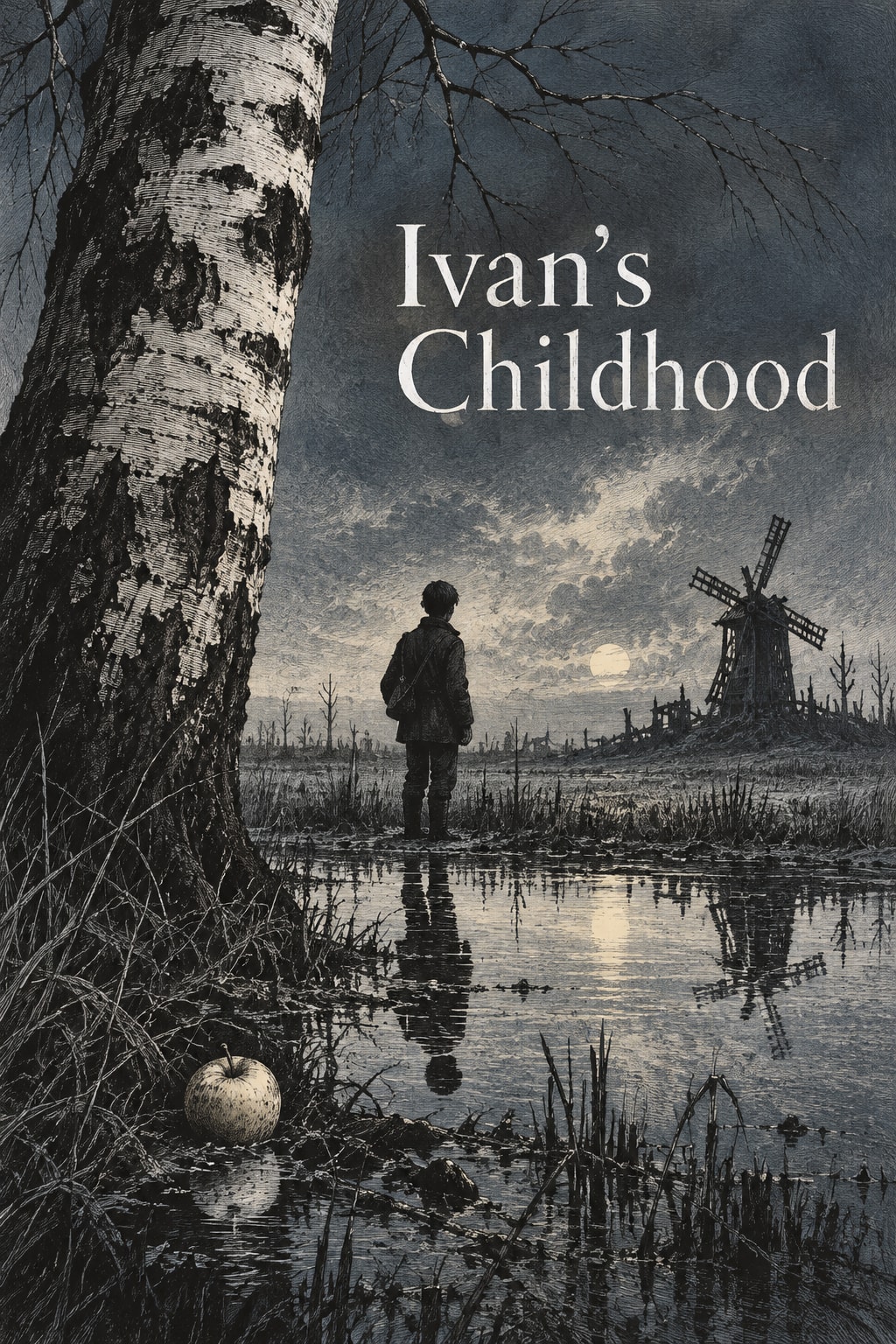
Ivan’s Childhood announced Andrei Tarkovsky’s cinema through the collision of harsh military reality and fluid dreams. Ivan works as a scout behind German lines, valued for the very fearlessness that reveals how completely war has consumed his childhood. Vadim Yusov’s black-and-white photography moves between mud, ruined interiors, birch woods, water, and impossible memory with extraordinary freedom. The film won the Golden Lion and expanded the Soviet war film beyond heroic action. Its central tragedy is not simply that a child faces danger, but that adult institutions accept his usefulness within it.
Comment aborder le film
The dreams are not puzzles requiring a single interpretation; they provide a sensory counterworld of family, sunlight, water, and movement. Keep Ivan’s reconnaissance missions as the narrative spine while allowing chronology to loosen around memory. The film is visually beautiful, but that beauty sharpens rather than softens its view of war.
À savoir
Ouvrir la note ↓ Fermer la note ↑
Ivan moves through water in both war and dream, but the element never means the same thing twice. Tarkovsky lets memory restore motion and light without pretending it can restore safety. The beauty feels like evidence of what war has stolen, not an escape from it.
— Momo

Générique et versions
- Distribution
- Nikolai Burlyaev — Ivan · Valentin Zubkov — Captain Kholin · E. Zharikov — Lieutenant Galtsev · S. Krylov — Corporal Katasonych
- Scénario
- Vladimir Bogomolov · Mikhail Papava
Carte des versions
Sources des données
Pour poursuivre la découverte
Envie d’un prochain film plus doux, plus court ou plus étrange ? Demandez à Momo un film dans le même esprit → (S’ouvre en anglais)
Momo est de service. Visiter Momo Cinema → (S’ouvre en anglais)