Die Bedienelemente der Seite sind übersetzt. Filmtitel bleiben wie im Katalog verzeichnet. Redaktionelle Texte und Quellenbeschreibungen sind auf Englisch.

← Zurück zu den Filmen

Surrealist satire

The Exterminating Angel

Laufzeit
Nicht ermittelt

After an elegant dinner, a group of wealthy guests discover that none of them can bring themselves to leave the room.

Nach einer Ausgabe suchen ↓ Vor dem Ansehen ↓

Amazon.com-Suche · Werbelink. Prüfe vor dem Kauf Ausgabe und Region.

Sprache
Spanish
StrangeFunnyBleak Gut zugänglich · Für geduldige Zuschauer Surrealist satire
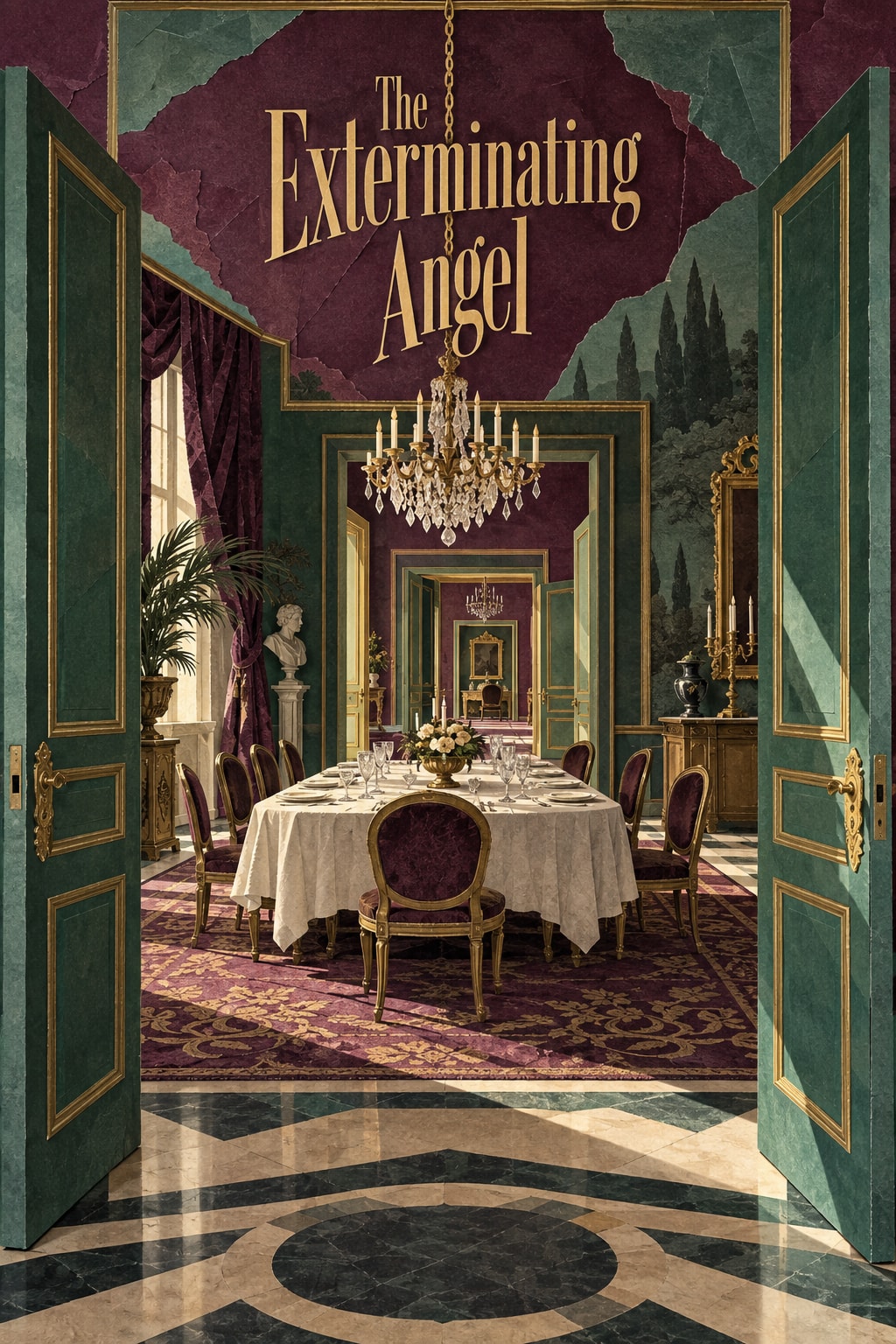
Original illustration for The Exterminating Angel: An extravagant dining room viewed through an enormous completely open doorway: empty table setting, chandelier, rugs and doors that loop into further doors, all precise overlapping paper planes.

Image: Monocurator · source · Original Monocurator artwork

The Exterminating Angel: reading the ending

Follow the sequence of the final scenes, then consider what their repetition might mean.

Follow the final scenes and their repetition · Ending spoilers

What happens in the scenes

Leticia, one of the guests, believes the group has returned to the arrangement of an earlier moment in the drawing room. She asks the others to repeat what they said and did that first night. After this reenactment, they can leave the room and the house.

Her recognition is the character’s claim. In her Criterion essay, Marsha Kinder points out that some guests have died, complicating any literal return to the original gathering. The repetition brings a way out without establishing a dependable rule for how the confinement works.

The apparent release is followed by a church service. At its close, members of the congregation and clergy find that they cannot leave. Michael Joshua Rowin’s MUBI account traces this renewed confinement; the story has moved beyond the private dinner party.

One reading of the ending

The move from drawing room to church widens the satire: a public institution associated with order becomes another place of collective paralysis. On this reading, leaving the first room has not freed the wider society from the pattern. Alex Cox’s Criterion essay likewise treats the ending as a return of the problem. This is an interpretation of the recurrence; the film supplies no final mechanical, theological or psychological explanation for it.

Was dich erwartet

Buñuel refuses to explain the invisible barrier, making social ritual itself feel like the trap. Courtesy, status, religion, and appetite lose their civilised surfaces while the doorway remains physically open.

Tipps für den Einstieg

Do not search for a mechanical cause. Watch repeated actions and social roles; the film treats repetition as evidence that the group is imprisoned by more than architecture.

Gut zu wissen

Ein kurzer, nicht vollständiger Hinweis Includes death, suicide, animal slaughter, starvation, illness, class cruelty, and religious satire.
Momo's Note Kann Spoiler enthalten Wer ist Momo? → (Öffnet sich auf Englisch)
Notiz öffnen ↓ Notiz schließen ↑

I enjoy how quickly an impeccable room becomes a complete social system. Nobody needs to lock the door when everyone has learned the same rules about who may move first.

— Momo

Momo thinking about this film

Mitwirkende und Fassungen

Quellen zu den Filmdaten

Wohin als Nächstes?

Soll der nächste Film sanfter, kürzer oder seltsamer sein? Frag Momo nach etwas Ähnlichem → (Öffnet sich auf Englisch)
Momo hat Dienst. Momo Cinema besuchen → (Öffnet sich auf Englisch)
Weiter durch den Katalog →