页面操作控件已翻译。片名保留片目原有写法。编辑撰写的正文和资料来源说明仍为英语。

← 返回电影列表

Surrealist satire

The Exterminating Angel

片长
尚未确定

After an elegant dinner, a group of wealthy guests discover that none of them can bring themselves to leave the room.

搜索影片发行版本 ↓ 观影之前 ↓

在Amazon.com搜索 · 付费推广链接。购买前请核对版本和地区。

语言
Spanish
StrangeFunnyBleak 容易入门 · 适合耐心观看 Surrealist satire
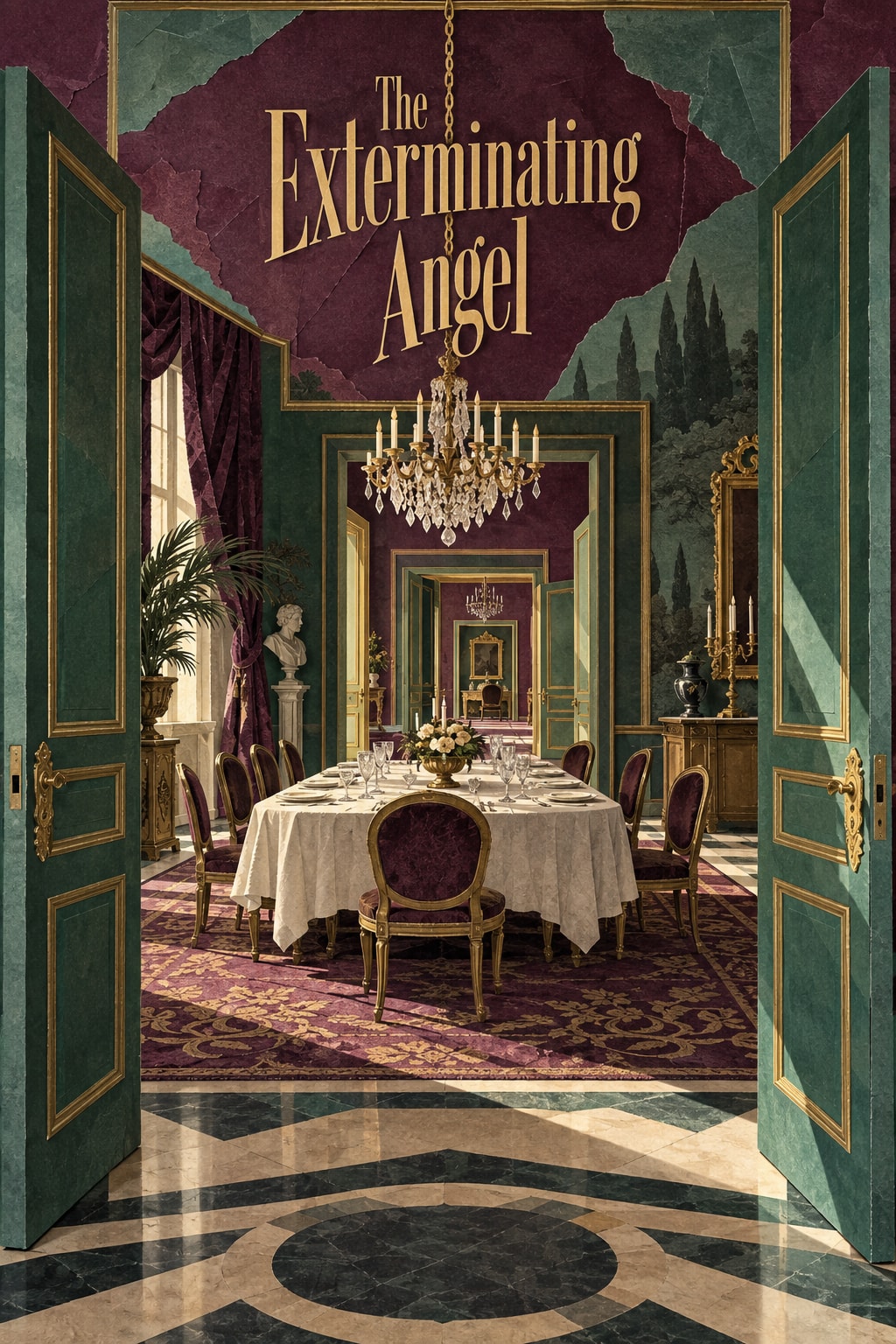
Original illustration for The Exterminating Angel: An extravagant dining room viewed through an enormous completely open doorway: empty table setting, chandelier, rugs and doors that loop into further doors, all precise overlapping paper planes.

Image: Monocurator · source · Original Monocurator artwork

The Exterminating Angel: reading the ending

Follow the sequence of the final scenes, then consider what their repetition might mean.

Follow the final scenes and their repetition · Ending spoilers

What happens in the scenes

Leticia, one of the guests, believes the group has returned to the arrangement of an earlier moment in the drawing room. She asks the others to repeat what they said and did that first night. After this reenactment, they can leave the room and the house.

Her recognition is the character’s claim. In her Criterion essay, Marsha Kinder points out that some guests have died, complicating any literal return to the original gathering. The repetition brings a way out without establishing a dependable rule for how the confinement works.

The apparent release is followed by a church service. At its close, members of the congregation and clergy find that they cannot leave. Michael Joshua Rowin’s MUBI account traces this renewed confinement; the story has moved beyond the private dinner party.

One reading of the ending

The move from drawing room to church widens the satire: a public institution associated with order becomes another place of collective paralysis. On this reading, leaving the first room has not freed the wider society from the pattern. Alex Cox’s Criterion essay likewise treats the ending as a return of the problem. This is an interpretation of the recurrence; the film supplies no final mechanical, theological or psychological explanation for it.

你将看到什么

Buñuel refuses to explain the invisible barrier, making social ritual itself feel like the trap. Courtesy, status, religion, and appetite lose their civilised surfaces while the doorway remains physically open.

如何轻松入门

Do not search for a mechanical cause. Watch repeated actions and social roles; the film treats repetition as evidence that the group is imprisoned by more than architecture.

观影提醒

简要提示,并非详尽清单 Includes death, suicide, animal slaughter, starvation, illness, class cruelty, and religious satire.
Momo's Note 可能含剧透 Momo是谁? → (以英语打开)
展开笔记 ↓ 收起笔记 ↑

I enjoy how quickly an impeccable room becomes a complete social system. Nobody needs to lock the door when everyone has learned the same rules about who may move first.

— Momo

Momo thinking about this film

演职员与版本

影片信息的资料来源

接下来去哪看

下一部想看更温和、更短,或更奇特的电影? 问问Momo,有没有类似的电影 → (以英语打开)
Momo正在值班。 前往Momo Cinema → (以英语打开)
继续浏览片目 →