Les commandes de la page sont traduites. Les titres des films restent tels qu’ils figurent au catalogue. Les textes éditoriaux et les descriptions des sources sont en anglais.

← Retour aux films

Crime

Breathless

À bout de souffle

Durée
90 min90-minute 4K restoration Sources des versions ↓

Cool, restless — the moment cinema broke its rules.

Rechercher des options de visionnage ↓ Avant de regarder le film ↓

Liens de recherche, sans disponibilité confirmée. Vérifiez l’édition et la région.

Langue
French
StrangeRomantic À garder pour plus tard · Pour les spectateurs patients Crime
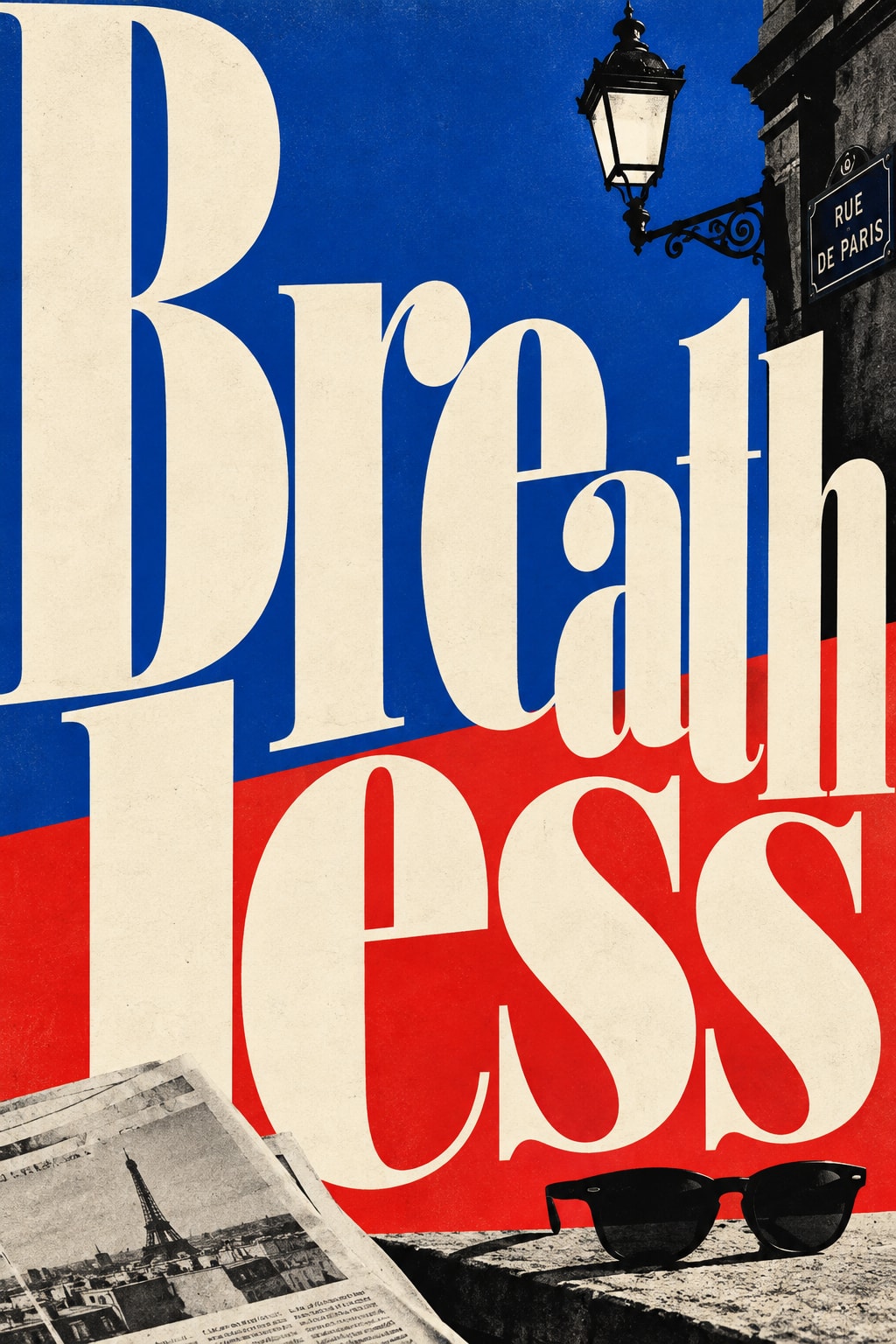
Breathless: Huge ivory lettering cuts across blue and red fields above sunglasses and a newspaper.

Image: Monocurator · source · Original Monocurator artwork

How do the jump cuts in Breathless work?

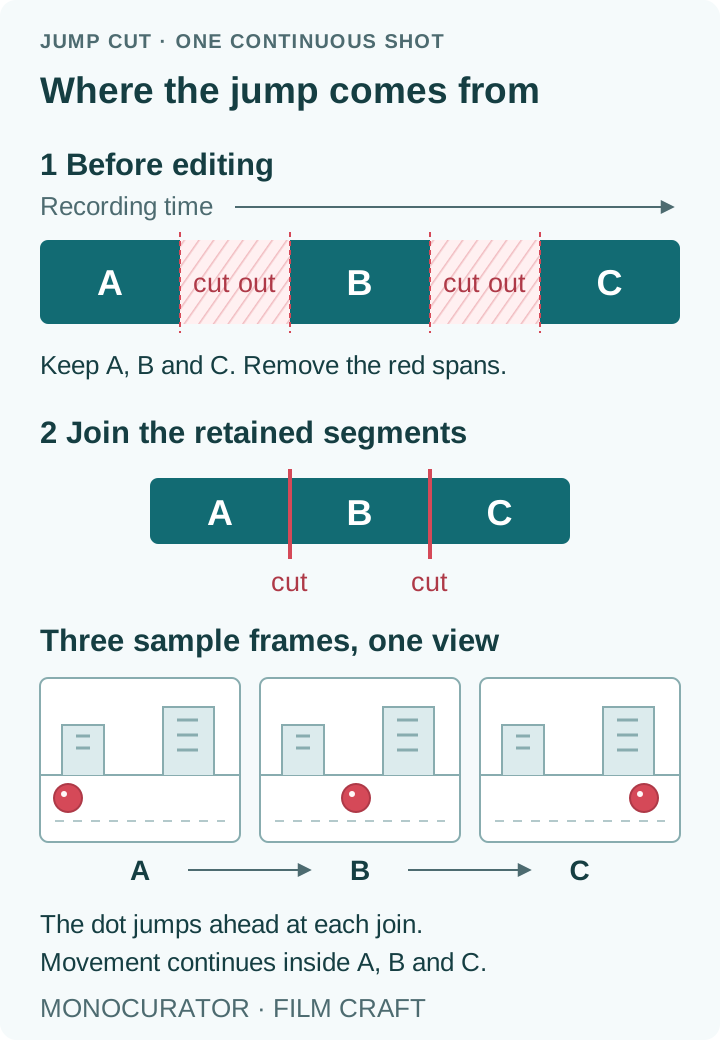
A jump cut makes a break in time visible while the view remains similar. One way to create it is to remove part of a shot and join the pieces left behind. A person seems to jump into a new position because we never see the movement between the two. The cut compresses an action rather than taking us to a new scene.

One continuous shot keeps segments A, B and C while two intervals are removed. Three sample frames show a red dot jumping forward against the same background; movement continues within each segment.
An original diagram of the principle. Follow the moving dot through the same view, then see what disappears when time is removed.

Why did Godard cut the film this way?

In a 1994 interview with Andrew Sarris, Godard recalled that his first cut ran two and a half hours and the producer wanted an hour removed. He described shortening pieces throughout the film, then keeping the parts he liked. This was selection within the material: a scene could survive while some of its elapsed time vanished.

That recollection helps explain the practical decision. To feel what it does, watch the joins. The missing movement becomes something you notice, giving the remaining gestures a sharper, more impatient rhythm.

A moment to look for in Breathless

Look at Patricia during her conversation with Michel. In his 1960 Sight and Sound review, Louis Marcorelles singled out a passage that keeps the camera on her face while cutting the sequence down. Our attention stays with the same person, but her presence no longer guarantees uninterrupted time.

Try following her posture rather than just the dialogue. At each visible join, ask what motion you expected to see next. That small absence is the useful thing to notice: the film lets you feel the editing as you watch.

For a different use of editing, compare how Psycho builds its shower scene from separate views.

À quoi s’attendre

Breathless moves like a conversation that keeps changing direction. Loose performances, abrupt editing, city streets, and movie-fed poses create a style that feels casual even when it is carefully controlled. Beneath the cool surface is a sharp interest in people trying on identities. The film remains inviting because its freedom is visible: you can feel old storytelling rules being tested in every scene.

Comment aborder le film

Let the film be restless. Its jump cuts, sudden changes of subject, and long apartment conversation are not clues to solve; they create the feeling of time being used up in the present. Michel's crime plot supplies urgency, but Patricia's uncertainty supplies the shape. Notice when their movie-star poses slip and ordinary hesitation enters the room.

À savoir

Une brève note non exhaustive Includes gun violence, misogynistic behaviour, coercive intimacy, crime, and near-constant smoking.
Momo's Note Peut contenir des révélations sur l’intrigue Qui est Momo ? → (S’ouvre en anglais)
Ouvrir la note ↓ Fermer la note ↑

Breathless is full of people borrowing gestures from other movies and hoping the gesture will become a self. That makes its coolness fragile rather than effortless. I like the pauses most—the moments when talk keeps going because neither person can find a cleaner truth. The jump cuts feel like impatience made visible.

— Momo

Momo thinking about this film

Générique et versions

Générique
Distribution
Jean-Paul Belmondo — Michel Poiccard · Jean Seberg — Patricia Franchini
Photographie
Raoul Coutard

Carte des versions

Pour regarder et lire

ActionSearch destination
Watch Check availability on JustWatch
Rent Search rentals on Apple TV
Read Search books on Bookshop.org

U.S. search destinations · Links checked 2026-07-27 · Stock, editions, prices, and availability can change · Disclosure

Pour poursuivre la découverte

Envie d’un prochain film plus doux, plus court ou plus étrange ? Demandez à Momo un film dans le même esprit → (S’ouvre en anglais)
Momo est de service. Visiter Momo Cinema → (S’ouvre en anglais)
Poursuivre la découverte du catalogue →